150 years ago today, the United States–a nation mired in the fourth
year of a bloody Civil War–was celebrating the anniversary of its
independence from Great Britain. In the ranks of the vast Union armies
fighting to preserve that nation, the significance of the day did not go
unnoticed.
On July 4, 1864, hundreds of thousands of Union soldiers were spread
out across the Southern United States, occupying lands of the
Confederacy in what was the final year of the American Civil War. Most
notably, two Union commanders were on the precipice of seizing major
southern cities. In Virginia, Grant was settling in near Petersburg,
beginning a months long siege that would force he and his men to wait
until 1865 until their goals of victory in the campaign for Richmond
could be realized.
Far to the south, in the state of Georgia, William Tecumseh Sherman’s
army group, consisting of the Army of the Cumberland, the Army of the
Tennessee, and the Army of the Ohio, rested just miles from Kennesaw
Mountain, the imposing height which had stalled Sherman for the latter
half of June and the first several days of July. It had only been on the
morning of July 3rd that Union soldiers discovered that Confederates
had vacated their Kennesaw trenches, having been forced out by yet
another flanking maneuver from Sherman. Kennesaw Mountain had been a
resounding defeat for Sherman’s men, as each attacking column the
Federals sent forward on the morning of June 27, 1864, was handsomely
repulsed. Yet, one week later, the Confederates had retreated, and the
Union soldiers who had seen their comrades slaughtered in such great
number in front of the Kennesaw Line were preparing to push for the
Chattahoochee River and toward Atlanta itself.
Thus, 150 years ago, Union soldiers had cause for both sadness and
gratefulness, for both remorse and relief. The troubles of Kennesaw
Mountain were past, yet the struggle for Atlanta lay firmly in their
future.
“One year ago were in Shellbyville Tenn. Wonder next 4th will
find us, or me. Enjoying the blessings of peace, I hope. Hardly think it
will. One consolation, my term of service will have nearly expired.
Weather very warm. A man would have been called insane three years ago,
who would have prophesied that the war would last till July 1864”
O.M. Scott, Commissary Sergeant, 121st Ohio Volunteer Infantry
“This is a holiday to all Americans whether it will be so to us remains to be seen.”
Sgt. Israel Connell, 51st Ohio Volunteer Infantry
“We are celebrating the birthday of the Nation by firing an
occasional salute on the works of the foe in our front. Company E was on
the skirmish line all day, and it was very interesting. A year ago we
were at Shelbyville, Tenn., and on that day Vicksburg was taken by
General Grant. Where will we be July 4th, 1865?”
Francis McAdams, 113th Ohio Volunteer Infantry
“Thankful should we be to Divine Providence that our ever honored
and memoriable National Birthday is thus made the more sacred by a
victory over the Nation’s and Freedom’s enemies.”
Albert Champlin, 105th Ohio Volunteer Infantry
Showing posts with label Atlanta Campaign. Show all posts
Showing posts with label Atlanta Campaign. Show all posts
Friday, July 4, 2014


Sunday, February 3, 2013
Kennesaw Mountain Book Announcement
Greetings from Georgia!

If you recall, a few months ago I posted about visiting Georgia for research and battlefield hiking to prepare for a new project. Well, I am back in the beautiful state of Georgia once again. I flew in to Atlanta on Friday, and will be here for the next week to visit family, hike battlefields, and work on my new project, which has been ongoing for a few months now. I haven't been able to announce it yet, but I am now able to tell you about it because I have gotten the final go ahead from the publisher.
I have agreed to write a book for the History Press on the June 1864 Battle of Kennesaw Mountain!
This book will be a part of the History Press's Civil War Sesquicentennial Series, a series which features two outstanding books by my friend and colleague, John Hoptak (his books are on South Mountain and on Gettysburg). John is a big reason why this project is happening, as he put me in touch with the folks at the History Press. I owe him a tremendous thanks for his help. The book will be an overview of the battle, but considering that there aren't many books out there solely devoted to this fight, it will be based largely off of primary sources from soldiers who fought in 1864.
While Antietam has long been my main field of interest, I have also spent considerable time studying the Atlanta Campaign. While at John Carroll I wrote my Master's thesis on Ohio soldiers who fought during this campaign, and I have made several trips to Georgia to see the battlefields from this pivotal campaign in the American Civil War. I have also posted on here about Kennesaw Mountain before.
Of course, while in Georgia, I am staying with my Uncle Jeff and Aunt Paula, who live in Kennesaw and are opening their home and giving me a place to stay while I work on this project. Yesterday, Jeff and I spent some time hiking at Pickett's Mill State Battlefield, a very well preserved historic site with miles of trails that allow visitors to see the site of the May 27, 1864 Battle of Pickett's Mill that resulted in a Confederate victory.
My Kennesaw Mountain book likely won't be finished until this fall, and it won't hit the shelves until late this year or early in 2014, but I am very excited and looking forward to this incredible opportunity!
Stay tuned to the blog for more information and updates about the book over the upcoming months. I will post on here regularly about the project and about Kennesaw Mountain, in addition to my ongoing Antietam research which I hope will be published soon as well (more on that to come soon!)
I am very grateful for this wonderful opportunity. From time to time, when things get difficult and I don't know what my next step will be, God always tosses me another stone to jump to, to continue on across the stream and along the path He has set before me. Whatever success I may have had, I owe it all to Him. Thank the Lord for this great opportunity for which I could not be more excited.
Monday, October 29, 2012
Georgia Visit Postscript
Yesterday, I flew back to Ohio from Georgia. Judging from the wind and rain outside my window right now, it was not a moment too soon. While I love Georgia, and I love seeing my Uncle Jeff and Aunt Paula, who hosted me for a few days, being able to avoid the mess of cancelled flights and all the joys they bring is a big relief.
In the days and weeks ahead, I will begin to turn the attention of this blog to the Atlanta Campaign a bit more. I will still try to do posts on the events of the war 150 years after they occured, as well as continue to provide Antietam content. Additionally, I want to begin posting some things regarding my research for the Joseph Harsh award on here, as I am coming close to finishing a few articles regarding the project. However, while I will still work on my Army of the Potomac research, I have some other projects this winter that will turn my interests to the south, and to two years after Antietam, during the pivotal, and grueling, Atlanta Campaign of 1864. I have posted a few things on here about this campaign before, but not a whole lot. For those who don't know, I wrote my Master's Thesis at John Carroll University on the experiences and motivations of Ohio soldiers during this campaign. In fact, the title of this blog comes from a diary entry of one of those soldiers, Private Albert Champlin of the 105th Ohio. Champlin was from Willoughby, Ohio, a town right next to my own hometown of Kirtland. I hope to post some letters, diary entries, and other thoughts from soldiers who experienced the Atlanta Campaign, as it was a crucial point in the war. While I can't yet say where all of this is going, it is all a part of a new project I am working on. Stay tuned for more details...
For now, here are some more pictures from my trip to Georgia. For those who guessed last time, my visit was to primarily see Kennesaw Mountain National Battlefield Park (the pictures were of the battlefield there). Here are some more photos from the visit.



In the days and weeks ahead, I will begin to turn the attention of this blog to the Atlanta Campaign a bit more. I will still try to do posts on the events of the war 150 years after they occured, as well as continue to provide Antietam content. Additionally, I want to begin posting some things regarding my research for the Joseph Harsh award on here, as I am coming close to finishing a few articles regarding the project. However, while I will still work on my Army of the Potomac research, I have some other projects this winter that will turn my interests to the south, and to two years after Antietam, during the pivotal, and grueling, Atlanta Campaign of 1864. I have posted a few things on here about this campaign before, but not a whole lot. For those who don't know, I wrote my Master's Thesis at John Carroll University on the experiences and motivations of Ohio soldiers during this campaign. In fact, the title of this blog comes from a diary entry of one of those soldiers, Private Albert Champlin of the 105th Ohio. Champlin was from Willoughby, Ohio, a town right next to my own hometown of Kirtland. I hope to post some letters, diary entries, and other thoughts from soldiers who experienced the Atlanta Campaign, as it was a crucial point in the war. While I can't yet say where all of this is going, it is all a part of a new project I am working on. Stay tuned for more details...
For now, here are some more pictures from my trip to Georgia. For those who guessed last time, my visit was to primarily see Kennesaw Mountain National Battlefield Park (the pictures were of the battlefield there). Here are some more photos from the visit.

View toward Atlanta from the top of Big Kennesaw, 1800 feet high

A Confederate artillery position on top of big Kennesaw

A monument marking the spot where Confederate General Leonidas Polk was killed instantly by an artillery shell on Pine Mountain, June 14, 1864

Confederate earthworks on Pigeon Hill

Confederate artillery placement on Cheatham Hill

Illinois Monument, along with remnants of a tunnel begun by Union soldiers, on Cheatham Hill

Field where portions of George Thomas's command formed up to assault Confederate lines on Cheatham Hill

The last open stretch which the men of Col. Daniel McCook's brigade had to charge across to assault Confederate works at the "Dead Angle" on Cheatham Hill

Marietta National Cemetery, Marietta, Georgia, Kennesaw Mountain in the background. Over 10,000 Union dead from the Atlanta Campaign are interred here.


At the Marietta History Museum, they remember William T. Sherman fondly. When he and his men left for their March to the Sea, Sherman burned portions of Marietta. The top floor of what was then the Fletcher House hotel was lost in that fire. That building now houses this museum. Thus, the men's room is equated with Sherman.

Mural of Sherman in the men's room...


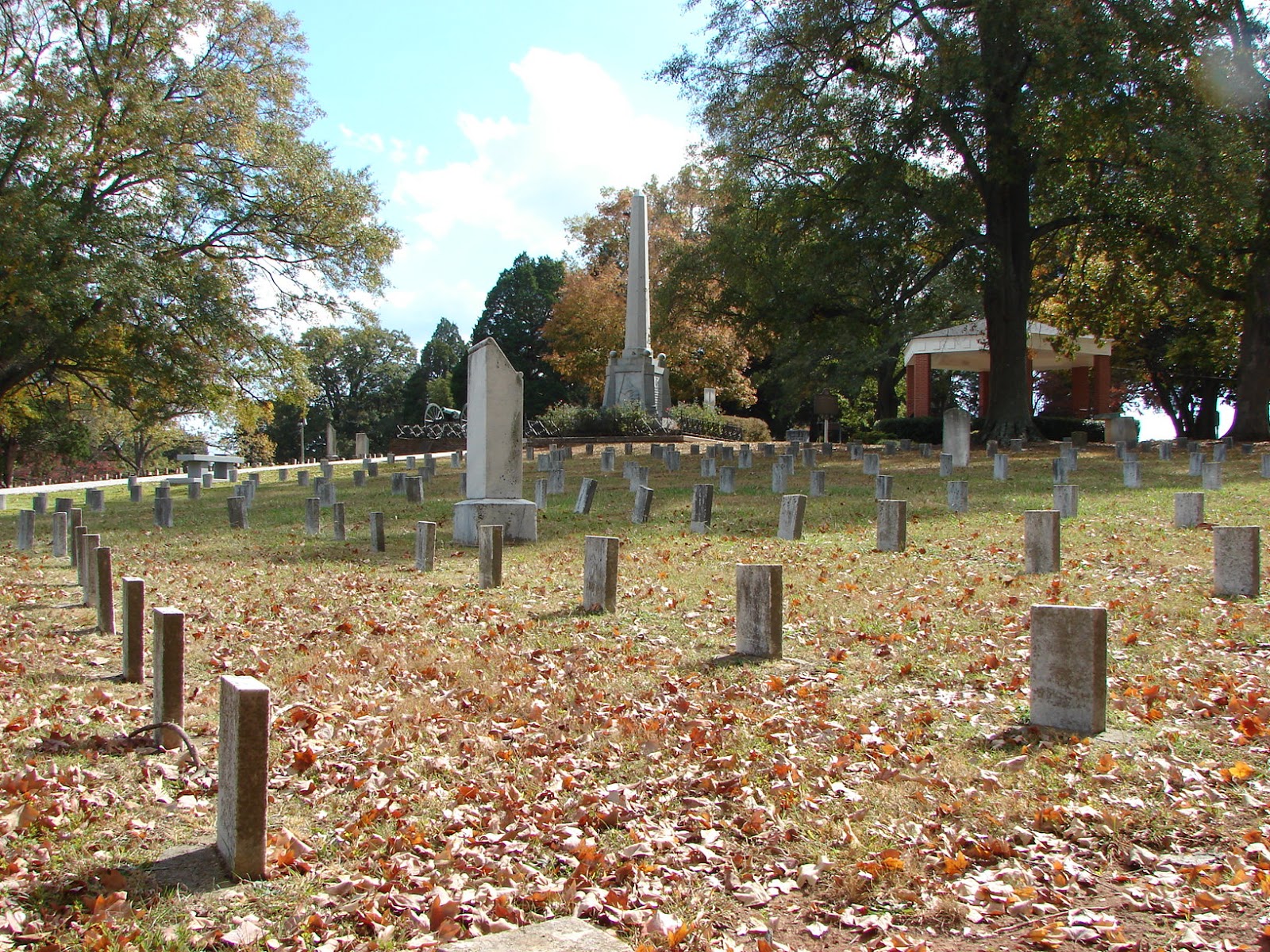
Confederate Cemetery in Marietta, Georgia, where over 3,000 Confederates are buried.

These are just a few of the photos from my wonderful trip to Georgia. Stay tuned... lots more on Georgia, the Atlanta Campaign, and Kennesaw Mountain to come...
Wednesday, July 4, 2012
"Yes, around comes July and soon will come the honored Fourth."
On July 4, 1864, Federal forces under the command of Major General William Tecumseh Sherman were engaged in a slogging match with Joe Johnston's Confederate Army of Tennessee north of Atlanta. For weeks, Sherman had been pressing southward toward Atlanta, one of the South's most strategically important cities. For every move Sherman made, Johnston would retreat deeper and deeper into the heart of Georgia. By mid-June, however, the Federal advance had slowed to a crawl. On June 27, frustrated and hoping to break the stalemate, Sherman launched an aggressive assault against Confederate positions on and around Kennesaw Mountain, leading to the most severe fighting and bloodletting of the Atlanta Campaign. The Federal assaults were thrown back by firm Confederate defensive lines, resulting in more trenches and stalemate. Yet by July 2, Confederate forces began falling back yet again toward Atlanta, as a result of another Federal flanking maneuver. In the midst of all this, Private Albert Champlin of the 105th Ohio Volunteer Infantry was fastidiously recording his impressions of these events in his diary. During the first days of July, 1864, Champlin was looking forward to the Fourth of July, understanding that, because of the bloody struggle encompassing the nation, that historic day was even more significant. July 4, 1776 was the day in which America declared its independence from Great Britain, as Abraham Lincoln said in his Gettysburg Address, based on "the proposition that all men are created equal." In 1864, in the midst of a struggle "testing whether that nation, or any nation so conceived and so dedicated can long endure," remembering the nation's birth and its promise for a better future was one of the things which helped Private Albert Champlin to carry on in the midst of the long, bloody, and brutal march toward Atlanta during what would be in many ways the pivotal campaign of the American Civil War.
July
1, Friday—“Yes, around comes July and soon will come the honored Fourth. What will be the events thereof? Will they be similar to those of a year ago? [Referring to Federal victories at Gettysburg and Vickburg on July 3 and 4, 1863] At least may God grant that the present great work of our country and nation may continue to advance successfully to the end of putting down treason and rebellion and with them may their enormous parent evils and iniquities be annihilated, and may the time thus come when soldiers can return to civil vocations under Free Government and that even improved.”
July
2, Saturday—artillery firing back and forth
July
3, Sunday—Sherman
having again pushed his flanks around those of the enemy, thus compelling them
again to evacuate a truly strong hold or do worse by remaining, which Joe
Johnson don’t choose to do. Troops are on the move as early as sunrise but our
division moves at about 9 AM, bivouacking that night 5 miles south of Marietta,
rebels retreated nearly to the river… Thus again Sunday passes, the enemy
having again taken it as their day for retreat. They are reported as making
another stand this side of the [Chattahoochee] River.
July
4, Monday—Champlin writes of artillery firing on Confederates that morning. Private Champlin and others of the 105th Ohio were sent to Marrieta as a
garrison, where they learned of an “extensive and successful charge including part of the 14th
Corps made upon the enemies' works, the works carried, many prisoners taken,
also considerable artillery besides the rebels loss being heavy in killed and
wounded. Number of our killed and wounded not yet reported but must be
considerable, our troops being the attacking party. Thankful should be be to Divine Providence that our ever honored and memorable National Birthday is thus made the more sacred by a victory over the
Nation’s and Freedom’s enemies.”
Albert Champlin's Diary can be found in the Alfred Mewett Papers Collection at the Western Reserve Historical Society in Cleveland, Ohio
Subscribe to:
Posts (Atom)