Our Country's Fiery Ordeal

A blog about the American Civil War, written and maintained by historian Daniel J. Vermilya, author of The Battle of Kennesaw Mountain (History Press, 2014) and James Garfield and the Civil War (History Press, 2015)

Dedicated to my great-great-great grandfather, Private Ellwood Rodebaugh, Company D, 106th Pennsylvania Volunteer Infantry, killed at the Battle of Antietam, September 17, 1862.

"And may an Overuling Providence continue to cause good to come out of evil, justice to be done to all men where injustice has long prevailed, and finally, peace, quiet, and harmony to come out of this terrible confrontation and our country's fiery ordeal." -- Albert Champlin, 105th Ohio, Diary entry of June 19, 1864 (Western Reserve Historical Society)

Showing posts with label Civil War monuments. Show all posts

Saturday, March 31, 2012

Shiloh's Hornets' Nest

“In many cases, and certainly at Shiloh, the treatment of the events after the fact has had more to do with how we view the battles today than how they were actually fought.” –Timothy B. Smith, “Anatomy of an Icon: Shiloh’s Hornets' Nest in History and Memory,” in The Shiloh Campaign, Edited by Steven Woodworth pgs. 55- 75, (Southern Illinois Press, 2009), 56.


Some names and places associated with the Civil War speak for themselves. When one hears Pickett’s Charge or Bloody Lane, one would likely think of Gettysburg or Antietam. Places such as these are seared into our collective historical conscience. They represent both our country at its best and our country at its worst. Another such place is Shiloh’s Hornets' Nest.


View of the Sunken Road, just east of the Hornets' Nest


Sunken Road, running through the Hornets' Nest


Along with Albert Sydney Johnston’s death site, Shiloh's Hornets' Nest stands out as easily one of the most famous parts of the battlefield. Even if one visits Shiloh with just a passing knowledge of the battle and the battlefield, odds are they will be drawn to the Hornets' Nest.
In many ways, this makes perfect sense. The Hornets' Nest is located right smack dab in the middle of the battlefield. It has Shiloh’s sunken road running through it, an excellent place for hikes and walks. It has an abundance of monuments in and around it as well, including several state monuments, and the Confederate Memorial. 


One of the many monuments to Iowa regiments which fought in this area

  Union artillery positions, with the forest of the Hornets' Nest in the background


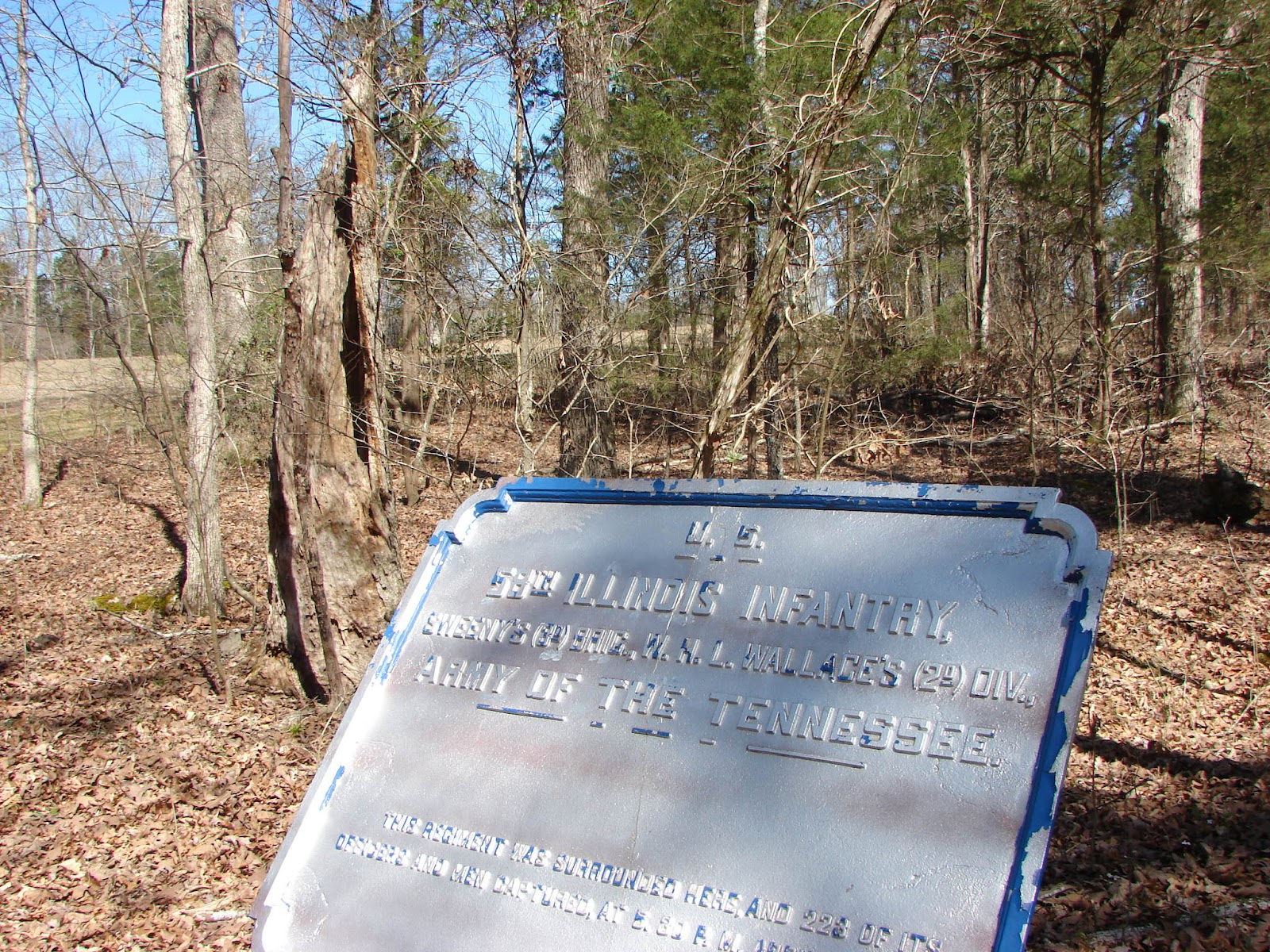
More importantly, for many years, historians have hailed the Hornets' Nest as the most important part of the Battle of Shiloh. According to the standard interpretation, as Federal forces fell back on the right and left flank, remnants of Benjamin Prentiss’s division and several brigades of W.H. L. Wallace’s division held fast, serving as a hindrance for the Confederate advance. Confederates who made gallant attempts to overcome these Union troops later compared the experience of the shot and shell flying through the air to the sounds and stings of hornets, thus creating the name, "The Hornets' Nest." After hours of heated fighting with numerous Confederate frontal assaults and artillery barrages, Federal forces at the Hornets' Nest were overwhelmed. The collapse of supporting troops on their right and left flanks meant that the attacking Confederates enveloped the position entirely; some Federals got away, but over 2,000 Union soldiers surrendered, including Brigadier General Benjamin Prentiss himself (another post on Prentiss's division at Shiloh can be found here). If one takes a short walk into the Hornets' Nest woods, markers locating the surrender sites for many of these regiments can be found (these were easily some of my favorite markers on the battlefield).


 Surrender site of Brigadier General Benjamin Prentiss

 Prentiss surrender site in the Hornets' Nest
David W. Reed, a veteran who fought as a part of an Iowa Regiment in the Hornets' Nest, became the first historian of Shiloh. His work and interpretations of the battle focused heavily on the Hornets Nest, sparking generations of historical works which likewise saw the action there as the central moment of the battle.  The Federal stand at the Hornets' Nest delayed the Confederate advance, allowing Grant time to form his last defensive line near Pittsburg Landing. Thus, Federal forces at the Hornets' Nest may have been captured, but they served a vital and indispensable purpose for Grant’s army that day. This interpretation, advanced first by Reed, picked up by later generations, and carried along by the long running Shiloh park film, is perhaps why the Hornets' Nest is such a famous aspect of the battle. 


 Sunken Road, on the Federal right flank in the Hornets' Nest, with Duncan Field to the left

 
 Across Duncan field (to the right), on the afternoon of the 6th, over 50 Confederate guns were gathered for an artillery barrage aimed at driving back Federal troops at the position above.


In more recent interpretations of the battle, historians such as Shiloh Park Historian Stacy Allen and former Shiloh ranger Timothy Smith have advanced theories that the Hornets' Nest was not the key to the battle. In fact, they suggest, using detailed views of the battle, that the heaviest fighting occurred both east and west of the Hornets' Nest, particularly to the west, where the divisions of William T. Sherman and John McClernand fought a brutal struggle against nine Confederate brigades on the Union right flank. Allen and Smith have argued that rather than the stand at the Hornets' Nest, Confederates lost the battle due to confusing terrain, not understanding the position of the Union army, and a lack of cohesion in the Confederate attacks that day. Johnston's battle plan had called for the Confederates to turn the Federal left flank close to the Tennessee River; the Confederates could then push Grant’s army back on the swampy land around Owl Creek, forcing the surrender or destruction of the Army of the Tennessee. Moreover, these historians have argued that the fighting around the Hornets Nest was relatively light compared to elsewhere on the field. While several fierce Confederate charges were made, they were not as great in number as others may claim.
After doing extensive reading on the battle over the last few weeks, I would have to say that I personally agree with the newer interpretation of Shiloh. I find the Hornets' Nest to be a fascinating, compelling, and important part of the battle. But, I don’t see it as the one area where the Union army was saved or turned the Confederate tide. In a battle as vast and complicated as Shiloh, there cannot be just one area where the tide turned (same thing with Gettysburg: sorry Chamberlain, you were great, but so was George Sears Greene on Culp’s Hill). Perhaps it was the fierce fighting of Sherman and McClernand as they fell back, the stubborn stand of Prentiss and Wallace at the Hornets' Nest, the death of Johnston, the firm last defensive line of Grant, and Beauregard’s decision to halt the attack that evening which together conspired to slowly turn the tide from Confederate surprise to Federal defensive stand on April 6. Of course, all of these factors were ultimately influenced by the confusing terrain and the jumbled Confederate attack. It all goes back to the necessity of understanding the terrain and the field to understand how battles were fought and why they ended as they did.


 Park wayside marker for the Hornets' Nest surrender. The portion of the Federal line running along the road in the foreground was held by two brigades of Brig. Gen. W.H.L. Wallace's division


Along with Allen and Smith, the late historian O. Edward Cunninghman’s thesis on the battle, which was published posthumously and edited by Gary Joiner and Timothy Smith, elucidates these newer interpretations of the battle quite nicely. I would highly recommend it for anyone interested. For the other historians who I have mentioned, Shiloh historian Stacy Allen penned a great two part piece on Shiloh that appeared in the Blue and Gray magazine in the late 1980s, which is a must read. Timothy Smith has written a few fantastic books on the battle and the battlefield, among which are The Untold Story of Shiloh, ThisGreat Battlefield of Shiloh, an upcoming book on the fight for Corinth which followed Shiloh (titled Corinth,1862). Smith also penned an essay specifically on the Hornets Nest which can be found in The Shiloh Campaign, edited by well known historian Steven Woodworth. Anyways, these are just a few thoughts from your humble blogger/Antietam ranger, who will be the first to admit his lack of expertise in the field of Shiloh studies (If you can permit me to write in the third person, that is). If you are interested in this topic, feel free to check out some of these outstanding works on the battle that I have thoroughly enjoyed reading over the past few months (you will find that the titles are linked to amazon.com pages for the books). I thought a brief historiographical piece and my thoughts on the topic would be a much more interesting way of showing off my Hornets' Nest pictures. If you are like me, then you find how we interpret Civil War battles to be just as fascinating and important as the actual battle itself.   


Thursday, March 29, 2012

Shiloh's State Monuments


I have been quite busy as of late working on several projects, which I will hopefully be able announce/post about on here soon. One of them is my upcoming Shiloh presentation for the James A. Garfield NHS Major Battles of the Civil War series, which will take place on April 11 at noon, at the Mentor Public Library (all are welcome, the program is free, call ahead for reservations at 440-255-8811).


Thus, for today's post in my ongoing Shiloh series, I thought I would go with some pictures of various state monuments from my visit. Below, you will find nearly all of the state memorials at Shiloh, save for the Alabama and Kentucky memorials (I saw each, just seemed to forget to take a picture, oh well, there is a good reason to go back!).


Iowa State Monument
 Located near the park Visitor Center, and near Auto Tour Stop1, Grant's Last Line. 


 Illinois State Memorial
Located at the intersection of the Hamburg-Purdy and Corinth-Pittsburg Landing roads, near Auto Tour Stop 13, Water Oaks Pond.


Tennessee State Memorial
Located adjacent to Illinois State Memorial, pictured above.


Texas State Memorial
Located along the Hamburg-Purdy Road, between the intersection with 
the Eastern Corinth Croad and the Hamburg-Savannah Road


 Arkansas State Monument
Located at Tour Stop 10, the Hornet's Nest, 
where the historic Sunken Road crossed the Eastern Corinth Road


Wisconsin State Memorial
Located near Tour Stop 10, in the wooded area of the Hornet's Nest


Michigan State Monument
Located at the intersection of the Corinth-Pittsburg Landing Road and the Hamburg-Savannah Road


Missouri State Memorial
Located just north of Tour Stop 17 along the Hamburg-Savannah Road


Friday, March 16, 2012

Shiloh's Confederate Monument

This is the latest post in my ongoing series on my recent visit to Shiloh. Over the next few weeks leading up to the battle's 150th anniversary, I will be posting on topics such as William Tecumseh Sherman at the battle, the death of Albert Sydney Johnston, the action in the Hornet's Nest and its relevance for the battle, Union gunboats, as well as other themes. I should note that in just a few weeks I will be resuming my work at Antietam, as another busy season is upon us. However, before I go back, I will again be speaking at the Mentor Public Library as a part of the James A. Garfield site's featured series of speakers on the Major Battles of the Civil War. I spoke a few weeks back in early February about Forts Henry and Donelson for the same series. The program is free, and all are invited. It will take place at noon on April 11 at the Mentor Public Library. Reservations are preferred (to get a good estimate of the crowd, and again, it is free event), and can be made by contacting the library via their website or by calling them at (440) 255-8811.


One of my favorite parts of visiting Civil War battlefields is observing the unique monuments left by veterans of battles, as well as others who simply want to commemorate the sacrifice and service of Civil War soldiers. I find the imagery and symbolism of monuments to be fascinating because it reveals the wildly different meanings that the Civil War had for soldiers of both sides. Union monuments recognize sacrifice that led to triumph and victory, yet Confederate monuments tend to be sullen, marking the service of Confederate soldiers whose cause died along with them. For those who read my post from yesterday about Confederate burial trenches at Shiloh, this monument post follows a similiar theme. While Shiloh has over 150 monuments and markers, one that stood out for me in particular was the Confederate Monument, located at Stop 2 on the park's driving tour map.


The first thing I noticed about this monument was the significance of its placement on the battlefield. Placed near the site of the Federal surrender in the Hornet's Nest on the afternoon of April 6 (more to come on that topic), one might say this monument signifies a moment of high tide for the Confederate Army of the Mississippi at Shiloh. Over 2,000 Federal soldiers were surrounded and captured in the Hornet's Nest, including General Benjamin Prentiss. Thus, with its location, the Confederate Monument would seem to be a nod to the school of thought on Shiloh which holds the Hornet's Nest to be the key to the battle. Such a haul was a tremendous morale boost for Confederates, and deprived Grant of key forces as he was forming his last ditch defensive lines near Pittsburg Landing on the Tennessee. Yet, as the park's film also notes (a film running continuously since April of 1956), Federal resistance at the Hornet's Nest slowed Confederate advances for a period of several hours. While Union forces on the right and left flanks fell back toward the Tennessee River, Confederates were delayed in advancing further due to various pieces of the divisions of W.H.L. Wallace, who was mortally wounded, and Benjamin Prentiss, who was captured. According to this school of thought, the Hornet's Nest was important for Union victory because it allowed Grant time to gather his men and form a defensive line, significantly slowing Confederate attacks for a several hour period.


Yet, while the monument's location near the Hornet's Nest suggests that the action there was a turning point in the battle, the imagery of the monument conforms with the early Lost Cause notion that it was the untimely death of General Albert Sydney Johnston that saw a change in the tide of battle. Johnston was the number two ranking general in the entire Confederacy, and to this day he remains the highest ranking American officer killed in action in American history (with the obvious asterisk of him fighting for the Confederacy). A closer view of the monument reveals that this marker, erected by the United Daughters of the Confederacy in the 1930s, is steeped in numerous layers of imagery involving Johnston and the Confederate fate at Shiloh.


The memorial's centerpiece depicts three figures: in the middle is the South, on her right is Death, and on her left is Night. If one looks closely, the center figure representing the South can be seen handing off the wreath of victory to Death on her right. The symbolism here is a part of Lost Cause mythology regarding Shiloh. Essentially, it was Death, specifically the death of Albert Sydney Johnston, which took away the wreath of victory on April 6 at Shiloh. Likewise, that evening, when Night set in, the new Confederate commander, P.G.T. Beauregard, ordered the attacks to stop and withdrew his lines to the Union camps from earlier that day. The cessation of Confederate attacks, combined with the arrival of Don Carlos Buell's Federal Army of the Ohio that evening, made the night of April 6 an equal contributor to the Confederate loss in the eyes of the South. Put it all together and this is what you get: the death of Albert Sydney Johnston led to a lull on the field and a leadership vacuum, which P.G.T. Beauregard could not properly fill. Had Johnston lived, he would have continued the attacks, preventing the night from staving off Confederate victory. Thus, Death and Night together stole victory from the South in a scenario revolving around Johnston.


Located just below the three figures pictured above is a profile of Albert Sydney Johnston, giving him a central place in the memorial. Not only does the figure of death and Johnston's profile focus the monument around the loss of the Confederate commander, but the flanking sides of the monument are highly symbolic of Johnston as well. 


 On the left side of the monument, stone carvings of faces marching confidently into battle are depicted. There are eleven faces present; one face for each Confederate state. To the far left, one can see two Confederate soldiers, an infantryman holds a Confederate flag in defiance of the Federal government, and he is supported by an artilleryman. Both infantry and artillery played prominent roles at Shiloh.


On the other side of Johnston, representing what occurred after his death, the same faces retreat with their heads down, although now they are fewer in number. They are joined by a frustrated cavalryman, as cavalry was not much used at Shiloh. Behind the cavalryman is a Confederate officer, representing the blame some felt the Confederate officers of the Army of the Mississippi deserved for the loss at Shiloh. While Johnston is heralded in death as a heroic figure, generations of Lost Cause veterans and historians blamed P.G.T. Beauregard in part for the loss. Had Johnston lived and the Confederates still lost at Shiloh, which was highly likely given the arrival of Federal reinforcements, Grant's strong defensive positions near the river, confusing and difficult terrain, and the chaos and disorganization of the Confederate attack by that point in the day, the now martyred Confederate general would surely be remembered differently.


 Here, the three central figures can be seen, flanked by the Confederates marching to and from battle.


In 1913, the United Daughter's of the Confederacy held a design competition to determine the nature and style of the monument they would place at Shiloh (the process had begun in 1905). The competition  winner was Frederick C. Hibbard. After beginning construction in 1916, the monument was dedicated on May 17, 1917. Inside the cornerstone of the monument, the UDC placed state flags from each Confederate state, Confederate money, a replica of the Confederacy's official seal, as well as a lock of Albert Sydney Johnston's hair.


I find this monument to be fascinating for so many reasons, but the biggest one is how much it has to say about Confederate interpretations of Shiloh. As a historian, part of my job is to understand not only what happened in the past, but to understand how others have interpreted history as well. Three main interpretations for the Battle of Shiloh can be found in this monument: (1) Confederates lost because of the death of Albert Sydney Johnston, which ultimately caused a lull on the field and led to great disorganization in the Confederate ranks, (2) Confederates lost because of decisions by Beuaregard and other officers, such as inefficient use of cavalry (ie. Nathan Bedford Forrest on the Confederate right), a poor strategy of attack, and the decision not to press the attacks of the 6th to their conclusion, but rather to call them off at dark, allowing Federal reinforcements to turn the tide of battle, and (3) that the Federal resistance at the Hornet's Nest delayed Confederate forces to the point of allowing Grant sufficient time to reinforce his lines and make a defensive line near Pittsburg Landing, all but dooming further Confederate assaults. In essence, this monuments placement and symbolism contain elements of all three explanations, which is why it is such a fascinating memorial.


The above interpretations of Shiloh are quite interesting in that they place the onus for losing the battle on the Confederates rather than giving Union forces the credit for victory. It is a common theme in Civil War history, such as the common argument that Meade didn't win at Gettysburg, but Lee lost there. For some reason, we seem to have a very difficult time giving Union officers the credit that they are due for victories that they won. In the much quoted words of George Pickett, when asked years later why the South lost at Gettysburg, "I always thought the Yankees had something to do with it."


This brings me to one of my common refrains: the Civil War proves definitively that the adage that the winners always write the history is far from true. The most famous generals of the war are all Confederates; the most famous battles of the war are commonly seen through Confederate perspectives; and our general interpretation of why the North won (that it simply had too many men and too much strength) plays right into traditional narratives of the Confederate Lost Cause mythology. It is these same interpretations of a Confederate loss, rather than a Union victory, which can be found so prominently at the Confederate Monument at Shiloh, one of the more profound and meaningful monuments on that battlefield, or any other from the American Civil War.