Our Country's Fiery Ordeal

A blog about the American Civil War, written and maintained by historian Daniel J. Vermilya, author of The Battle of Kennesaw Mountain (History Press, 2014) and James Garfield and the Civil War (History Press, 2015)

Dedicated to my great-great-great grandfather, Private Ellwood Rodebaugh, Company D, 106th Pennsylvania Volunteer Infantry, killed at the Battle of Antietam, September 17, 1862.

"And may an Overuling Providence continue to cause good to come out of evil, justice to be done to all men where injustice has long prevailed, and finally, peace, quiet, and harmony to come out of this terrible confrontation and our country's fiery ordeal." -- Albert Champlin, 105th Ohio, Diary entry of June 19, 1864 (Western Reserve Historical Society)

Showing posts with label Antietam Campaign. Show all posts

Thursday, July 12, 2012

Edwin V. Sumner to his wife, September 20, 1862: "I think I was never in such a fire as when that division broke"

Here is another recent find from my research in various collections in the Manuscript Division of the Library of Congress. The below is the transcript of a letter which Major General Edwin V. Sumner, commander of the Second Corps of the Army of the Potomac at Antietam, to his wife three days after Antietam. It is very candid and informal, and he relays his thoughts on the recent battle, as well as Union strategy going forward from Antietam.


My own dear Wife,
The battle is over and we are safe. The enemy has fled from Maryland and I do not think we shall meet them again for some time, for it will take a little time to make preparations before we pursue them. It was a terrific battle. Some generals under my command were wounded. Mansfield was killed early in the action. He had only had command of his Corps two days, that corps (Banks) is under my command and in addition to my own. I did not like the way in which the troops were put into battle. They went in corps after corps instead of being all forward in battle array before we engaged.
On the right Hooker went [forward], and then my second corps under Mansfield and then my own corps. The consequence was that we were not strong enough—Sedgwick was wounded and his division broke and never did I have to make such exertion as I did to rally that division. I succeeded finally and got them again into line and held my position.
The enemy fought like maniacs to give you an idea of it. Nineteen of their men lay dead about a piece of artillery that one of my batteries knocked to pieces.—Two of my staff were wounded. Col. Revere and young (illegible). They have both gone home.
Our dear boy behaved splendidly. He was much more anxious about me than about himself—he was as cool and manly as an old veteran.
Col. Revere left before he knew the fate of his brother the doctor, he was shot through the heart and killed instantly, but it was not known till the next day. I have sent his remains home in charge of an officer. The battle has been unequally fatal to officers, and especially to those of high command. I think I was never in such a fire as when that division broke—I was obliged to shout in such a way that I could not speak loud for some time afterwards—We have been on the field ever since the battle but today I have got the command a little more comfortably fixed, and we are all enjoying the rest.
I don’t know what their plans will be—I think everything we can raise should be pushed upon them at once and grind them to powder—If there should be a pause in the operations I will come home, dear, and rest for I do feel that I need your care and love.
Fatherly love to all
Dear father,
E
(Sumner Family Papers, Box 1, Library of Congress, Manuscript Division)

This letter fascinates me on many different levels. First off, it is a personal note from Sumner to his wife just after the battle, relaying to her his private thoughts on the fighting at Antietam. Seeing his descriptions of his son's conduct in battle is particularly interesting in this regard. For Sumner, escaping combat unscathed was not just about him, but about his son as well. His closing lines about hoping to come home soon for her love and care are particularly moving as well.

In regards to the battle itself, Sumner's letter adds some colorful descriptions of the fighting involving Sedgwick's division in the West Woods. By describing how loud he was yelling when trying to rally the men, the letter provides an excellent personal account of what the West Woods fight was like for the 2nd Corps commander that morning. When over 7,000 Confederate slammed into Sedgwick's left flank, the route was on, and it was all Sumner could do to save himself and attempt to salvage what was left of the division he had led so confidently into the woods just a few moments before.
Also, his comment objecting to the piecemeal manner in which troops were committed that day holds true to his reported impatience on the morning of the 17th. While the 1st and 12th Corps were plunging into battle, Sumner was still at McClellan's headquarters awaiting his go ahead to take his corps across the creek.

Sumner's comments regarding the necessary time it would take to regather the army after the battle are illuminating as well. It highlights the exhausted nature of the men following the fight, something which many armchair general historians too easily forget. I really like his line regarding his desire to "grind them to powder." It certainly displays his firm resolve to end the war and the rebellion sooner rather than later. 

It is also worth making a point of clarification. Sumner writes of having two corps under his command. During the advance of the Army of the Potomac from Washington, Sumner commanded the army's center wing, consisting of his 2nd Corps and the 12th Corps, formerly the 2nd Corps of the Army of Virginia, previously commanded by Nathaniel Banks (the corps formally switched its designation on September 12). The right wing consisted of the 1st and 9th Corps, and was commanded by Ambrose Burnside, and the left wing consisted of the 6th Corps and Darius Couch's 4th Corps division, and was commanded by William B. Franklin. By the time the army reached the banks of Antietam Creek, this three wing formation was all but dead: the 1st and 9th Corps were on opposite ends of the battlefield, and on the night of the 16th, the 12th Corps was sent across the creek without its 2nd Corps counterpart for the center wing. Indeed, at the start of the battle, only Franklin's wing of the army was still together, being located several miles away in Pleasant Valley. Thus, despite demise of the three wing command by the time the opening guns were firing at Antietam, Sumner was still writing as though he was still the commander of the center wing of the army (both his 2nd Corps and the 12th Corps) three days after the battle.


Monday, June 25, 2012

Captain George A. Custer to Major General George B. McClellan, September 15, 1862

Over the past few weeks, on days when I am not working at the park, you can most likely find me in Washington, at either the National Archives or the Library of Congress, digging through rolls of microfilm and dusty old record books, working away on my ongoing research regarding the strength, experience, and composition of the Army of the Potomac at Antietam. The McClellan Papers at the Library of Congress have turned out to be very, very interesting. While Stephen Sears published a collection of McClellan's Civil War correspondence years ago, the collection only scratches the surface of what can be found in the Library of Congress holdings. Thus far, I have mostly been digging through rolls and rolls of correspondence on microfilm, primarily things that were sent to McClellan before and during the campaign. Some of this material can be found in the Official Record volumes relating to Antietam (and the supplemental volume as well). Yet, much of it is unpublished reports and dispatches. For an excellent example, I have below a dispatch sent to McClellan by a young Captain by the name of George Armstrong Custer (sound familiar?) Custer was serving on McClellan's staff during the Maryland Campaign, and on September 15, the day after the Battle of South Mountain, Custer sent a message to McClellan describing for him Lee's positions outside of Sharpsburg. The time on this dispatch appears to be 1 p.m., meaning that this message is a firsthand account of Lee's battle lines by Custer, who was apparently one of the first Union officers to survey the positions along Antietam Creek.


The enemy is drawn up in line of battle on a ridge about two miles beyond Potomac [.] They are in full view [.] Their line is a perfect one about a mile and a half long. We have can have equally good position as they now occupy. Richardson is forming his line to attack. We are lacking in artillery Tidball’s being the only artillery available hurry up more guns we can get good position for two hundred guns. Longstreet is in command and has forty cannon that we know of. We can employ all the troops you can send us.
Custer
Library of Congress, George B. McClellan Papers (A80: Roll 32)


In the McClellan Papers, this dispatch is dated September 17, 1862. Yet, because of its content and the other dispatches which Custer sent McClellan that day (at least from those I saw in the McClellan Papers thus far), this must have been on the 15th, and whomever cataloged the papers simply mislabeled it. The mention of Tidball's Battery, Richardson's Division, and the defensive positions of Lee's army outside of Sharpsburg all suggest that this was a dispatch sent on the 15th, making it an early assessment of the Confederate position outside of Sharpsburg.


In the Sears collection of McClellan's Civil War correspondence, a reference is made to this dispatch in a footnote where Sears only included the following portion: "The enemy is drawn up in line of battle on a ridge about two miles beyond [Keedysville]. They are in full view. Their line is a perfect one about a mile and a half long.... Longstreet is in command and has forty cannon that we know of." Sears omitted the lines where Custer notes the lack of Federal artillery at the front, as well as the mention of Tidball’s battery and Richardson’s division. It should be noted that, while Custer's dispatch clearly says Lee is two miles beyond the Potomac, he was either mistaken or confused in his wording. As Sears indicated in his reference to this dispatch, Custer meant that Lee was two miles beyond Keedysville, not the Potomac River. On the 15th, Lee was indeed two miles beyond Keedysville, drawn up outside of Sharpsburg. If Custer did indeed mean the Potomac, then using beyond was a poor word choice, as it suggests that Lee's army was past the river, rather than a few miles away from it, still on Maryland soil. However, given the lack of punctuation and the hurried nature of the writing, I doubt Custer took a moment to proofread the message he was sending along. Either way, it is a fascinating dispatch from an officer who would go on to be one of the more famous generals of the war, and of the 19th century, offering one of the first Union assessments of Lee’s position outside of Sharpsburg. 


Sunday, June 10, 2012

Antietam Commanders: Colonel Walter Phelps, Jr.


First off, let me apologize for the paucity of posts on here as of late. Things have been extremely busy. Tour giving season at the park is in full swing, and as visitation numbers rise, there is less and less time for reading and research during the day. Of course, this means that my research for my project on the Army of the Potomac at Antietam is taking up much of my mornings, nights, and all of my weekends. The past few weekends (for me Tuesdays and Wednesdays) I have been camped out in the park library or down in D.C. at the Library of Congress (and this upcoming Tuesday, the National Archives). Of course, being busy is not a bad thing. I can't think of anything I would rather be doing, especially this year, for the Sesquicentennial of Antietam. In the weeks to come, I hope to begin posting some of the letters I have been coming across, as well as other thoughts and observations regarding my ongoing research.


Now that we have the preliminaries out of the way, let us resume our series on Union brigade commanders at Antietam with a look at Colonel Walter Phelps, Jr., who during the Antietam Campaign, commanded the 1st Brigade, 1st Division, 1st Corps, consisting of the 22nd New York, 24th New York, 30th New York, 84th New York, and the 2nd U.S. Sharpshooters.


Many of those commanding regiments, brigades, and divisions at Antietam were doing so in battle for the first time in their lives. One of those men was Colonel Walter Phelps, Jr. A native of New York, Phelps spent his antebellum years in local business, as well as participating in his local militia. His first role in the Civil War was as the colonel of the 22nd New York Volunteer Infantry, a regiment which he helped to organize and recruit. The 22nd New York did not see heavy action until the early summer of 1862, when its brigade was made a part of John Pope’s ill-fated Army of Virginia. During July 1862, Phelps became seriously ill, and received a 30 day leave from the service on July 31. Thus, during the last week of August, when the 22nd New York and the rest of John Pope’s Army of Virginia were engaged at 2nd Manassas, Phelps was not present. During that battle, the 22nd New York suffered over 150 casualties, and their brigade, commanded by John Hatch, lost over 770 men.

Immediately after 2nd Manassas, Phelps rejoined his regiment, but soon discovered that it was not the same unit which he had left one month prior. Writing to his wife Eliza, on September 4th, Phelps made clear his shock and dismay over the devastated ranks of his unit: “When I contrast the present scenes about me with the past I can hardly imagine the reality, it seems like a dream... War news to me is a stern reality, it is stripped of all pomp and tinsel and of all happy circumstances that once surrounded it. All agree that the 22d Reg. acted splendidly in the battles of last week. I do not know what orders the brigade may have for the present, but think they will be allowed to recruit, it has been terribly cut up.” Phelps went on to describe the strength of the regiment in numbers, listing several of the officers who were killed at 2nd Manassas: “I joined my regiment the first moment I could, it can hardly be called a regiment now. Every officer and man in the brigade thinks it has been sacrificed. How long are these things to be? James Wythe, poor fellow was killed on Friday night. I have but 4 line officers doing duty with the regiment and but 240 men. The other regiments in the brigade are about the same.”[1]


For Phelps, the 22nd New York, and the other regiments of Hatch’s brigade, there would be no time for rest following the bloodletting at 2nd Manassas. Robert E. Lee was moving north into Maryland, and the newly reorganized Union Army of the Potomac was called upon to stop the Confederate threat. Now in the 1st Corps of the Army of the Potomac, John Hatch rose to division command, replacing Rufus King, who suffered from epileptic seizures, preventing him from commanding the division any further. This meant that Colonel Walter Phelps Jr., with no command experience beyond the regimental level, was now elevated to command of a shattered brigade at the outset of a vitally important campaign.

Initially, Phelps only had a temporary command over the brigade; on the morning of the 14th of September, John Hatch informed Phelps that the brigade was now officially his, as Hatch was assuming official command of the 1st division of the 1st Corps, Army of the Potomac. That day, Hatch led the division into battle on the slopes of South Mountain (Hatch was wounded in the battle, leaving the division in the very capable hands of Brigadier General Abner Doubleday for the fighting to come at Antietam). Despite being new to command, and despite reported rumors from his hometown of alleged cowardice on his part for not being present at Second Manassas, Phelps ably led the brigade into action that day against Confederate forces just north of Turner’s Gap. The brigade's aggregate strength was near 500 men.

By the evening of the 14th, Union forces of the 1st and 9th Corps had taken Frosttown, Turner’s, and Fox’s Gaps on South Mountain, delivering a timely victory for George McClellan’s Army of the Potomac and giving Lee cause to consider retreating back to Virginia and ending the Maryland Campaign. Yet, thanks to the efforts of “Stonewall” Jackson at Harpers Ferry on the 15th, Lee was indeed able to continue his campaign, reuniting his army outside of Sharpsburg for the big fight to come.

On the 16th, Phelps again wrote to his wife, telling her of the Battle of South Mountain and the role his brigade had played in the action: “We had a terrible engagement, it was a general one. I formed my brigade in line of battle and steadily advanced up the mountain, driving the enemy before me, until they reach a line heavy fence. Here they made a desperate stand, but I then drove them from their position. The brigade has covered itself with glory.”[2]

The following day, on September 17, Phelps would again lead his brigade into combat. On that morning, Phelps's men, now roughly 425 in number, would support those of Brigadier General John Gibbon’s brigade, known popularly as the Iron Brigade (Phelps’s own brigade had the same nickname, but Gibbons’s men are the ones whom popular history has chosen to confer the moniker upon almost exclusively).

Phelps’s brigade received orders at 5:30 a.m. to support Gibbon’s advance south along the Hagerstown Turnpike, just as the first rays of dawn were breaking over the ridges of South Mountain. Experiencing Confederate artillery fire from both Nicodemus Heights to the west and the Dunker Church Plateau to the south, Phelps aligned his brigade 50 paces behind Gibbon’s men as they moved south into David Miller’s cornfield. As Gibbon advanced, Confederate Brigadier General William Starke brought forward two brigades from the West Woods, and took a position along the western side of the Hagerstown Turnpike, so as to fire directly into the Union flank. As Gibbon maneuvered his lines to meet this threat, Phelps ordered forward the 2nd U.S. Sharpshooters to support Gibbon’s right flank in defending against Starke’s counterattack. In what was assuredly one of the fiercest moments at Antietam, these two battle lines found themselves just yards apart, firing point blank across the Hagerstown Turnpike at 6:45 a.m. By 7 o’clock, Phelps and Gibbon had stymied the Confederate advance, killing Starke in the process. Yet, with the onset of John Bell Hood’s division’s furious charge into the cornfield, Phelps and Gibbon were forced to retire from their position; while portions of Gibbon's command remained west of the turnpike, immediately west of the cornfield, Phelps removed his brigade back to the area surrounding the David Miller farmhouse. Altogether, in the hour and a half that they were engaged in the cornfield, out of 425 men present for duty, Phelps lost 154 men killed, wounded, and missing, for a casualty rate of 36%.[3]


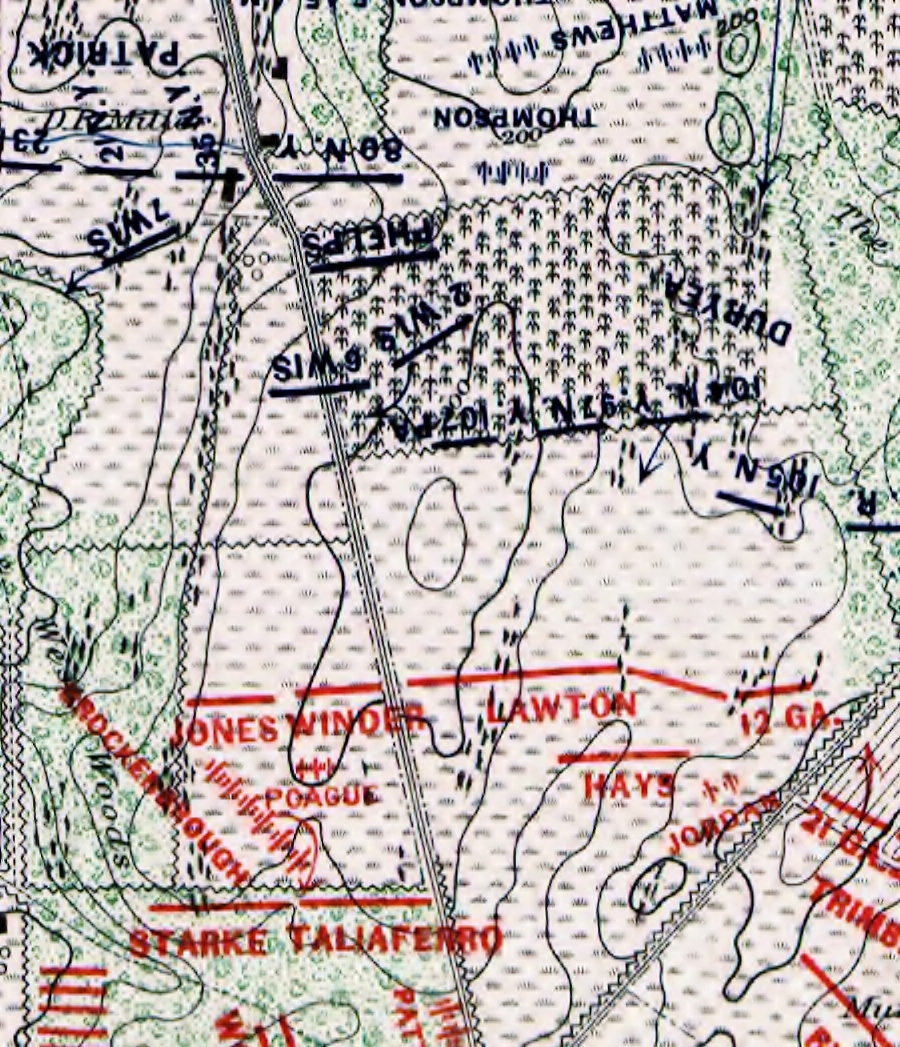
 Section of Ezra Carman's map showing troop positions at daybreak on the 17th. Phelps's brigade can be seen north of the North Woods and east of the Hagerstown Turnpike.


 Section of Ezra Carman's map showing troop movements between 6 and 6:20 a.m. on the 17th. Phelps's brigade can be seen in the northwestern edge of David Miller's cornfield.


 Section of Ezra Carman's map showing troop movements between 6:45 and 7 a.m. on the 17th. Phelps's brigade can be seen along the Hagerstown Turnpike, on the southwestern boundary of the cornfield.

Section of Ezra Carman's map showing troop movements at 7:20 a.m. on the 17th. Phelps's brigade can be seen north of the cornfield, located directly next to David Miller's farmhouse.


The day following Antietam, Phelps again wrote to Eliza. “The brigade is cut to pieces,” he informed his wife, “but I shall remain with them to the last. I have passed through everything for the past few days. I cannot now describe anything, the sights of the battle field are awful to behold, but familiarity with them makes me feel differently.”[4] Several days later, Phelps went into more detail concerning the terrible nature of the fighting along the Hagerstown Turnpike on the morning of the 17th:

I am pleased to know that so far, I have received the approbations of the officers and men of the brigade. I was under very heavy fire Sunday had men fall all about me, but [I was] excepted miraculously, but the fire of Sunday [Sept. 14th] bore no comparison to the one of Wednesday [Sept 17th]. I do not know how I escaped. I assure you that at night I offered the most fervent prayer of the thanksgiving for my wonderful preservation through the dangers of the battle fields. Fortunately I am very cool under fire and the fact of my quietly lighting my pipe when the shot and shell were flying about cutting down my men seemed to enspirit the men and gave them confidence. I have no had my clothes off for 10 days, oh for the luxuries of a bath. My cough troubles me very much and my lungs are becoming very sore, but I shall not complain when there is such pressing necessity for every officer and man to be in the field.[5]

Following Antietam, Phelps remained in command of his brigade, seeing action at Fredericksburg in December of 1862 and Chancellorsville in May of 1863. In June of 1863, when the two year enlistments of three of Phelps’s regiments expired, he went home with them as well. Despite having commanded a brigade through three major battles, despite a petition signed by many in his command, and despite the personal recommendations of numerous high ranking officers in the Army of the Potomac, Phelps did not receive a promotion to Brigadier General. Although he received a brevet promotion to the rank, he left the army in June of 1863 with the official rank of colonel.[6] Phelps's combat record during the Maryland Campaign is but one example of a larger trend in the Army of the Potomac; officers with little to no prior experience stepping into new commands to lead troops into battle. These command changes on the eve of Antietam were a major component of the experience and composition of the Army of the Potomac in September of 1862.


[1] Colonel Walter Phelps to Eliza Phelps, September 4, 1862, “A Brigade Commander’s First Fight: The Letters of Colonel Walter Phelps, Jr. during the Maryland Campaign,” edited by Tom Clemens, in Civil War Regiments, Vol. 5, No. 3, pg. 63.
[2] Col. Walter Phelps to Eliza Phelps, September 16, 1862, in Ibid., 65.
[3] O.R. Report, Col. Walter Phelps, Vol. 19, Part 1, 233-234.
[4] Col. Walter Phelps to Eliza Phelps, September 18, 1862, in “A Brigade Commander’s First Fight,” 66.
[5] Col. Walter Phelps to Eliza Phelps, in Ibid., 67.
[6] Ibid., 68.

Thursday, September 15, 2011

The Fall of Harper's Ferry and the Road to Antietam 149 years ago...

As the morning of the 15th of September dawned, the situation did not look good for Robert E. Lee and his Confederate army. George McClellan's Army of the Potomac sat atop South Mountain, holding several key passes. Stonewall Jackson was still at Harper's Ferry with nearly half the Confederate army. Worse yet, the Union 6th Corps was threatening the rear of Confederate forces at Harper's Ferry. It appeared as though the clock had struck midnight for the Confederate invasion of Maryland.

However, as Confederate guns on the heights overlooking Harper's Ferry unleashed their fearful shot and shell into the town below, Colonel Dixon Miles decided to surrender his 12,000 man garrison. They were in an indefensible position, as Confederate forces had taken all three of the heights overlooking the town. Jackson, elated with his success, sent off a quick message to Lee, informing him that the Union garrison at Harper's Ferry had surrendered. This telegram would change the campaign yet again. It was what led these two armies to Antietam.

After receiving this telegram, Lee began concentrating his forces near the small town of Sharpsburg. Over the next two days, Confederates would stream into the town, most of them arriving from Harper's Ferry to the south. On the eastern banks of Antietam Creek, Union soldiers began to arrive in droves, having just made the march down South Mountain, through Boonsboro, and toward Sharpsburg. As they arrived, they took position on the hills and fields to the north, east, and south of Sharpsburg. Surely, many of them knew that a battle was imminent. However, none knew of the price they would be forced to pay on the approaching Wednesday, September 17, 1862.

Tuesday, June 21, 2011

"There is no doubt but the Emperor is both willing and anxious to recognize our independence..."

One of the most understudied aspects of the American Civil War is how it played out overseas. In regards to Antietam and the Maryland Campaign in particular, the strategic impact that battles had on international affairs is blatantly clear. One of my favorite quotes about Antietam comes from George Stevens, a surgeon with the 77th New York. When describing the Antietam landscape after the war, Stevens could not fathom how such a peaceful place became the scene of "one of the grand battles which would decide the march of events in the history, not only of our own country, but of the world...."

One of the books in my possession that I value quite highly is a volume of the Messages and Papers of the Confederacy. There is a treasure trove of information in this book, and a good deal of it has to do with diplomatic affairs during 1862. One of the letters that stood out quite dramatically when I was reading through this volume the other day is an exchange between Confederate diplomat James M. Mason and Confederate Secretary of State Judah Benjamin. On September 18, the day following Antietam, Mason wrote to Benjamin to apprise him of the effect that the Confederate successes of 1862 were having in Europe. The following is a portion of that letter:


I have heard from one or two accredited quarters that this question (recognition) is again to come under the consideration of the British Cabinet in October, and the same report has reached Mr. Slidell.

In this posture of affairs, I can but hope that the reconsideration of the British Cabinet is brought about at the instance of the Emperor (Napoleon III, Emperor of France); and if this is so, I have little doubt that a favorable response will be strongly pressed upon it by him.

There is no doubt but the Emperor is both willing and anxious to recognize our independence, and seems so to declare himself without reserve. I had a note the other day from an English gentleman of high position, who told me that he had just seen the Emperor at Chalons, and who told him in conversation that he was, and had been for some time, ready to recognize us, and spoke rather impatiently of the opposite disposition of the British Government....

We are all much cheered and elated here at the signal successes of our arms in the series of battles reported from the Rappahanock to the Potomac lines opposite Washington, followed up by an arrival yesterday announcing that our forces had crossed into Maryland. We have only the Northern accounts, but even they are full to show that our victories have been complete, and the enemy both routed and disorganized. At this distance, and without the power to aid, I am filled with emotions of gratitude to those by whose counsels and whose courage such great events have been brought about. I look with renewed confidence to the effect which they must produce on the pending decision of the Emperor as to recognition.

(James Mason to Benjamin Judah, September 18, 1862, in Messages and Papers of the Confederacy, ed. James Richardson, Vol. II, Nashville: United States Publishing Company, 1906, 316-7.)

When Mason wrote this letter, he had yet to receive news of what had occurred the day before in Western Maryland. Many historians agree that had Lee won at Antietam, both England and France would have recognized the Confederacy as an independent nation. Europe loved American cotton, and laborers in factories and textile mills required it for their own livelihoods. European recognition most likely would not have come in the form of an international war being fought on American soil, but it would lead to financial, diplomatic, and political support. With these things considered, the dark days of 1862 could have been even darker for Union forces with Europe firmly on the side of the Confederacy.

Yet, with Lee's defeat and subsequent retreat from Maryland, events turned back in favor of the Union armies, stymieing European desires for recognition. The resulting Emancipation Proclamation was yet another nail in the coffin of European recognition. The case for Antietam's international impact is clear; it was a failed Saratoga for Robert E. Lee. Should Lee have won in Maryland, England and France were poised and ready for recognition and possible financial alliance. The Confederacy would never again come as close to gaining the international recognition and legitimacy that they so craved as they had come in the pivotal month of September, 1862.