Our Country's Fiery Ordeal

A blog about the American Civil War, written and maintained by historian Daniel J. Vermilya, author of The Battle of Kennesaw Mountain (History Press, 2014) and James Garfield and the Civil War (History Press, 2015)

Dedicated to my great-great-great grandfather, Private Ellwood Rodebaugh, Company D, 106th Pennsylvania Volunteer Infantry, killed at the Battle of Antietam, September 17, 1862.

"And may an Overuling Providence continue to cause good to come out of evil, justice to be done to all men where injustice has long prevailed, and finally, peace, quiet, and harmony to come out of this terrible confrontation and our country's fiery ordeal." -- Albert Champlin, 105th Ohio, Diary entry of June 19, 1864 (Western Reserve Historical Society)

Friday, April 13, 2012

Antietam's 150th: Ready, Set, Go!


"Who would have selected this lovely valley as the scene of one of the most bloody struggles that has ever occurred?....Yet, here, on these smiling fields, and among these delightful groves, one of the grand battles which should decide the march of events in the history, not only of our own country, but of the world, was fought."
George T. Stevens, 77th New York Volunteer Infantry


Greetings from Maryland, where I have returned once again to don my Ranger hat and work at one of the most beautiful, and meaningful, national parks in the country. Today was my first back at the Visitor Center. It was an incredibly busy day, which tells me that things are gearing up for the 150th. It will be a busy, beautiful, and incredibly important year at Antietam, and I can assure you that we will do all we can to be up for the task of preserving and interpreting such a beautiful and meaningful battlefield.

Over the upcoming weeks and months, look for new things on here, as I shift my focus from Shiloh and the Western Theater back to Antietam and the East. During the next few months, we will see how men such as Robert E. Lee, George McClellan, "Stonewall" Jackson, Ambrose Burnside, and even my great-great-great grandfather, Elwood Rodebaugh, all wound up along the banks of Antietam Creek on the morning of September 17, 1862. On this blog, we will take a look at various generals who fought at Antietam, various parts of the battlefield which might not be seen by the common visitor, some of the stories which are not often told, and some of the new interpretations of Antietam which emphasize how the battle was actually fought, not how historians think it should have been fought. In addition, I will post updates on my research on the Army of the Potomac at Antietam for the Dr. Joseph L. Harsh Scholarship Award. So, stay tuned for this blogger/ranger's view of Antietam 150 years after the battle was fought.

As for now, while I get settled in Maryland, here are just a few shots from my early morning walk through the park today...


Philadelphia Brigade Monument in the West Woods


View of the Tompkin's Battery guns, with Elk Ridge and South Mountain in the background


The Dunker Church, with portions of the Stephen Lee Artillery guns

Stephen Lee guns, with Maryland Monument in the background


New York State Monument

Friday, April 6, 2012

April 6, 1862


150 years ago today, on April 6, 1862, the Battle of Shiloh began. Over the past few weeks, I have done various posts on Shiloh, stemming from my recent visit. I have always been fascinated by this battle, as I was born on its 125th Anniversary (yes, that makes today my birthday). Shiloh has always stood out for me as being a very unique battle. It was the first of the great and terrible battles of the war. One week short of one year into the war, 24,000 Americans lay dead, wounded, or dying on once peaceful fields in Southern Tennessee. There was no turning back for America after Shiloh, as it forever changed the nation. It told all who would listen that the war would not be an easy affair, that the war would not be over quickly, and that with such momentous issues at stake, a great deal of blood would be required to settle the matter of which vision of liberty would prevail.


In Corinth, Mississippi, about 20 miles south of Shiloh, there is a relatively new NPS Interpretive Center. If you get the chance, I highly recommend you go there. Along with the fine museums and interpretive films, the Interpretive Center has a small display behind the building. The display, pictured above, is of a stream, the stream of American history. It starts with the Declaration of Independence; small ripples in the stream are caused by various sectional controversies leading up to the war. The blocks in the middle represent the war itself, with the larger blocks representing the larger battles. I found this to be fascinating because it is an excellent way to understand how these battles impacted history. Shiloh, Antietam, Gettysburg, and many others were all major events in the stream of American history, causing ripples which are still being felt today. Shiloh led to unforeseen casualties, the rise of a Lost Cause myth, the rise of Ulysses S. Grant, but more importantly, it taught Americans exactly how high the price of freedom truly is. The Declaration of Independence and the Constitution were documents that were so sacred that in order to either destroy or save them, thousands upon thousands of lives would need to be sacrificed. Those sacrifices, made at Shiloh 150 years ago, still affect our lives today, reminding us of what it means to be a citizen in this great republic.


Because I have written quite a bit about my recent visit to Shiloh, today, in commemoration of the battle's 150th anniversary, I wanted to simply share some of my favorite photos from my visit there (what I hope will be the first of many visits). Let us remember the sacrifices made 150 years ago today in the fields and woods surrounding Shiloh Church. As Lincoln wrote in his December 3, 1861 message to Congress, "The struggle of today, is not altogether for today -- it is for a vast future also. With a reliance on Providence, all the more firm and earnest, let us proceed in the great task which events have devolved upon us."


Here are the links for the posts I have done about Shiloh over the past few weeks. You can find many more Shiloh photos in these posts as well.

Shiloh National Cemetery
Confederate Burial Trenches 
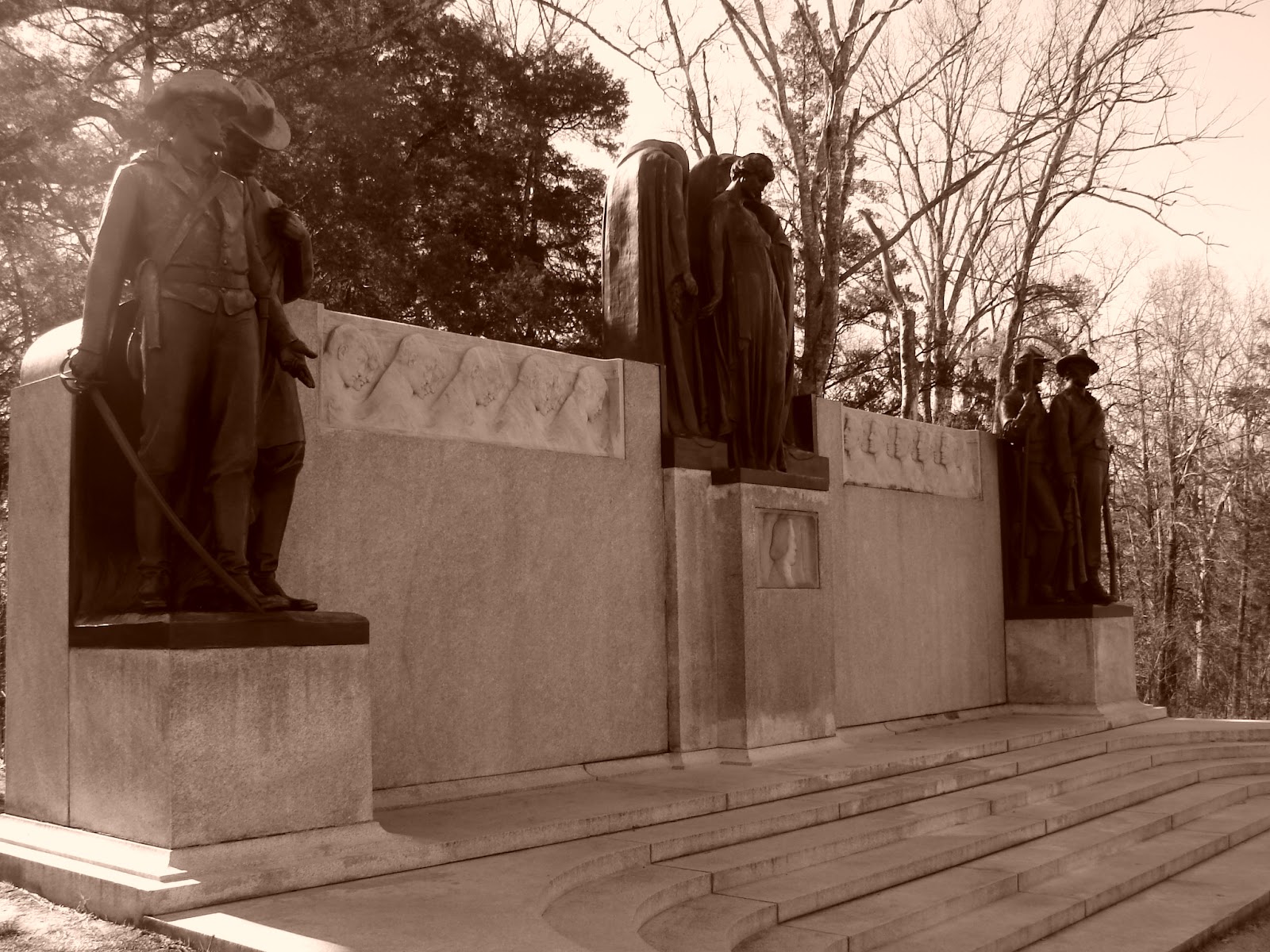
Shiloh's Confederate Memorial
Sherman Arrives at Pittsburg Landing
Battle of Shiloh Begins
Shiloh's Rhea Field
Shiloh's State Monuments
Shiloh's Hornets' Nest
April 3, 1862: Confederate Advance, Union Camps
April 5, 1862: "The eyes and hopes of eight millions of people rest upon you" (Death of A.S. Johnston)


I would be remiss if I didn't put the most important photo first. Going to Shiloh with my Dad made my first visit to Shiloh all the more special. Here is Dad and I along the edge of the Hornets' Nest, with Duncan Field behind us. 


Now, on to my other favorite photos...


Iowa Monument

Iowa Monument


Confederate Memorial


 Tennessee Memorial


 Artillery near Water Oaks Pond

 Sherman's Headquarters sign


 57th Ohio Monument


The Peach Orchard


One of the park's resident Bald Eagles, taken in Cloud Field

 Shiloh at sunset, taken from the Peach Orchard (same for next few)


Shiloh National Cemetery

Graves of Wisconsin Color Bearers overlooking the Tennessee River

Site of Grant's Headquarters on the evening of April 6ht

Shiloh National Cemetery


Confederate Battery Tablet


 Albert Sydney Johnston Death Site

Confederate Burial Trench


Thursday, April 5, 2012

April 5, 1862: "The eyes and hopes of eight millions of people rest upon you"

"While the troops were deploying for battle... the sun set clear and red beyond the tasseling oaks on tomorrow's battlefield. There was a great stillness in the blue dusk, and then the stars came out. The moon, which had risen in the daylight sky, was as thin as a paring, a sickle holding water but unclouded. I never saw the moon so high, so remote--a dead star lighting a live on where forty thousand men, young and old but mostly young, slept on their arms in line of battle, ready for the dawn attack through the woods before them. God knows what dreams came to them or how many lay there sleepless thinking of home."
Reflections of Lieutenant Palmer Metcalfe, Aide-de-Camp on Albert Sydney Johnston's staff, on the night before Shiloh. [From Shelby Foote's novel, Shiloh (Revised edition, New York: Vintage Books, 1980), 25.]


Albert Sydney Johnston


Raid, mud, inexperience, and poor communication had all hampered the march north, but they could not dismay Albert Sydney Johnston. On the evening of April 5, 1862, Johnston was on the eve of his greatest moment. His entire life had been one of service. He could claim to be a general of three republics, as one of his biographers has termed him. He served the United States Army, the army of the Republic of Texas, and now, he was the commander of Confederate forces in the west, one of the highest ranking officers in the entire Confederacy. He even outranked P.G.T. Beauregard, the Confederacy's hero of Fort Sumter and [First] Manassas, victories which gave Southerners hope in 1861.

But now, it was spring of 1862. Beauregard's victories seemed long ago. Federal successes at Forts Henry and Donelson had torn the Confederate defenses asunder, sending legions of blue clad Yankees deep into the heart of the South. Using rivers to move into Southern Tennessee, Major General Ulysses S. Grant had as his next target the only form of transportation that was more important than rivers: railroads. Corinth, where the Mobile and Ohio and the Memphis and Charleston Railroads intersected, was the next strategic point where Federal forces had their hearts set on. With over 48,000 Federal soldiers at Pittsburg Landing on the west bank of the Tennessee River, just 20 miles from Corinth, it appeared as though it would be only a matter of time before Grant achieved yet another incredible victory.

Albert Syndey Johnston knew this. Thus, he determined he would not wait for defeat; he would seize the initiative to achieve victory. On April 3, Johnston and Beauregard began moving north with their Army of the Mississippi, over 40,000 strong and full of green recruits with shotguns previously used for squirrel hunting. By the evening of April 5, the Confederates were behind schedule. Their initial plans had called for an attack on April 4th. Those plans were adapted to attacking on the morning of the 5th. Yet, rather than launching an attack on the morning of the 5th, many Confederates were still arriving in their pre-battle positions throughout the day.

On the evening of the 5th, a Confederate council of war saw Johnston, Beauregard, and their leading commanders discussing the prospects for an attack the following morning. After the long and difficult march, Beauregard now felt the odds of surprising the Federals were no longer in their favor, suggesting Grant's army would be "entrenched to the eyes." The Louisiana native was in favor of withdrawing to avoid being defeated by a well prepared enemy.

Johnston would have none of it. After hearing from several of his commanders, including Major General Leonidas Polk, who was in favor of the attack, Johnston proclaimed, "Gentlemen, we shall attack at daylight."

Upon ending the conference, Johnston remarked to Colonel William Preston, his brother-in-law and aide, "I would fight them if they were a million. They can present no greater front between those two creeks than we can; and the more they crowd in there, the worse we can make it for them.... Polk is a true soldier and a friend."

Johnston's enthusiasm for the moment was not his alone. Many Confederates knew the stakes of the battle that would come on the morrow. An array of Confederates in uniforms of grey, butternut, as well as some in shades of blue, with battle flags of different corps varying in style, was truly an amalgamation of Southerners. Men from Alabama, Mississippi, Tennessee, Arkansas, Louisiana, and Texas were preparing to launch a surprise attack on men who they had previously called their countrymen. The attack that would come the following morning would prove to be a landmark event, forever changing the course and flow of American history. That evening, Johnston's battle message was read aloud to the various units of his army, reminding them of the stakes of the upcoming fight:


“I have put you in motion to offer battle to the invaders of your country. With the resolution and disciplined valor becoming men fighting, as you are, for all worth living or dying for, you can but march to a decisive victory over the agrarian mercenaries sent to subjugate and despoil you of your liberties, property, and honor. 
Remember the precious stake involved; remember the dependence of your mothers, your wives, your sisters, and your children on the result; remember the fair, broad, abounding land, the happy homes, and the ties that would be desolated by your defeat. 
The eyes and hopes of eight millions of people rest upon you. You are expected to show yourselves worthy of your race and lineage; worthy of the women of the South, whose noble devotion in this war has never been exceeded in any time. With such incentives to brave deeds and with the trust that God is with us, your generals will lead you confidently to the combat, assured of success.”

The following morning, as Johnston heard the first shots of the battle from Fraley Field, he said to his staff, "Tonight we will water our horses in the Tennessee River." Yet, by 2:30 that afternoon of April 6, 1862, Johnston lay dead under an oak tree near Sara Bell's Peach Orchard.


Throughout the day, Johnston led from the front, channeling different brigades and regiments into battle. His fiery demeanor and courage inspired the men as they went to meet the enemy. During the early afternoon fighting, Johnston found himself leading an attack into one of the hottest parts of the battlefield. After hearing that several Confederate regiments were hesitant to charge the Federal lines near the Peach Orchard, Johnston rode to the front of the 9th Arkansas, clanging a tin cup he took from a Federal camp along the bayonets of the men, proclaiming, “Soldiers, get ready! Soldiers of the 9th Arkansas regiment are you ready to drive the invaders of your country from our soil?” The men responded with a shout: "We are!"

Johnston then told the Arkansas men, " you who boast of using cold steel, don’t waste your ammunition. I will lead you”. According to one observer, Johnston's words were incredibly powerful and effective: “His presence was full of inspiration… his voice was persuasive, encouraging, and compelling. It was inviting men to death, but they obeyed it. But, most of all, it was the light in his gray eyes, and his splendid presence… that wrought upon them.”

Johnston rode forward with the Confederate attack, retiring back behind the lines around 2 p.m. Shortly thereafter, Tennessee Governor Isham Harris, an aide on Johnston's staff, noticed the general leaning in the saddle. Harris asked Johnston, "General, are you wounded?", to which he replied, "Yes, and I fear seriously." 

Harris helped to lead Johnston's horse "Fire Eater" out of the line of fire, bringing the general down into a nearby ravine. After helping him from his horse, Harris and Johnston's staff frantically checked the general for wounds. None were found. By 2:30 p.m., Johnston bled to death from a wound in the back of his knee, severing an artery. His blood and pooled in his knee high boots. Johnston was found to have had a field tourniquet in his pocket when he died; had he used it, he may have lived. Yet, no one discovered the wound, and before they knew it, Albert Sydney Johnston became the highest ranking officer to be killed during the American Civil War.


Johnston's Monument at Shiloh, located where he was found leaning in the saddle.


Site believed to be where Johnston died. Recent studies have suggested that Johnston's death site was in fact a few hundred yards away from this location.


Taken from the Peach Orchard looking southeast, 
Johnston's monument can be seen in the distance on the right side of the picture.


 Johnston's Death is prominently featured and mourned on the Confederate Memorial at Shiloh

Tuesday, April 3, 2012

Shiloh, April 3, 1862: "The weather is now springlike..."

On April 3, 1862, the clouds of war were gathering in southern Tennessee. The Army of the Tennessee, led by Major General Ulysses S. Grant, was concentrating around Pittsburg Landing, on the Tennessee River. Over twenty miles to the south, Confederate forces were gathering, preparing, and organizing for one of the greatest attacks in American history. Confederate General Albert Sydney Johnston, commander of the Confederate Department of the West, knew that time was of the essence. The Federal forces at Pittsburg Landing were gathering to strike at Corinth, Mississippi, where the Memphis and Charleston, and Mobile and Ohio Railroads intersected, connecting nearly every part of the Confederacy. Johnston knew that Major General Don Carlos Buell was advancing from Nashville with his Army of the Ohio. The time to strike was now. A decision was made; the Confederate Army of the Mississippi, with Johnston in the lead, would move north to strike Grant’s force at Pittsburg Landing, hopefully taking them by surprise.


While decisions were being made at Corinth, at Pittsburg Landing, the air was filled with springtime, and the sounds of an army in camp. New recruits were drilled in marching and battle techniques, soldiers inspected weapons, and men wrote letters home. Among those doing the latter was Brigadier General William T. Sherman. Sherman’s road to this point in his life was filled with ups and downs. His life before the war was marked with personal failures and great self doubt. In 1861, at the start of the war, he was a Louisiana military academy superintendent. With the wave of secession sweeping the South, Sherman went north to his native Ohio, leaving the South behind, believing his southern friends were making a grave mistake. Sherman took command of a brigade, and received his Civil War baptism of fire at the Battle of First Manassas. By the fall of 1861, Sherman was the commander of the District of Kentucky. The job proved to be too much for him. Believing that innumerable Confederates were amassing for an attack, Sherman sent urgent messages to his superiors, calling for more men, let he and the North be overwhelmed. Because of this, he was relieved of his post, and sent to St. Louis to serve under General Henry Halleck. Many in the north called him insane for his seemingly irrational fears of a strong Confederate army and a prolonged and bloody war. Yet, after several months had passed, when it was time for a Federal army to exploit the gains made by Grant at Forts Henry and Donelson, Sherman was in the right place for a division command. His men were among the first Federal soldiers to set up camp at Pittsburg Landing. Indeed, Sherman was in many ways responsible for the location of the Federal camp there.

On that April 3, 1862, as Confederates began marching north from Corinth, Mississippi, and Albert Sydney Johnston prepared an attack upon which rode the hopes of the Confederacy, Sherman was writing a letter to his wife, Ellen, from his headquarters near Shiloh Church. He described for her the situation at Pittsburg Landing, noting that spring had arrived. Portions of the letter are below:


Sherman's Headquarters Monument, near Shiloh Church

Recreation of historic Shiloh Church, sitting on the same site (next to modern day Methodist Church)

Pittsburg, Landing, Tennessee
Camp, April 3, 1862
Dearest Ellen,

I have really neglected writing for some days. I don’t know why, but I daily become more and more disposed to stop writing… We have now near 60,000 men here, and Bragg has command at Corinth only 18 miles off, with 80 regiments and more coming. On our part, McCook, Thomas, and Nelson’s Divisions are coming from Nashville and are expected about Monday …[These divisions compose the Army of the Ohio; they did indeed arrive on Monday, just in time for the second day of the Battle of Shiloh] when I suppose we must advance to attack Corinth or some other point on the Memphis and Charleston Road.


Peach Orchard in bloom

Shiloh's Peach Orchard is located in Sara Bell's Cotton Field. While Sherman wrote of the trees in bloom, the majority of his division was camped to the south and west of the Peach Orchard. However, the brigade of Colonel David Stuart was encamped just a few hundred yards away, guarding the road south to Hamburg, Tennessee. 


The weather is now springlike, apples and peaches in blossom and trees beginning to leave, bluebirds singing and spring weather upon the hillsides. This part of the Tennessee differs somewhat from that up at Bellefonte. There the Alleghany Mountains still characterized the Country whereas here the hills are lower and rounded covered with oak, hickory, and dogwood, not unlike the Hills down Hocking [in Ohio]. The people have mostly fled, abandoning their houses, and such as remain are of a neutral tint not knowing which side will turn up victors. That enthusiastic love of the Union of which you read in the newspapers is a form of expression easily written, but is not true. The poor farmers certainly do want peace, and protection, but all the wealthier classes hate us Yankees with a pure unadulterated hate. They fear the Gunboats which throw heavy shells and are invulnerable to their rifles and shotguns, and await our coming back from the River.


 Blossoming trees in the Peach Orchard, with the Manse George Cabin in the background


…My Division is very raw and needs much instruction. Brigade Commanders are [Colonel John A.] McDowell, [Colonel David] Stuart, [Colonel Jesse] Hildebrand, and [Colonel Ralph] Buckland. General Grant commands in chief, and we have a host of other generals, so that I am content to be in a mixed crowd.


I don’t pretend to look ahead far and do not wish to guide events. They are too momentous to be a subject of personal ambition.

We are constantly in the presence of the enemy pickets, but I am satisfied that they will await our coming at Corinth or some point of the Charleston Road [Charleston and Memphis Railroad]. If we don’t get away soon the leaves will be out and the whole country an ambush.

Our letters come very irregularly, I have nothing from you for more than a week but I know you are all well and happy at home and that is a great source of consolation.

My love to all yours. Ever,

W.T. Sherman


Just a few days after this letter, William Tecumseh Sherman found himself in the fight of his life. On April 6, 1862, Sherman would find his rebirth as a military commander during the fighting at Shiloh. Yet, 150 years ago today, he was still a division leader whose sanity many questioned, laying in wait with his men among the blossoming trees and sunshine of Shiloh's spring weather. 


Sherman's Civil War: Selected Correspondence of William T. Sherman, 1860-1865, Edited by Brooks D. Simpson and Jean V. Berlin (Chapel Hill: University of North Carolina Press, 1999), 198-199.

Monday, April 2, 2012

Dr. Joseph L. Harsh Memorial Scholarship Award

This past February, Save Historic Antietam Foundation (SHAF) accepted applications for the Dr. Joseph L. Harsh Memorial Scholarship. This award is a research grant in honor of the late Dr. Joseph L. Harsh, a man whose work is a staple in Maryland Campaign historiography, and has inspired generations of historians, including myself. I am extremely honored and humbled to announce that Save Historic Antietam Foundation has named me the first recipient of this award.


This award is an incredibly exciting opportunity for me. It consists of a research grant to further knowledge on Antietam. For my research, I will be studying the strength, composition, and experience of the Army of the Potomac at Antietam. My work will investigate exactly how strong a fighting force the Army of the Potomac was, and how its strength potentially affected how George McClellan fought the battle. I believe this topic has tremendous implications for how we understand the accomplishments of the Union army during the Maryland Campaign, and it could also inform how we understand the generalship of George McClellan. Upon the completion of my research, I will be speaking and presenting my findings at a seminar, sponsored by SHAF, on September 8 at Antietam National Battlefield, the weekend before the park’s official Sesquicentennial celebrations. I will also be submitting the research as a publishable article. Needless to say, I can’t wait to get started on this project. I will hopefully be able to incorporate my research and findings into posts on here as well, sharing tidbits that I come across along the way.


As I said, I am extremely honored and humbled by this award. Dr. Harsh’s work on the Maryland Campaign has been an enormous influence on my growth as a historian. Before I read Dr. Harsh’s work, I was just a common observer of the campaign. I wasn’t truly a student of Antietam until I had dog eared, underlined, and highlighted copies of Dr. Harsh’s main work Taken at the Flood, and its companion Sounding the Shallows on my bookshelf (not to mention Confederate Tide Rising as well). To be doing such important research on such an important topic during the year of the Sesquicentennial for Antietam is beyond anything I could have imagined. If you told the nine year old me who was fascinated with Antietam when he first visited that he would be doing this kind of work during the 150th anniversary of the battle, he wouldn’t have believed you. I am incredibly blessed.


I sincerely thank the folks at Save Historic Antietam Foundation for this opportunity. Below, I have the text of their press release on the award. I would also like to congratulate Susan Rosenvold from the Pry House Field Hospital Museum. SHAF has awarded Susan a Sesquicentennial Award for Scholarship, funding her research on the work which Clara Barton did during and after Antietam. Susan will be presenting her research at SHAF’s September seminar as well.

 
For Immediate Release

Save Historic Antietam Foundation Inc. (SHAF) is proud to announce the recipient of its first Dr. Joseph L. Harsh Memorial Scholarship. The winner’s research will be presented at a free seminar at Antietam National Battlefield sponsored by SHAF on September 8, 2012. This award was created in honor of Dr. Harsh, a professor at George Mason University, an award-winning author on Confederate strategy in the Maryland Campaign and member of SHAF. The purpose of the Scholarship is to further knowledge on the battle of Antietam and Maryland Campaign, and it is open to all applicants. The first award recipient is Daniel Joseph Vermilya of Kirtland, Ohio. Dan is a seasonal ranger at Antietam National Battlefield. His topic will be “The Strength, Composition, and Experience of the Army of the Potomac at the battle of Antietam,” which will also be submitted to SHAF as a publishable article. Dan’s research is based on primary sources, and will be conducted extensively at the Antietam Battlefield library and the National Archives.

There were several very strong applications, and the selection process was quite difficult. After long deliberation the selection committee decided to also fund a proposal by Susan Rosenvold, the Director of Operations and Education, Pry House Field Hospital Museum at Antietam National Battlefield. Susan is an authority on the life and services of Clara Barton, and her proposal was to identify and locate the places on and around the Antietam Battlefield where Barton worked and cared for the wounded. Susan listed an impressive number of sources she intends to consult to complete her project, and she, too, will present her findings at the SHAF Seminar in September. The results of her research will also be published. Because of the merits of her proposal and the experience she brings to the project the selection committee decided to award Susan a special SHAF Sesquicentennial Award for Scholarship.

Additional information on the research papers and the free September 8, 2012 Antietam seminar will be posted this spring on SHAF’s website (www.shaf.org).

Further information can be obtained from Tom Clemens, President of SHAF, 301-432-2522 or at Antietam@verizon.net.