Our Country's Fiery Ordeal

A blog about the American Civil War, written and maintained by historian Daniel J. Vermilya, author of The Battle of Kennesaw Mountain (History Press, 2014) and James Garfield and the Civil War (History Press, 2015)

Dedicated to my great-great-great grandfather, Private Ellwood Rodebaugh, Company D, 106th Pennsylvania Volunteer Infantry, killed at the Battle of Antietam, September 17, 1862.

"And may an Overuling Providence continue to cause good to come out of evil, justice to be done to all men where injustice has long prevailed, and finally, peace, quiet, and harmony to come out of this terrible confrontation and our country's fiery ordeal." -- Albert Champlin, 105th Ohio, Diary entry of June 19, 1864 (Western Reserve Historical Society)

Showing posts with label 1st Manassas. Show all posts

Sunday, July 24, 2011

The 150th at Manassas

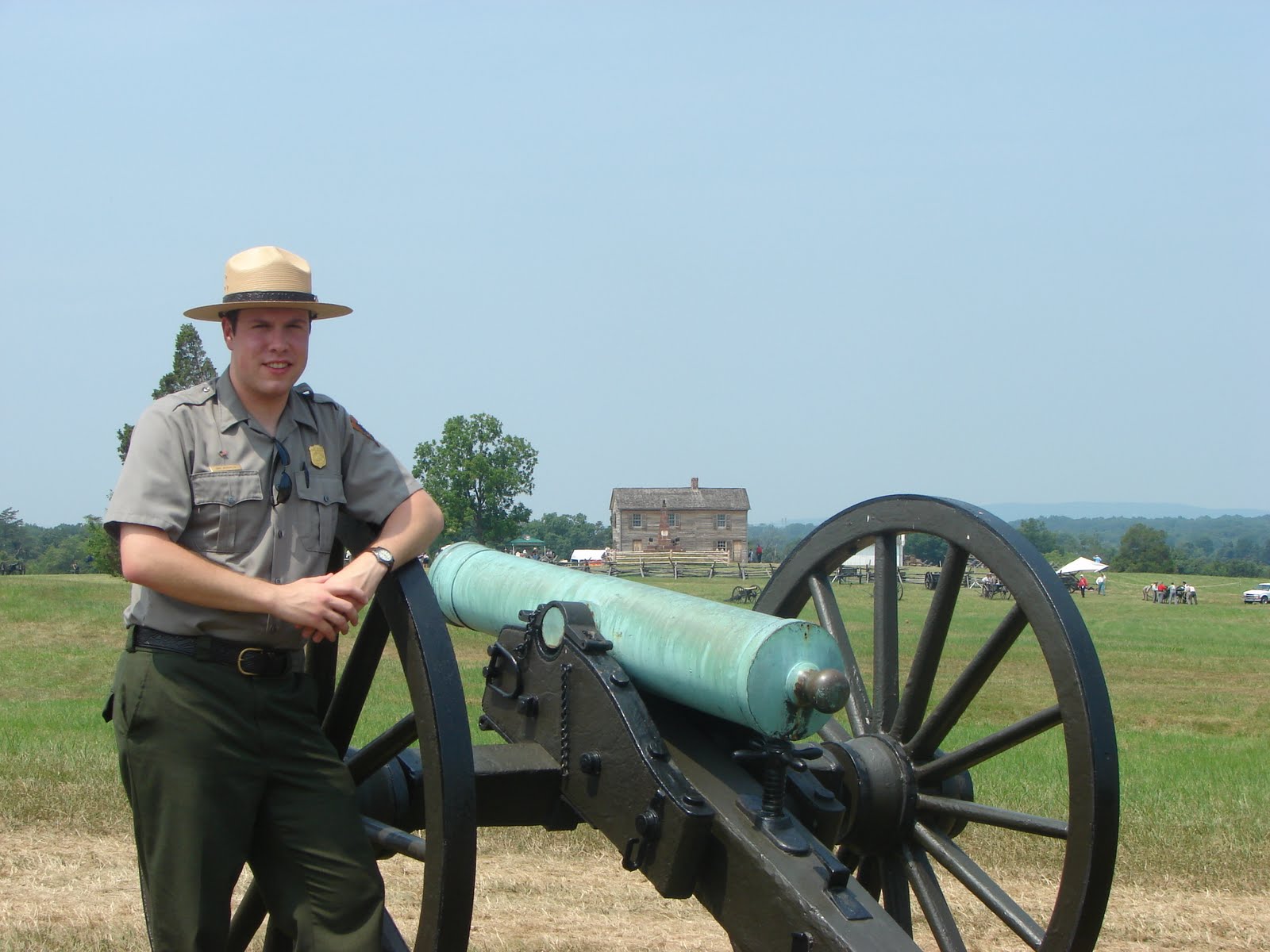
On July 21, 1861, the first major land battle of the American Civil War erupted on the plains of Manassas in Northern Virginia. 150 years (and 2 days) later, I had the great honor of journeying to those same plains, NPS Ranger hat in tow, to spend the day outside greeting visitors and helping to explain the significance of those same events.


With temperatures soaring above 100 degrees, it was a day best spent inside for many. Not so for yours truly. I spent the day traversing between different stations on the Henry Hill walking tour of 1st Manassas, answering questions, helping folks fill up on water, and providing whatever interpretation of the battle that I could. For the majority of the people I met, their first and only interest was in staying hydrated and stopping to chat about the days events. Others had routine questions about where Jackson was when he earned his famous sobriquet, what happened to Judith Henry of Henry House, who commanded which army, what the deal is with different names for the same battle... you get the idea.

For most of the day, I was positioned at Ranger stops near the spot where Jackson's line stood on the afternoon of July 21. These stops saw few visitors, giving me lots of time to take in the days events from afar. Even though events between 2 and 6 were cancelled because of the heat (heat index was 115), it was still an amazing thing to sit on the battlefield and think about the experience of battle 150 years ago.

Of the many pictures I took, here are some of the best which I thought might give you an idea of what my day at Manassas was truly like...


Arriving on the field just before 8 AM, I had the place nearly all to myself. I was truly in awe when I first walked onto the field. The day was just beginning, yet it was still unbelievably hot. I took a few moments to take pictures and simply enjoy being there before I began to make my way out to my stations. There were many tents, chairs, and a stage set up right behind the Visitor Center, signifying the importance of the four day commemorations for the battle.


A beautiful sky over the field in the morning.


You know you are somewhere important when C-SPAN shows up...

The guns from James Rickett's Battery, sitting near the Henry House, a rebuilt version of the same home guns in this position fired into on July 21, 1861 to rid it of Confederate sharpshooters, killing 85 year old widow Judith Carter Henry in the process.


One of the many NPS tents doubling as a Ranger and water station.


Living history reenactors' tents complete with battle flags near the Henry House


Monument to the Union soldiers who died at First Bull Run, dedicated on June 13, 1865, making it one of the first Civil War monuments to be created.


One of the several living history groups on Henry Hill performing a musket firing demonstration for visitors

Stop 1 for my day, the Henry Hill overlook. In the distance, one can see Matthews Hill, where the fighting began in earnest at around 9:30 in the morning on July 21, 1861. Union troops from the divisions of David Hunter and Samuel Heintzelman were ordered on a flanking movement by commanding Brig. Gen. Irvin McDowell. The Confederate brigade of Nathan Evans was notified of this movement and shifted west from their position at the Stone Bridge to attempt to block this flanking force. It was on this hill where Col. Ambrose Burnside's brigade met Evans men that morning. It was also on this hill where Major Sullivan Ballou of the 2nd Rhode Island Volunteers, author of the famous letter to his wife professing his love of country and the premonition of his death, was mortally wounded.


Ranger Dan with the Stone House and Matthews Hill in the background.


Stop 2 for my day was the site of the Robinson House, where only the foundations remain. James Robinson was a freed black man who lived on the 1st Manassas Battlefield. While his home and family escaped harm that day, the house was lost to suspected arson in 1993. Only the foundation still exists, with little else to signify the importance of this spot.


Stop 3 for me, where I spent most of my afternoon, was the small Ranger tent located behind Jackson's statue. It was here, on the downward slope of the hill, where Jackson made his famous stand. Nathan Evans's brigade, along with the brigades of Barnard Bee and Francis Bartow, were pushed off Matthews Hill, leaving few Confederate troops in the way of a Union victory. However, without orders, Thomas Jonathan Jackson, a professor from VMI, had moved his brigade of Virginians over to Henry Hill to support Evans, Bartow, and Bee and to make a defensive stand. Here, Jackson would firmly hold the Confederate line that day through several hours of fierce back and forth fighting between regiments and batteries of both armies. It was here where Jackson earned his famous name of "Stonewall" when Brigadier General Barnard Bee proclaimed to his men, "Look, men, there is Jackson standing like a stone wall! Let us determine to die here, and we will conquer! Follow me!"


Shortly after this now famous episode, Barnard Bee was mortally wounded. He succumbed to his wounds the next day. Not far from where the statue of Jackson sits, famously echoing Bee's words and pointing towards Jackson's destiny of being one of the most revered figures in American history, there is a marker signifying the spot where Bee met his own fate.

Out at Jackson's line, I had an excellent view of the artillery demonstrations taking place at the Henry House.


Always an awesome sight to see artillery pieces fired on a Civil War battlefield.


All in all, my day at Manassas was quite enjoyable. My final stop was at the Henry House, where I had begun my day many hours earlier. It was a bit busier at this site, as I had the chance to talk to a few folks about what happened during the battle and what its significance was, but again, the main interest of many folks was in drinking lots of the cold water we were providing. While I was dissapointed I did not have more opportunities to discuss the history and significance of the battle and to do interpretation, looking back on my experience, it was still a remarkable day. While not what I had expected and prepared for, it was amazing to simply be out on the battlefield as a Park Ranger for the 150th anniversary of the battle. Greeting people, chatting with visitors, and experiencing the events and the atmosphere are things I will never forget. The heat and the nearby reenactment drew some visitors away from the park, but it was still a great place to be with a good crowd of nice people hoping to learn a thing or two about history and to pay their respects to those who sacrificed for us.


I think when I look back upon my day at Manassas, what I will remember most won't be the heat, the sparse crowds, or the logistical difficulties of the day. Rather, when I look back, I will remember how amazing it was to be on the same field where 150 years earlier Thomas Jonathan Jackson became "Stonewall" Jackson, where JEB Stuart led a Confederate cavalry charge for the first time, where William Tecumseh Sherman led troops against Henry Hill, and where Americans began to realize that war was not a quick and easy affair.  While other battles had more casualties than 1st Manassas, few had more long reaching implications. Not only did 1st Manassas erase hopes of a quick end to the war, but it sparked the Civil War careers of some of that conflicts most famous officers and generals. In commemorating the 150th anniversary of 1st Manassas, we are remembering far more than the battle of July 21, 1861; rather, we are remembering that day, and the many days like it over the next four years which would forever change America.


Thursday, July 21, 2011

July 21, 1861: The Battle of First Manassas and Major Sullivan Ballou of the 2nd Rhode Island Volunteers


150 years ago today, the first major land battle of the American Civil War was fought outside the Manassas railroad junction, roughly 30 miles southwest of Washington, D.C. General Irvin McDowell's Army of Northeastern Virginia met the Confederate forces of Joseph Johnston, freshly arrived from the Shenandoah Valley, and Pierre Gustave Toutant Beauregard, and a fierce and confusing fight ensued. Today, on the fields of Manassas, the Park Service is staging the first of their four days of commemoration ceremonies, which several of my Antietam colleagues have the honor of taking part in (I will have that same privilige on this upcoming Saturday).

While the numbers of casualties from First Manassas are far fewer than the numbers who would soon line the fields near towns named Sharpsburg, Gettysburg, and Spotsylvania Court House, the impact of the casualties from 150 years ago today were still immense. From April through July of 1861, Americans had been convinced that the war would be an easy affair, quickly won with one grand charge against the enemy. Many thought of war as only the romantic event it was portrayed as in books, stories, and folklore. It took the Battle of 1st Manassas to shake loose the notion that the war would be easy and quick. Manassas signaled that the Civil War would be a struggle far longer, far bloodier, and far more devastating than any had dared to imagine.


On this date 150 years ago, roughly 4,700 men fell in battle as casualties. Armies of civilians fought against each other in a desperate struggle. Men wore uniforms of every style, make, and color, making it nearly impossible to distinguish friend from foe on certain parts of the field that day. Civilians came from Washington with picnic baskets, prepared to watch the grand battle that was sure to decide the whole matter of secession quickly and decisively. Those same civilians, along with many of the Union soldiers, found themselves scrambling to get back to the safety of Washington by days end, shocked and terrified by the terrible reality of war. The order of battle for 1st Manassas reads as a "who's who" listing of famous Civil War names. Not only were McDowell, Johnston, and Beauregard present, but so was Longstreet, Jackson, Stuart, Early, Ewell, and Burnside, Sherman, Howard, Richardson, and Franklin. Many of these men would go on to have brilliant and distinguished careers during the war. Thomas Jonathan Jackson would rise to fame after standing upon Henry Hill "like a stonewall," only to be cut down at the height of his fame and glory at Chancellorsville in May of 1863. Ambrose Burnside would leave his mark on many a battlefield of this war, leading troops over a small three arch bridge along Antietam Creek, as well as ordering troops to assault heights overlooking the quiet town of Fredericksburg. William Tecumseh Sherman led a brigade of troops against Confederate forces on Henry Hill that day, a much smaller force than the one he would lead through the state of Georgia in 1864, burning cities, foraging crops, and bringing the realities of war home for the entire Confederacy. J.E.B. Stuart, who led a dramatic cavalry charge at Manassas, rocketed to fame as the Confederacy's fearless cavalryman, leaping into the hearts, minds, and imaginations of an entire people, only to be mortally wounded at Yellow Tavern in 1864, dying at the young age of 33.

For all of these men, their journey through the American Civil War began 150 years ago today.

Yet, while Jackson, Burnside, Sherman, and Stuart went forward from 1st Manassas to achieve fame on other fields of battle, many men never left the field that day. One of those men was Major Sullivan Ballou of the 2nd Rhode Island Volunteers.

The story of Sullivan Ballou, much like so many other stories of individuals who fought and died during the Civil War, reminds us that the war was not a romantic sport, nor was it a weekend hobby for those who fought it. It was a life and death struggle for the future of their lives, their families, and this country. It was a fiery ordeal which touched both the battlefield and the home front, exacting a terrible price from all who experienced it.

Before the war, Sullivan Ballou was an attorney and politicain, serving in the Rhode Island House of Representatives. He was a Republican and a supporter of Abraham Lincoln. On October 15, 1855, he married Sarah Hunt Shumway, with whom he had two boys, Edgar and William. He volunteered to serve in the 2nd Rhode Island Volunteers at the outset of the war, which brought him to the fields along side Bull Run Creek on July 21, 1861. On that morning, while riding into battle out in front of his troops, a 6 pound solid shot severed Ballou's right leg below the knee and killed his horse. Ballou was carried from the field in severe pain, and though surgeons did what they could for him, he succumbed to the terrible nature of his wounds one week later.

On July 14, 1861, exactly 1 week before he was mortally wounded at 1st Manassas, Ballou wrote a letter home to his wife explaining his feelings in the event that he would be killed in battle. Ballou seemed to have a premonition that his death was near, and his letter serves as final testimony of his love for his wife, his children, and his country. The letter was never sent. It was found in Ballou's trunk after his death, and was given to his wife by Rhode Island Governor William Sprague. The letter which Ballou wrote stands as one of the most remarkable letters any soldier from either side wrote during the war. It captures a deep love for family and country. Ballou's Christian faith shines through in his words, and his profession of faith, love, and patriotism remind us why it was that so many left their safe and peaceful homes to fight in a deadly struggle which was so greater than themselves.


Major Sullivan Ballou, 2nd Rhode Island Volunteers


July the 14th, 1861
Washington D.C.
My very dear Sarah:
The indications are very strong that we shall move in a few days—perhaps tomorrow. Lest I should not be able to write you again, I feel impelled to write lines that may fall under your eye when I shall be no more.
Our movement may be one of a few days duration and full of pleasure—and it may be one of severe conflict and death to me. Not my will, but thine O God, be done. If it is necessary that I should fall on the battlefield for my country, I am ready. I have no misgivings about, or lack of confidence in, the cause in which I am engaged, and my courage does not halt or falter. I know how strongly American Civilization now leans upon the triumph of the Government, and how great a debt we owe to those who went before us through the blood and suffering of the Revolution. And I am willing—perfectly willing—to lay down all my joys in this life, to help maintain this Government, and to pay that debt.
But, my dear wife, when I know that with my own joys I lay down nearly all of yours, and replace them in this life with cares and sorrows—when, after having eaten for long years the bitter fruit of orphanage myself, I must offer it as their only sustenance to my dear little children—is it weak or dishonorable, while the banner of my purpose floats calmly and proudly in the breeze, that my unbounded love for you, my darling wife and children, should struggle in fierce, though useless, contest with my love of country.
Sarah, my love for you is deathless, it seems to bind me to you with mighty cables that nothing but Omnipotence could break; and yet my love of Country comes over me like a strong wind and bears me irresistibly on with all these chains to the battlefield.
The memories of the blissful moments I have spent with you come creeping over me, and I feel most gratified to God and to you that I have enjoyed them so long. And hard it is for me to give them up and burn to ashes the hopes of future years, when God willing, we might still have lived and loved together and seen our sons grow up to honorable manhood around us. I have, I know, but few and small claims upon Divine Providence, but something whispers to me—perhaps it is the wafted prayer of my little Edgar—that I shall return to my loved ones unharmed. If I do not, my dear Sarah, never forget how much I love you, and when my last breath escapes me on the battlefield, it will whisper your name.   
Forgive my many faults, and the many pains I have caused you. How thoughtless and foolish I have often been! How gladly would I wash out with my tears every little spot upon your happiness, and struggle with all the misfortune of this world, to shield you and my children from harm. But I cannot. I must watch you from the spirit land and hover near you, while you buffet the storms with your precious little freight, and wait with sad patience till we meet to part no more.
But, O Sarah! If the dead can come back to this earth and flit unseen around those they loved, I shall always be near you; in the brightest day and in the darkest night—amidst your happiest scenes and gloomiest hours—always, always; and if there be a soft breeze upon your cheek, it shall be my breath; or the cool air fans your throbbing temple, it shall be my spirit passing by.
Sarah, do not mourn me dead; think I am gone and wait for me, for we shall meet again.
As for my little boys, they will grow as I have done, and never know a father's love and care. Little Willie is too young to remember me long, and my blue-eyed Edgar will keep my frolics with him among the dimmest memories of his childhood. Sarah, I have unlimited confidence in your maternal care and your development of their characters. Tell my two mothers his and hers I call God's blessing upon them. O Sarah, I wait for you there! Come to me, and lead thither my children.
Sullivan