150 years this week, George B. McClellan was dismissed as the commander of the Army of the Potomac. He had built the army from when he came to Washington in the summer of 1861; it was in many ways a reflection of him and his ideas on how to fight a war. It is no secret that McClellan was much loved by his men; many of the officers were loyal to him as well.
All of this leads to a very important question, one that might seem very simple. Was McClellan simply a bad general who deserved to be dismissed? Certainly, that is a refrain often heard when discussing "Little Mac." When I wrap up my talks or tours at the battlefield, I can usually expect to have a visitor or two who want to debate the merits of McClellan as a commander. I can't tell you how many times myself and my colleagues at Antietam have heard, "McClellan was just a bad general, and Ole' Lincoln got rid of him just as he should have."
Here is my short and simple take on McClellan's dismissal. As a military commander in the Maryland Campaign, McClellan delivered one of the finest leadership performances of the war for any commander on either side. He built an army out of a mess, moved his men through Maryland, fought two difficult offensive battles against difficult terrain, and significantly damaged Lee's army, forcing an end to the Confederate invasion of Maryland. However, because of his political views and strong disagreement with Lincoln on matters of policy, he had to go.
McClellan favored a conciliatory war, one that was seeking to restore the old Union with no major changes. After Antietam, Lincoln was ready to boldly lead the country toward a new and better future, one where freedom applied to millions more than it previously had. To do this, Lincoln needed generals willing and able to faithfully execute his policies. McClellan was not one of those men. This is not to suggest (although many have) that McClellan was disloyal or a traitor; in fact, he was faithfully devoted to the Union and to preserving the Constitution. However, after Antietam, and after the Emancipation Proclamation, McClellan was no longer the man Lincoln needed to carry through on his policies of moving the nation toward "a new birth of freedom."
McClellan's dismissal served as a watershed moment for Lincoln and the nation. From that point onward, Lincoln would come into his own as a military leader. The "Hard War" that Northern forces waged against the Confederacy was driven not by political generals, but by Lincoln himself. The Emancipation Proclamation signaled that the war would be anything but conciliatory; it would remake the country. Because of his disagreements with Lincoln, McClellan was not the right general to lead Union forces in this task.
McClellan was not a bad general, in fact, on the battlefield at Antietam, he was a good one. However, McClellan was too much of an overtly political general, and for that, he had to go.
These are my rather quick two cents on the matter. What do you think? Was McClellan fired for being a bad general or because he was no longer the right man to enact the policies of the Lincoln administration in the Civil War?
Showing posts with label George McClellan. Show all posts
Showing posts with label George McClellan. Show all posts
Friday, November 9, 2012


Saturday, November 3, 2012
"Perfect clarity of understanding..."
Because I am now in the process of getting my research from this summer published, I wanted to post a few of the letters, dispatches, and telegrams that I found during my research for the project.
The dispatch below is from the George B. McClellan Papers at the Library of Congress. It is one of the strongest examples of the chaos inflicting Union forces in and around Washington D.C. following the Federal defeat at Second Manassas. Fitz John Porter, the commander of the Fifth Corps, had a tougher task than most. The Fifth Corps had the distinction of being involved in both the Peninsula and Second Manassas battles, meaning that it had suffered more than its fair share of casualties, sickness, and stragglers in the weeks preceding the Maryland Campaign. Thus, when George McClellan and his staff were attempting to assess Federal strength in early September, the Fifth Corps was a problem. September 1st and 2nd saw McClellan and his staff writing to different commanders inquiring about the strength and composition of their commands. On September 5th, Porter wrote to Seth Williams, Assistant Adjutant General of the Army of the Potomac, informing him that, because of the heavy losses in the officer corps and the disorganized state of the ranks, it would be very difficult to provide any reliable strength numbers for his corps. On the same day that Porter was informing Williams that he couldn't get an estimate of his strength, Stonewall Jackson and thousands of Confederates were crossing over the Potomac River and into Maryland. Thus, McClellan was starting the campaign with a serious disadvantage.
Halls Hill, VA, Sept 5, 1862Gen. S. WilliamsI find it almost impossible to get a report of the strength of the command. Colonels and Adjt Generals and Assistant Adjutant Generals either killed, wounded, sick, or absent. Have destroyed everything. New (books) are employed and records are with the Commands. I have done my best and I must beg you to be patient.Will send report at the earliest moment.F.J. Porter,Major General Comdg.
Many historians use certainty and hindsight to excoriate officers in the past; yet, as Joe Harsh wrote in Taken at the Flood, “Perfect clarity of understanding was impossible, and even reasonable clarity usually came long after decisions had to be rendered.” McClellan would leave Washington with uncertainty in his mind over the strength and condition of his forces. That uncertainty was a result of dispatches like this one.
(Fitz John Porter to Seth Williams, September 5, 1862, George B. McClellan Papers, Box A78, Reel 31, Library of Congress, Manuscript Division)
Friday, September 7, 2012
September 7, 1862: "A victory now and we will soon be together"
150 years ago today, Major General George Brinton McClellan moved his headquarters into Rockville, Maryland, officially beginning his move northward into Maryland to pursue Robert E. Lee and the Confederate Army of Northern Virginia. McClellan wrote the following letter to his wife that day:
This short post will have to do for today. For those in the area, tomorrow I will be presenting my research on the strength, experience, and condition of the Army of the Potomac at Antietam for the Save Historic Antietam Foundation Seminar at Antietam National Battlefield. If you are in the area, stop on by. The seminar will be at the Mumma Barn, and I will be speaking at 10:45 am.
It is a great time to be at Antietam. Today, the Visitor Center was packed from open to close, we officially opened our new museum gallery, and the phones were ringing off the hook. The 150th is definitely right around the corner!
We are all well and the entire army is now united, cheerful and confident. You need not fear the result for I believe that God will give us the victory. I leave here this afternoon to take command of the troops in the field. The feeling of the Government towards me, I am sure, is kind and trusting. I hope with God's blessing, to justify the great confidence they now repose in me, and will bury the past in oblivion. A victory now and we will soon be together. I send a short letter today. God bless and reward your trust in Him and all will be well.
This short post will have to do for today. For those in the area, tomorrow I will be presenting my research on the strength, experience, and condition of the Army of the Potomac at Antietam for the Save Historic Antietam Foundation Seminar at Antietam National Battlefield. If you are in the area, stop on by. The seminar will be at the Mumma Barn, and I will be speaking at 10:45 am.
It is a great time to be at Antietam. Today, the Visitor Center was packed from open to close, we officially opened our new museum gallery, and the phones were ringing off the hook. The 150th is definitely right around the corner!
Sunday, September 2, 2012
September 2, 1862: "A terrible and thankless task"
150 years ago today, George Brinton McClellan officially assumed command of all Federal forces defending Washington D.C., including both his force of the Army of the Potomac and John Pope's Army of Virginia.

George Brinton McClellan
The Civil War Papers of George B. McClellan, edited by Stephen Sears, pg. 428.
To Mary Ellen McClellan, September 2, 1862, 12:30 pm
I was surprised this morning when at breakfast by a visit from the President and Halleck--in which the former expressed the opinion that the troubles now impending could be overcome better by me than anyone else. Pope is ordered to fall back upon Washington and as he reenters everything is to come under my command again! A terrible and thankless task--yet I will do my best with God's blessing to perform it. God knows that I need his help. I am too busy to write any more now--Pray that God will help with a full knowledge of all its difficulties and of the immensity of the responsibility. I only consent to take it for my country's sake and with the humble hope that God has called me to it--how I pray that he may support me!...
Don't be worried--my conscience is clear and I can trust in God
George B. McClellan
Later that day, in the mid afternoon hours of September 2, George McClellan put on one of his finest uniforms. He looked resplendent, with a bright yellow sash, golden trim, and his dress sword surrounding the dark blue of his Federal coat. He began riding out to the outskirts of Washington, where he would meet the remnants of Pope's defeated army as they slowly streamed back into the city. By 4 pm, McClellan had reached Upton's Hill, where he met John Pope, at the head of a column of defeated Union troops. After informing Pope that he was no longer in command, the defeated commander continued his dreary ride into Washington. Simultaneously, men of John Hatch's division of the 3rd Corps, Army of Virginia, had overheard McClellan's conversation. Cheers began erupting up and down the ranks as men jubilantly celebrated the news that "Little Mac," their beloved general, would once again lead them forward into battle. The scene must have been quite dramatic: a defeated John Pope, hanging his head as he rode back into Washington; exhausted, but excited, soldiers cheering their new commander; and George McClellan, in his finest uniform, sitting atop his black horse, "Dan Webster", observing the scene with the pride of knowing he was once again in command, but also knowing that the job ahead of him was, as he wrote his wife earlier that day, "a terrible and thankless task." While these soldiers were cheering now, it would be McClellan's job to turn this force around, transforming it from a defeated and disorganized army into a force capable of defeating Lee and saving the future of the Republic. 150 years ago today, Major General George B. McClellan's work was just beginning.
Friday, August 31, 2012
The Road to Antietam, August 31, 1862: "I am utterly tired out"
150 years ago today, the Confederate victory at Second
Manassas was complete. John Pope’s Army of Virginia was slinking back toward
Washington, and it appeared as though the end of the Union might soon be in
sight. During the day on the 31st, George McClellan wrote to Henry
Halleck that his staff was reporting “our army as badly beaten: our losses very
heavy… Some of the corps entirely broken up into stragglers.” It was becoming obvious
that the situation was desperate for the Union. Several hours later, at 7:30
pm, McClellan again wrote to Halleck, reporting that as many as 20,000
stragglers littered the roads of Northern Virginia between Manassas and
Washington (OR, Vol 12, Part 3, 771-773).
Late on the evening of August 31st, General in
Chief sent the following telegraph:
Aug 31, 1862
From Washington, 10:07 pm
To Maj. Genl McClellan
Since receiving your dispatch
relating to command I have not been able to answer any note of absolute
necessity. I have not seen the order as published but will write to you in the
morning. You will retain the command of everything in this vicinity not
temporarily to be Pope’s army in the field. I beg of you to assist me in this
crisis with your ability and experience. I am utterly tired out.
H. W. Halleck, General in Chief
In the last hours of August, as the Union appeared to be
crumbling before the victorious army of Robert E. Lee, Halleck was turning to George
B. McClellan to pick up the pieces of defeat and attempt to salvage not only
the army, but the country, from the mess. The above telegram is not in the
Official Records exchange of dispatches sent back and forth on the 31st,
and is found in the McClellan papers (McClellan Papers, LOC, Box A75, Reel 30).
McClellan’s response, which can be found in the O.R.,
simultaneously accepted his new role and showed uncertainty over to what that
role would be: “I am ready to afford you any assistance in my power, but you
will readily perceive how difficult an undefined position, such as I now hold,
must be. At what hour in the morning can I see you alone, either at your own
house or the office?” (OR, Vol 12, Part 3, 773).
Two days later, as the broken remnants of Federal forces seeped into
Washington a few days later, it would be McClellan who greeted them on the
outskirts of the city. McClellan had by then met with both Lincoln and Halleck, and had been officially placed in command of the Federal troops in and around Washington, tasked with defending the Capital from the menacing threat of Lee's victorious and triumphant Rebel army, just 30 miles away.
150 years ago today, Federal leaders were trying to understand just how bad the situation truly was. It was becoming readily apparent that Pope’s time in command was over. McClellan, uncertain of what his role was to be going forward, received the above dispatch from Halleck informing him that he was likely to have the command of not only his former army from the Peninsula, but the defeated remnants of John Pope’s force as well. Still, McClellan’s orders were not clear, nor was his understanding of his task facing him, or his understanding of the force he would command. In the days to come, the dire condition of his army, as well as the condition of the nation, would become known to McClellan, Halleck, and many others. Indeed, 150 years ago was a trying time not just for Henry Halleck, as he wrote to McClellan, but for the country as well.
150 years ago today, Federal leaders were trying to understand just how bad the situation truly was. It was becoming readily apparent that Pope’s time in command was over. McClellan, uncertain of what his role was to be going forward, received the above dispatch from Halleck informing him that he was likely to have the command of not only his former army from the Peninsula, but the defeated remnants of John Pope’s force as well. Still, McClellan’s orders were not clear, nor was his understanding of his task facing him, or his understanding of the force he would command. In the days to come, the dire condition of his army, as well as the condition of the nation, would become known to McClellan, Halleck, and many others. Indeed, 150 years ago was a trying time not just for Henry Halleck, as he wrote to McClellan, but for the country as well.
Tuesday, August 7, 2012
Book Review: The Long Road to Antietam, by Richard Slotkin
"Good philosophy must exist, if for no other reason, because bad philosophy needs to be answered."
-C.S. Lewis
I wanted to begin my review of the latest Antietam book to hit the market with this quote for two reasons.
1. I love C.S. Lewis, and have a general rule of using his writing as much as possible.
2. While referring to philosophy, I think the principle of the quote applies to history as well. Good history must be written, if for no other reason, because bad history needs to be answered.
Which leads me to The Long Road to Antietam by Richard Slotkin, the latest in a long string of popular histories written to tell the tale of Antietam and the Maryland Campaign of 1862. The story of the campaign is, after all, one of the most important in American history. At the start of September, Vegas surely would have been giving good odds for Robert E. Lee and the Confederacy to win their independence, and soon. Federal forces in Washington were in disarray, Lee's army was riding a high tide of momentum, and it appeared as though Abraham Lincoln may never have the chance to issue the draft of the Emancipation Proclamation that had set in his desk since July. Yet, incredibly enough, just two and a half weeks later, Lee's army was limping back into Virginia, Federal forces had saved Washington, Maryland, and Pennsylvania, the North had new life, and Lincoln was issuing the Emancipation Proclamation. Surely, the Union general who led the Union Army of the Potomac has been heralded by authors like Richard Slotkin out of thanks to his contributions in saving the country....
This, however, is not the story Richard Slotkin tells in his latest work. This book is an attempt to tell the story of "how the Civil War became a revolution," as the subtitle reads. Antietam is a vital part of the story of freedom in this country. It was the battle that transformed the Civil War from being a fight to restore the Union to a revolution that would destroy slavery and establish a new standard of freedom for all Americans. In many ways, Antietam was a battle for the future of freedom in America. That is the story this book sets out to tell.
First off, the narrative is filled with numerous errors when discussing the history of Antietam and the Maryland Campaign. One of the most glaring errors that I found (on page 239) was Slotkin writing that the Roulette farmstead that was burned during the Battle of Antietam. The William Roulette farmstead was not burned during the battle. The Mumma farmstead was. Perhaps even the casual visitor who has taken the Antietam driving tour would be able to point this out, being that the Mumma farm is one of the 11 stops on the park driving tour, and interpretive markers discuss what happened to the farm. Certainly, the Roulette farm is near the Mumma farm, but mistakes like this simply should not make their way into print. The burning of the Mumma farm was an important landmark on the battlefield, and affected both troop movements and the lives of the Mumma family alike.
Now, back to the review.
Slotkin uses The Long Road to Antietam to describe George McClellan as arrogant, narcissistic, neurotic, devious, timid, incompetent, and altogether, one really bad dude.
Basically, he is Scar from the Lion King.
Each one is an evil character, intent on seizing power from the good guys (either Lincoln or Mufassa) and using it for their own nefarious schemes. Also, each one has facial hair, so, there is that too.
See the similarities, right?
Students of the Maryland Campaign are no doubt familiar with Stephen Sears, author of Landscape Turned Red, the most widely read book on the Battle of Antietam. Sears is well known as being very critical of George McClellan. Yet, despite Sears's harsh judgments on McClellan, even he believes it is beyond the pale to question the motives and sincerity of the general. As Sears wrote in an essay collection on the Army of the Potomac:
In The Long Road to Antietam, Richard Slotkin suggests throughout the book that George McClellan was a general more concerned with his political reputation and future than victory on the battlefield, coming close to, if not crossing the line of, accusing the Union general of treason numerous times.
Repeatedly, Slotkin argues that McClellan cared far more about his reputation in Washington than about the rebel army in Maryland. In fact, he suggests that the only reason McClellan wanted to achieve a victory in the Maryland Campaign was to stick it to Stanton and Halleck and to possibly rise to become the leading figure in the war effort once again. He singles McClellan out as arrogant and nefarious, leaving the reader with an impression of McClellan as a commander more interested in political intrigue than in affairs on the battlefield. In one of the harshest and most peculiar knocks against McClellan, Slotkin argues that the Union commander issued no written orders at Antietam to protect his reputation should the battle go poorly:
McClellan not only limited the forces he entrusted to his assault commanders, he did not fully inform them of the tactical plan for the battle they were about to fight. His refusal may have reflected, and been intended to conceal, his indecision about where and how to strike his heaviest blows. It is also possible that he refused to discuss his plans with his subordinates, and declined to issue written orders, so that no one—neither his colleagues nor his rivals—would know whether his plans had been well—or ill—conceived. His defensive position had to be impregnable on both fronts. (247)
Rather than Slotkin's arguments about McClellan's tactical decisions being motivated by political intrigue, let's have a look at the explanation for the lack of written orders put forward by historian Ethan Rafuse in what I consider to be the best book published about George McClellan at Antietam.
Rafuse’s explanation of why McClellan did not issue written orders does not rely on an interpretation of McClellan as a psychotic general worried about his reputation in Washington over his troops in the field. Instead, it takes McClellan for who he was; a highly intelligent, competent, motivated, and loyal commander who realized that he was facing a fierce opponent in Robert E. Lee, and that the future of the country was in the balance at the Battle of Antietam. Thus, McClellan wanted to ensure that he would not be cornered into a plan which would become obsolete the moment the guns began firing.
Another major strain of Slotkin's critique of McClellan is that he believed that he, and ONLY HE, had the key to winning the war. This point brings up a few important questions.
Did Robert E. Lee drive Confederate strategy because he believed he knew what was best and how to win the war? Yes, and at a great and detrimental cost to the Confederacy. Lee's intense focus on the East, and on launching two aggressive invasions, cost his army crucial manpower and deprived the Confederate forces in the West of valuable resources and attention that contributed to the loss of the most important strategic points in the entire Confederacy.
Did Sherman believe that his "hard war" on Southerners was the only way to win the Civil War? Yes. He wrote voluminously to that effect. Did Grant believe that his strategy of driving toward Richmond in 1864 was the only way to defeat the Confederacy? Yes, and he pushed forward regardless of the chorus of cries in the North that he was a butcher wasting the flower of American youth on the fields of Virginia in a futile attempt to win the war.
The difference between McClellan and these generals is that he strongly disagreed with his superior in trying to carry out his strategy. Slotkin's argument that McClellan's belief that he alone knew how to win the war is misguided, as that was true for many officers. McClellan's difference is that he did not agree, or get along with, his Commander in Chief, where the other aforementioned generals did.
Historians must understand the disagreement between McClellan and Lincoln for what it was. Slotkin suggests that McClellan went so far as to foster a treasonous atmosphere in his headquarters, yet this was far from the truth. McClellan was true to the Union, and wanted to serve his country. He had political disagreements with Lincoln. He disliked Lincoln's strategy. He disliked Emancipation. As a result, he did not actively pursue Lincoln's goals for the war, which led to his removal from command in November of 1862. While McClellan's disagreements with Lincoln were not appropriate and he certainly deserved to be fired, there was nothing treacherous about this.
For those interested in a new and refreshing book on the Battle of Antietam, Abraham Lincoln, and George McClellan, The Long Road to Antietam is yet more of the same old McClellan bashing. It is a scathing indictment of George McClellan as a general, using errors and myths as evidence. Looks like the Merry-Go-Round of debate and controversy over George McClellan is still spinning away.
All things considered, you might be better off simply watching the Lion King.
-C.S. Lewis
I wanted to begin my review of the latest Antietam book to hit the market with this quote for two reasons.
1. I love C.S. Lewis, and have a general rule of using his writing as much as possible.
2. While referring to philosophy, I think the principle of the quote applies to history as well. Good history must be written, if for no other reason, because bad history needs to be answered.
Which leads me to The Long Road to Antietam by Richard Slotkin, the latest in a long string of popular histories written to tell the tale of Antietam and the Maryland Campaign of 1862. The story of the campaign is, after all, one of the most important in American history. At the start of September, Vegas surely would have been giving good odds for Robert E. Lee and the Confederacy to win their independence, and soon. Federal forces in Washington were in disarray, Lee's army was riding a high tide of momentum, and it appeared as though Abraham Lincoln may never have the chance to issue the draft of the Emancipation Proclamation that had set in his desk since July. Yet, incredibly enough, just two and a half weeks later, Lee's army was limping back into Virginia, Federal forces had saved Washington, Maryland, and Pennsylvania, the North had new life, and Lincoln was issuing the Emancipation Proclamation. Surely, the Union general who led the Union Army of the Potomac has been heralded by authors like Richard Slotkin out of thanks to his contributions in saving the country....
This, however, is not the story Richard Slotkin tells in his latest work. This book is an attempt to tell the story of "how the Civil War became a revolution," as the subtitle reads. Antietam is a vital part of the story of freedom in this country. It was the battle that transformed the Civil War from being a fight to restore the Union to a revolution that would destroy slavery and establish a new standard of freedom for all Americans. In many ways, Antietam was a battle for the future of freedom in America. That is the story this book sets out to tell.
Granted, this work does have its strong suits. The prose is
highly readable and enjoyable, and its emphasis on trying to combine political
and military history is one which is sorely needed in the field of Civil War
scholarship. However, after reviewing the work, I can't really say that this work does much to benefit our understanding of the Antietam Campaign and George McClellan.
First off, the narrative is filled with numerous errors when discussing the history of Antietam and the Maryland Campaign. One of the most glaring errors that I found (on page 239) was Slotkin writing that the Roulette farmstead that was burned during the Battle of Antietam. The William Roulette farmstead was not burned during the battle. The Mumma farmstead was. Perhaps even the casual visitor who has taken the Antietam driving tour would be able to point this out, being that the Mumma farm is one of the 11 stops on the park driving tour, and interpretive markers discuss what happened to the farm. Certainly, the Roulette farm is near the Mumma farm, but mistakes like this simply should not make their way into print. The burning of the Mumma farm was an important landmark on the battlefield, and affected both troop movements and the lives of the Mumma family alike.
Another
error, this one repeated throughout the work, is Slotkin's assertion
that Lee's army was organized into a corps structure during the Maryland
Campaign. This is not true. In Maryland, Lee used a two wing structure for
parts of the campaign: one wing was ostensibly commanded by “Stonewall”
Jackson, and the other by James Longstreet. During the division of his army
under Special Orders 191, these two wings were divided up to accomplish Lee’s
objective. Slotkin argues that the Confederate corps structure increased the organizational cohesion of the Confederate
force; that was not the case. During the Battle of Antietam, units that were
supposedly in Longstreet’s “wing” were fighting under Jackson, and Jackson's men fighting under Longstreet.
Furthermore, it is not until a few days after the battle, once Lee was back in
Virginia, that his army adopted a corps command structure.
Other errors that can
be easily found include the claim that Union generals Fitz-John Porter and
William Franklin were actually arrested following their conduct at Second
Manassas (they had charges leveled against them, but neither was actually arrested).
Slotkin also suggests that George Meade was given the Pennsylvania
Reserve Division in the First Corps at the start of the campaign to improve its function as a
fighting unit. This is untrue; Meade took command of the division just a
few days before the battle when its prior commander, John Reynolds, was sent to
Pennsylvania to take command of the state militia. Slotkin also rather
strangely refers to the East Woods and the West Woods as the East and West
“Wood”. I could keep going for quite awhile, but you are starting to get the picture.
Despite these inaccuracies, my primary problem with Richard
Slotkin’s newest book is the treatment of George B. McClellan.
DISCLAIMER: I am not a McClellan “apologist”. I am a Civil War historian who focuses on the Antietam Campaign, and one who thinks that discussing McClellan based on facts, evidence, and rational inquiry provides a more balanced view of the general, highlighting both his good and bad actions as a commander.
Now, back to the review.
Slotkin uses The Long Road to Antietam to describe George McClellan as arrogant, narcissistic, neurotic, devious, timid, incompetent, and altogether, one really bad dude.
Basically, he is Scar from the Lion King.
Each one is an evil character, intent on seizing power from the good guys (either Lincoln or Mufassa) and using it for their own nefarious schemes. Also, each one has facial hair, so, there is that too.


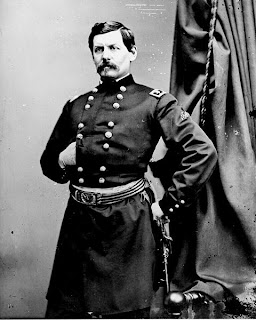 |
| George Brinton McClellan |
See the similarities, right?
Students of the Maryland Campaign are no doubt familiar with Stephen Sears, author of Landscape Turned Red, the most widely read book on the Battle of Antietam. Sears is well known as being very critical of George McClellan. Yet, despite Sears's harsh judgments on McClellan, even he believes it is beyond the pale to question the motives and sincerity of the general. As Sears wrote in an essay collection on the Army of the Potomac:
"Whether at headquarters or on the battlefield or in the political arena, in defeat and disappointment, George McCelllan never wavered in his determination to put down the rebellion. Historians will no doubt continue to debate his exact contribution to that cause, but they have no cause to deny the sincerity of his efforts." (Sears, "Little Mac and the Historians" in Controversies and Commanders, 24).
In The Long Road to Antietam, Richard Slotkin suggests throughout the book that George McClellan was a general more concerned with his political reputation and future than victory on the battlefield, coming close to, if not crossing the line of, accusing the Union general of treason numerous times.
Repeatedly, Slotkin argues that McClellan cared far more about his reputation in Washington than about the rebel army in Maryland. In fact, he suggests that the only reason McClellan wanted to achieve a victory in the Maryland Campaign was to stick it to Stanton and Halleck and to possibly rise to become the leading figure in the war effort once again. He singles McClellan out as arrogant and nefarious, leaving the reader with an impression of McClellan as a commander more interested in political intrigue than in affairs on the battlefield. In one of the harshest and most peculiar knocks against McClellan, Slotkin argues that the Union commander issued no written orders at Antietam to protect his reputation should the battle go poorly:
McClellan not only limited the forces he entrusted to his assault commanders, he did not fully inform them of the tactical plan for the battle they were about to fight. His refusal may have reflected, and been intended to conceal, his indecision about where and how to strike his heaviest blows. It is also possible that he refused to discuss his plans with his subordinates, and declined to issue written orders, so that no one—neither his colleagues nor his rivals—would know whether his plans had been well—or ill—conceived. His defensive position had to be impregnable on both fronts. (247)
Slotkin is arguing that McClellan did not issue written orders either because he was indecisive (with no proof or explanation as to why) or to protect himself from politicians in Washington (ie. Should the army lose,
his orders would not be used against him, with Washington being the second front referred to). This theory goes beyond the normal
complaints about McClellan being “slow” or “incompetent,” and ventures into the
realm of accusing the general of paranoia, and treachery. To suggest that McClellan would
put his soldiers’ lives at risk by knowingly holding back written orders simply to protect himself politically,
and to do so without any supporting
evidence is an egregious claim that does an enormous injustice to our understanding of both
George McClellan and the Battle of Antietam. Slotkin is no doubt not the first to make such accusations, but they are still misguided and incorrect.
Rather than Slotkin's arguments about McClellan's tactical decisions being motivated by political intrigue, let's have a look at the explanation for the lack of written orders put forward by historian Ethan Rafuse in what I consider to be the best book published about George McClellan at Antietam.
McClellan has been criticized for
not issuing written orders or providing explicit verbal guidance to his
subordinates laying out his intentions prior to the battle. This was a
consequence of McClellan’s desire—a commendable one given the unknowns he
faced—to maintain flexibility as the fighting developed and avoid committing
himself to a course of action that circumstances might prove unwise. (Ethan Rafuse, McClellan's War, 310)
Rafuse’s explanation of why McClellan did not issue written orders does not rely on an interpretation of McClellan as a psychotic general worried about his reputation in Washington over his troops in the field. Instead, it takes McClellan for who he was; a highly intelligent, competent, motivated, and loyal commander who realized that he was facing a fierce opponent in Robert E. Lee, and that the future of the country was in the balance at the Battle of Antietam. Thus, McClellan wanted to ensure that he would not be cornered into a plan which would become obsolete the moment the guns began firing.
Another major strain of Slotkin's critique of McClellan is that he believed that he, and ONLY HE, had the key to winning the war. This point brings up a few important questions.
Did Robert E. Lee drive Confederate strategy because he believed he knew what was best and how to win the war? Yes, and at a great and detrimental cost to the Confederacy. Lee's intense focus on the East, and on launching two aggressive invasions, cost his army crucial manpower and deprived the Confederate forces in the West of valuable resources and attention that contributed to the loss of the most important strategic points in the entire Confederacy.
Did Sherman believe that his "hard war" on Southerners was the only way to win the Civil War? Yes. He wrote voluminously to that effect. Did Grant believe that his strategy of driving toward Richmond in 1864 was the only way to defeat the Confederacy? Yes, and he pushed forward regardless of the chorus of cries in the North that he was a butcher wasting the flower of American youth on the fields of Virginia in a futile attempt to win the war.
The difference between McClellan and these generals is that he strongly disagreed with his superior in trying to carry out his strategy. Slotkin's argument that McClellan's belief that he alone knew how to win the war is misguided, as that was true for many officers. McClellan's difference is that he did not agree, or get along with, his Commander in Chief, where the other aforementioned generals did.
Historians must understand the disagreement between McClellan and Lincoln for what it was. Slotkin suggests that McClellan went so far as to foster a treasonous atmosphere in his headquarters, yet this was far from the truth. McClellan was true to the Union, and wanted to serve his country. He had political disagreements with Lincoln. He disliked Lincoln's strategy. He disliked Emancipation. As a result, he did not actively pursue Lincoln's goals for the war, which led to his removal from command in November of 1862. While McClellan's disagreements with Lincoln were not appropriate and he certainly deserved to be fired, there was nothing treacherous about this.
For those interested in a new and refreshing book on the Battle of Antietam, Abraham Lincoln, and George McClellan, The Long Road to Antietam is yet more of the same old McClellan bashing. It is a scathing indictment of George McClellan as a general, using errors and myths as evidence. Looks like the Merry-Go-Round of debate and controversy over George McClellan is still spinning away.
All things considered, you might be better off simply watching the Lion King.
Wednesday, August 1, 2012
Special Orders 191 at Monocacy: Their Meaning for the Maryland Campaign
Starting today, August 1, Monocacy National Battlefield has on display the original Special Orders 191 that was famously lost by Robert E. Lee’s Army of Northern Virginia, and then found by members of the 27th Indiana on September 13, 1862, just south of Frederick, Maryland, near the site of the July 1864 battle of Monocacy. I went by for a quick visit this afternoon to see the orders, and it is certainly worth the time. Of particular interest in their display are a few letters and items from the Union soldiers who actually found Lee’s famous orders; Corporal Barton Mitchell and Sergeant John Bloss.
While I am glad that Monocacy has these orders on display, as it will certainly generate more interest in the Maryland Campaign’s 150th anniversary, I hope that their presence will serve to further a better interpretation of the campaign and its events, rather than the tired, standard story of the supposed incompetence of George McClellan.
One of the biggest myths about the Antietam Campaign is that,
because of the finding of Lee’s Lost Orders, George McClellan should have
easily destroyed Lee’s army within a few hours. As the traditional
interpretation of events goes, McClellan lounged around and hesitated for an
entire day before advancing on Lee’s army. Being that Lee’s army was not
destroyed during the Maryland Campaign, many historians have used the Lost
Orders not as a way of understanding how the campaign progressed, but rather,
simply as a way of bashing George McClellan as a bad or incompetent general.
Generations of armchair generals and Monday morning quarterback historians have
criticized McClellan for failing to do more with Lee’s Lost Orders. One might say that the orders did more harm to McClellan's historical reputation than they did good for his army during the campaign. Let’s take
a moment to review this and determine if it is correct.
Here is the standard narrative for how Special Orders
affected the Maryland Campaign:
September 9: Lee issues Special Orders 191 in Frederick,
dividing his army up into 7 pieces. His primary objective is getting rid of the
Federal garrison at Harpers Ferry.
September 13: George McClellan is handed a copy of Lee’s
orders, lost south of Frederick, and thus has his opponent’s plans in hand.
McClellan boasts about having all of Lee’s plans, is credited with saying “Here
is the paper with which if I cannot whip Bobbie Lee I will be willing to go
home.” He then decides to take a nap for 16 hours, because, well, he is a bad
general, and bad generals take naps at really inopportune moments. Upon
awakening, he decides, eh, maybe we will attack (he doesn’t really take a nap,
but according to many historians, he might as well have; forgive me the comedic
license here).
September 14: Despite his hesitant blundering, the Battle of
South Mountain is fought. It is a Union victory, but had McClellan not taken
that 16 hour nap, oh boy, it would have been a REAL victory. You know, one of
those common Civil War battles where an entire army was destroyed in one fell
swoop (you can literally count on one hand the number of times that actually
happened during the war).
Here is how the Lost Orders actually affected the campaign:
September 9: With his army at Frederick, Lee realized that
his strategy for the campaign needed to be altered. He had originally believed
that the Federal garrison at Harpers Ferry would abandon that post due to the
Confederate presence in Maryland. Lee believed that the entire operation can be
concluded, and his army reunited, by September 12.
September 12: Reinforced by the Federal garrison from
Martinsburg, Harpers Ferry is still holding out. Lee’s army is still divided,
and Federal forces from Ambrose Burnside’s right wing of the Federal advance
reach Frederick. Lee is completely unaware of how close the Federals are to his
still divided army due to the failures of J.E.B. Stuart.
September 13: Several soldiers of the 27th
Indiana find a copy of Lee’s Special Orders 191, now known as the Lost Orders. The
orders reach George McClellan shortly after noon. By 3 pm, after verifying the
legitimacy of the orders, McClellan sends orders to Brigadier General Alfred
Pleasanton, commanding the Army of the Potomac’s cavalry, asking him to scout
Confederate positions to determine if the recovered orders are still accurate
and what the positions of Lee’s army are. By 6 pm, McClellan begins issuing
orders for an attack the following day. Federal forces camp that night in
Middletown Valley, between Catoctin and South Mountains. While McClellan was
verifying the Lost Orders and formulating a battle plan, Lee is finally
informed of Federal troops in Frederick, giving him a sense of alarm. He begins
turning his attention toward Boonsboro and South Mountain, hoping he can stop
McClellan from destroying the divided Confederate army.
September 14: Based on orders of the previous evening, the 9th and 1st Corps of the Army of the Potomac launch attacks on Turner’s, Fox’s, and Frosttown Gaps on South Mountain. Several miles to the South, William Franklin slowly leads his 6th Corps toward his objective of Crampton’s Gap, which he must carry and then attempt to liberate the trapped forces at Harpers Ferry. That evening, after being defeated on South Mountain, Lee decided to retreat back to Virginia. It was only the news of the Confederate victory at Harpers Ferry which convinced him to continue the campaign, thus setting the stage for the Battle of Antietam.
Thus, rather than simply waiting around, McClellan did what any good commander would do. To use the famous adage of Ronald Reagan, McClellan decided to trust, but verify. Rather than waiting for almost a full day as many historians claim, he only waited 6 hours, spending much of that time verifying the orders and having Pleasanton’s cavalry scout Confederate positions. It is possible that he could have ordered an attack on South Mountain on the night of the 13th, or even pushed his forces closer to the foot of the mountain. However, not knowing the strength of Confederate forces complicated matters for McClellan. The Lost Orders referred to the commands of both D.H. Hill and Longstreet as being at Boonsboro; however, by this time, Longstreet’s command was in Hagerstown, leaving just 8,000 Confederates on South Mountain. Yet, being unaware of Lee’s strength, or of the changes in the positions of Lee’s men, it is reasonable that McClellan would want to wait until he could bring forward enough strength for a concerted attack on what he had reason to believe was two full Confederate commands positioned on the daunting terrain of South Mountain. Anyone familiar with the terrain of Middletown Valley and South Mountain itself would clearly understand the difficulty in launching a hurried assault up the steep and tangled slopes of the mountain, especially in the growing dusk and dark of night, not to mention the possibility of overwhelming Confederate numbers defending the position. Thus, the battle would be fought on the 14th.
Clearly, I think that McClellan made the most of the orders and the information they provided him. It wasn't much, but it was still helpful in setting up the Federal victory at South Mountain. But, don't just take my word for it. How about the words of one of the men directly involved in the whole episode? As I mentioned earlier, one
of the nice features of the exhibit at Monocacy is the display of several
letters from the men who actually found Lee’s orders. One of them, from
Sergeant John Bloss, is particularly interesting in what it has to say about
the orders’ importance and what McClellan did with them. This letter has never
before been published, and I was provided with a transcript copy of it by the
Monocacy National Battlefield staff. Here are a few lines from Sergeant Bloss,
written on September 25, 1862, near the battlefield of Antietam, regarding Lee’s
Lost Orders:
Corporal Mitchell was very
fortunate at Frederick. He found General Lee’s plan of attack on Md and what
each division of his army was to do. I was with him when he found it and read
it first. I seen its importance and took it to the Col. He immediately took it
to General Gordon [George Gordon, brigade commander], he said it was worth a
Mint of Money and sent it to General McClellan. He pushed on the same day and I
think his expedition his movements kept enemy from uniting at the point they
had intended.
It is clear that Sergeant Bloss believed that the orders
were important in McClellan moving quickly on Lee’s army. McClellan issued
orders that same day to push forward against Lee’s army, and the following
morning, Union forces attacked Confederates on South Mountain. Thus, while
generations of historians may believe that McClellan let the opportunity of Lee’s
Lost Orders slip by the wayside, Sergeant John Bloss, one of the men who found
those orders, clearly did not.
The Lost Orders were indeed important in the campaign. They provided McClellan the necessary spark of information to launch his aggressive assault on South Mountain on the 14th. If it wasn't for the stellar efforts of "Stonewall" Jackson at Harpers Ferry, perhaps we would be remembering the Lost Orders for being the stroke of good luck which helped George McClellan in dispatching the Rebel army from Maryland with the climactic Battle of South Mountain. Simply put, the Lost Orders led to the Battle of South Mountain, while the Confederate victory at Harpers Ferry led to the fight at Antietam just a few days later.
Let’s hope that the display of the Lost Orders at Monocacy helps to remind people of what really happened during the Maryland Campaign of 1862.
Monday, June 25, 2012
Captain George A. Custer to Major General George B. McClellan, September 15, 1862
Over the past few weeks, on days when I am not working at the park, you can most likely
find me in Washington, at either the National Archives or the Library of
Congress, digging through rolls of microfilm and dusty old record books,
working away on my ongoing research regarding the strength, experience, and
composition of the Army of the Potomac at Antietam. The McClellan
Papers at the Library of Congress have turned out to be very, very interesting.
While Stephen Sears published a collection of McClellan's Civil War
correspondence years ago, the collection only scratches the surface of what can
be found in the Library of Congress holdings. Thus far, I have mostly been
digging through rolls and rolls of correspondence on microfilm, primarily
things that were sent to McClellan before and during the campaign. Some of this
material can be found in the Official Record volumes relating to Antietam (and
the supplemental volume as well). Yet, much of it is unpublished reports and
dispatches. For an excellent example, I have below a dispatch sent to McClellan
by a young Captain by the name of George Armstrong Custer (sound familiar?)
Custer was serving on McClellan's staff during the Maryland Campaign, and on September
15, the day after the Battle of South Mountain, Custer sent a message to
McClellan describing for him Lee's positions outside of Sharpsburg. The time on
this dispatch appears to be 1 p.m., meaning that this message is a firsthand
account of Lee's battle lines by Custer, who was apparently one of the first
Union officers to survey the positions along Antietam Creek.
In the McClellan Papers, this dispatch is dated September 17, 1862. Yet, because of its content and the other dispatches which Custer sent McClellan that day (at least from those I saw in the McClellan Papers thus far), this must have been on the 15th, and whomever cataloged the papers simply mislabeled it. The mention of Tidball's Battery, Richardson's Division, and the defensive positions of Lee's army outside of Sharpsburg all suggest that this was a dispatch sent on the 15th, making it an early assessment of the Confederate position outside of Sharpsburg.
In the Sears collection of McClellan's Civil War correspondence, a reference is made to this dispatch in a footnote where Sears only included the following portion: "The enemy is drawn up in line of battle on a ridge about two miles beyond [Keedysville]. They are in full view. Their line is a perfect one about a mile and a half long.... Longstreet is in command and has forty cannon that we know of." Sears omitted the lines where Custer notes the lack of Federal artillery at the front, as well as the mention of Tidball’s battery and Richardson’s division. It should be noted that, while Custer's dispatch clearly says Lee is two miles beyond the Potomac, he was either mistaken or confused in his wording. As Sears indicated in his reference to this dispatch, Custer meant that Lee was two miles beyond Keedysville, not the Potomac River. On the 15th, Lee was indeed two miles beyond Keedysville, drawn up outside of Sharpsburg. If Custer did indeed mean the Potomac, then using beyond was a poor word choice, as it suggests that Lee's army was past the river, rather than a few miles away from it, still on Maryland soil. However, given the lack of punctuation and the hurried nature of the writing, I doubt Custer took a moment to proofread the message he was sending along. Either way, it is a fascinating dispatch from an officer who would go on to be one of the more famous generals of the war, and of the 19th century, offering one of the first Union assessments of Lee’s position outside of Sharpsburg.
The enemy is drawn up in line of battle on a ridge about two miles beyond Potomac [.] They are in full view [.] Their line is a perfect one about a mile and a half long. Wehavecan have equally good position as they now occupy. Richardson is forming his line to attack. We are lacking in artillery Tidball’s being the only artillery available hurry up more guns we can get good position for two hundred guns. Longstreet is in command and has forty cannon that we know of. We can employ all the troops you can send us.
Custer
Library of Congress, George B. McClellan Papers (A80: Roll 32)
In the McClellan Papers, this dispatch is dated September 17, 1862. Yet, because of its content and the other dispatches which Custer sent McClellan that day (at least from those I saw in the McClellan Papers thus far), this must have been on the 15th, and whomever cataloged the papers simply mislabeled it. The mention of Tidball's Battery, Richardson's Division, and the defensive positions of Lee's army outside of Sharpsburg all suggest that this was a dispatch sent on the 15th, making it an early assessment of the Confederate position outside of Sharpsburg.
In the Sears collection of McClellan's Civil War correspondence, a reference is made to this dispatch in a footnote where Sears only included the following portion: "The enemy is drawn up in line of battle on a ridge about two miles beyond [Keedysville]. They are in full view. Their line is a perfect one about a mile and a half long.... Longstreet is in command and has forty cannon that we know of." Sears omitted the lines where Custer notes the lack of Federal artillery at the front, as well as the mention of Tidball’s battery and Richardson’s division. It should be noted that, while Custer's dispatch clearly says Lee is two miles beyond the Potomac, he was either mistaken or confused in his wording. As Sears indicated in his reference to this dispatch, Custer meant that Lee was two miles beyond Keedysville, not the Potomac River. On the 15th, Lee was indeed two miles beyond Keedysville, drawn up outside of Sharpsburg. If Custer did indeed mean the Potomac, then using beyond was a poor word choice, as it suggests that Lee's army was past the river, rather than a few miles away from it, still on Maryland soil. However, given the lack of punctuation and the hurried nature of the writing, I doubt Custer took a moment to proofread the message he was sending along. Either way, it is a fascinating dispatch from an officer who would go on to be one of the more famous generals of the war, and of the 19th century, offering one of the first Union assessments of Lee’s position outside of Sharpsburg.
Wednesday, April 18, 2012
The Wisdom of Charles Wainwright: "Antietam was a victory..."
Today was a good day for this historian. Why, you ask? Because it involved Civil War history books. Lots of Civil War history books. I spent a few hours this afternoon hitting a few bookstores in Gettysburg, trying to find some excellent sources for Antietam studies. I did quite well, picking up numerous volumes that will help with research, blog posts, developing programs for the 150th, and so on and so forth. Among these volumes is the Civil War journal of Colonel Charles Wainwright, the Union First Corps artillery chief who arrived at Sharpsburg the day after Antietam. Wainwright's collection is excellent in many ways, as it provides excellent insight into the operations of Union artillery during the war.
Wainwright's journal is excellent as well because it provides some great quotes on very important topics. One quote of Wainwright's in particular which stands out for me comes from a journal entry on October 5, 1862, where he is describing Antietam. While I disagree with some of his thoughts and conclusions on the battle, I find this one to be particularly astute:
"Antietam was a victory, and a glorious one when you consider that but seventeen days before this army was running most disgracefully from the same troops over which they were now victorious."
What?! Antietam was a glorious Union victory?! What a strange thought. Next you will be telling me that McClellan was a competent commander... (for those who follow the blog, you already know my thoughts on this)
Wainwright was exactly right. I often ask visitors who are convinced that the Union army lost at Antietam to stop and think about the broad picture of the campaign. Coming from Second Manassas, Lee had all the momentum, and the Federal forces in Washington were in disarray. Yet, just two and a half weeks later, the quickly revamped Army of the Potomac met the same Army of Northern Virginia in an even bloodier battle, sustaining massive casualties, yet exacting an unsustainable toll on the Confederate force. Following a quick turn around after a major defeat, McClellan was able to drive Lee from Union territory, achieving the same tactical and strategic result as the Gettysburg Campaign. If Gettysburg is a victory, then logic dictates that Antietam must be as well. Wainwright's quote regarding the outcome of Antietam is an excellent source to use when discussing these topics, as even if people don't like my opinion on the subject, they might be more inclined to listen to the words of a man who was actually at the battle itself.
Wainwright's journal is excellent as well because it provides some great quotes on very important topics. One quote of Wainwright's in particular which stands out for me comes from a journal entry on October 5, 1862, where he is describing Antietam. While I disagree with some of his thoughts and conclusions on the battle, I find this one to be particularly astute:
"Antietam was a victory, and a glorious one when you consider that but seventeen days before this army was running most disgracefully from the same troops over which they were now victorious."
What?! Antietam was a glorious Union victory?! What a strange thought. Next you will be telling me that McClellan was a competent commander... (for those who follow the blog, you already know my thoughts on this)
Wainwright was exactly right. I often ask visitors who are convinced that the Union army lost at Antietam to stop and think about the broad picture of the campaign. Coming from Second Manassas, Lee had all the momentum, and the Federal forces in Washington were in disarray. Yet, just two and a half weeks later, the quickly revamped Army of the Potomac met the same Army of Northern Virginia in an even bloodier battle, sustaining massive casualties, yet exacting an unsustainable toll on the Confederate force. Following a quick turn around after a major defeat, McClellan was able to drive Lee from Union territory, achieving the same tactical and strategic result as the Gettysburg Campaign. If Gettysburg is a victory, then logic dictates that Antietam must be as well. Wainwright's quote regarding the outcome of Antietam is an excellent source to use when discussing these topics, as even if people don't like my opinion on the subject, they might be more inclined to listen to the words of a man who was actually at the battle itself.
Monday, April 2, 2012
Dr. Joseph L. Harsh Memorial Scholarship Award
This past February, Save Historic Antietam Foundation (SHAF) accepted applications for the Dr. Joseph L. Harsh Memorial Scholarship. This award is a research grant in honor of the late Dr. Joseph L. Harsh, a man whose work is a staple in Maryland Campaign historiography, and has inspired generations of historians, including myself. I am extremely honored and humbled to announce that Save Historic Antietam Foundation has named me the first recipient of this award.
This award is an incredibly exciting opportunity for me. It consists of a research grant to further knowledge on Antietam. For my research, I will be studying the strength, composition, and experience of the Army of the Potomac at Antietam. My work will investigate exactly how strong a fighting force the Army of the Potomac was, and how its strength potentially affected how George McClellan fought the battle. I believe this topic has tremendous implications for how we understand the accomplishments of the Union army during the Maryland Campaign, and it could also inform how we understand the generalship of George McClellan. Upon the completion of my research, I will be speaking and presenting my findings at a seminar, sponsored by SHAF, on September 8 at Antietam National Battlefield, the weekend before the park’s official Sesquicentennial celebrations. I will also be submitting the research as a publishable article. Needless to say, I can’t wait to get started on this project. I will hopefully be able to incorporate my research and findings into posts on here as well, sharing tidbits that I come across along the way.
As I said, I am extremely honored and humbled by this award. Dr. Harsh’s work on the Maryland Campaign has been an enormous influence on my growth as a historian. Before I read Dr. Harsh’s work, I was just a common observer of the campaign. I wasn’t truly a student of Antietam until I had dog eared, underlined, and highlighted copies of Dr. Harsh’s main work Taken at the Flood, and its companion Sounding the Shallows on my bookshelf (not to mention Confederate Tide Rising as well). To be doing such important research on such an important topic during the year of the Sesquicentennial for Antietam is beyond anything I could have imagined. If you told the nine year old me who was fascinated with Antietam when he first visited that he would be doing this kind of work during the 150th anniversary of the battle, he wouldn’t have believed you. I am incredibly blessed.
I sincerely thank the folks at Save Historic Antietam Foundation for this opportunity. Below, I have the text of their press release on the award. I would also like to congratulate Susan Rosenvold from the Pry House Field Hospital Museum. SHAF has awarded Susan a Sesquicentennial Award for Scholarship, funding her research on the work which Clara Barton did during and after Antietam. Susan will be presenting her research at SHAF’s September seminar as well.
This award is an incredibly exciting opportunity for me. It consists of a research grant to further knowledge on Antietam. For my research, I will be studying the strength, composition, and experience of the Army of the Potomac at Antietam. My work will investigate exactly how strong a fighting force the Army of the Potomac was, and how its strength potentially affected how George McClellan fought the battle. I believe this topic has tremendous implications for how we understand the accomplishments of the Union army during the Maryland Campaign, and it could also inform how we understand the generalship of George McClellan. Upon the completion of my research, I will be speaking and presenting my findings at a seminar, sponsored by SHAF, on September 8 at Antietam National Battlefield, the weekend before the park’s official Sesquicentennial celebrations. I will also be submitting the research as a publishable article. Needless to say, I can’t wait to get started on this project. I will hopefully be able to incorporate my research and findings into posts on here as well, sharing tidbits that I come across along the way.
As I said, I am extremely honored and humbled by this award. Dr. Harsh’s work on the Maryland Campaign has been an enormous influence on my growth as a historian. Before I read Dr. Harsh’s work, I was just a common observer of the campaign. I wasn’t truly a student of Antietam until I had dog eared, underlined, and highlighted copies of Dr. Harsh’s main work Taken at the Flood, and its companion Sounding the Shallows on my bookshelf (not to mention Confederate Tide Rising as well). To be doing such important research on such an important topic during the year of the Sesquicentennial for Antietam is beyond anything I could have imagined. If you told the nine year old me who was fascinated with Antietam when he first visited that he would be doing this kind of work during the 150th anniversary of the battle, he wouldn’t have believed you. I am incredibly blessed.
I sincerely thank the folks at Save Historic Antietam Foundation for this opportunity. Below, I have the text of their press release on the award. I would also like to congratulate Susan Rosenvold from the Pry House Field Hospital Museum. SHAF has awarded Susan a Sesquicentennial Award for Scholarship, funding her research on the work which Clara Barton did during and after Antietam. Susan will be presenting her research at SHAF’s September seminar as well.
For Immediate ReleaseSave Historic Antietam Foundation Inc. (SHAF) is proud to announce the recipient of its first Dr. Joseph L. Harsh Memorial Scholarship. The winner’s research will be presented at a free seminar at Antietam National Battlefield sponsored by SHAF on September 8, 2012. This award was created in honor of Dr. Harsh, a professor at George Mason University, an award-winning author on Confederate strategy in the Maryland Campaign and member of SHAF. The purpose of the Scholarship is to further knowledge on the battle of Antietam and Maryland Campaign, and it is open to all applicants. The first award recipient is Daniel Joseph Vermilya of Kirtland, Ohio. Dan is a seasonal ranger at Antietam National Battlefield. His topic will be “The Strength, Composition, and Experience of the Army of the Potomac at the battle of Antietam,” which will also be submitted to SHAF as a publishable article. Dan’s research is based on primary sources, and will be conducted extensively at the Antietam Battlefield library and the National Archives.
There were several very strong applications, and the selection process was quite difficult. After long deliberation the selection committee decided to also fund a proposal by Susan Rosenvold, the Director of Operations and Education, Pry House Field Hospital Museum at Antietam National Battlefield. Susan is an authority on the life and services of Clara Barton, and her proposal was to identify and locate the places on and around the Antietam Battlefield where Barton worked and cared for the wounded. Susan listed an impressive number of sources she intends to consult to complete her project, and she, too, will present her findings at the SHAF Seminar in September. The results of her research will also be published. Because of the merits of her proposal and the experience she brings to the project the selection committee decided to award Susan a special SHAF Sesquicentennial Award for Scholarship.
Additional information on the research papers and the free September 8, 2012 Antietam seminar will be posted this spring on SHAF’s website (www.shaf.org).
Further information can be obtained from Tom Clemens, President of SHAF, 301-432-2522 or at Antietam@verizon.net.
Wednesday, November 2, 2011
The Rise of George B. McClellan: "Whatever it may be I will try to do my duty to the army and to the country"
On October 30, 1861, George McClellan was on the verge of the greatest accomplishment of his life. As tides of unease were growing in the north, major changes were in the works for the Union war effort. Winfield Scott, who only trailed Washington on the list of the greatest American generals at that time, was advanced in years and poor in health. Scott's inability to take command in the field significantly hampered his abilities as general-in-chief of the Union forces. While Scott's career was more decorated and remarkable than any other officer of the time, north or south, it was drawing to a quick end. And who would it be to replace such a man? None other than the "Young Napoleon", a man whose youth and vigor were the perfect solution to Scott's age and ailments.
The contrasts between these two men ran deeper than age and health. In August, 1861, McClellan, the rising star of the Union armies, had proposed a grandiose plan to Lincoln, outlining a strategy encompassing all the theaters of the war. The crux of the plan rested on McClellan moving an army of over 270,000 men directly against Richmond, taking the Confederate capital by sheer numerical force. Other aspects of the plan involved Union forces moving down the Mississippi River, moving from Kansas into Texas, and liberating Eastern Tennessee and driving to take Memphis. Such a plan was bold, no doubt, but it also stepped on the toes of the current general-in-chief, Winfield Scott. Scott had already been overruled by Lincoln on two major events: the resupplying of Fort Sumter and the Union advance toward Manassas (both of which Scott had opposed). Further inflaming the situation were telegrams which McClellan sent to Lincoln greatly exaggerating Confederate troop strengths in Virginia. McClellan's estimates of troops also contributed to fears over a Confederate invasion of Maryland in September of 1861 (one year exactly before the Antietam Campaign). After several months of political fighting and bickering over policy and the strength of the enemy, in late October, it appeared as though McClellan would be elevated to overall command of Union forces. On October 19, McClellan said as much in a letter to his wife: "I seems to be pretty well settled that I will be Commander in Chief within a week. General Scott proposed to retire in favor of Halleck (General Henry Halleck, who became general-in-chief the following year). The President and cabinet have determined to accept his retirement, but not in favor of Halleck."1.
Just a few days later, on October 30, McClellan again described his views on the matter in a letter to his wife. He went on at some length concerning his feelings about his role in the conflict, speaking of God's intentions for him during the war. He displays semblances of humility in the letter, seemingly odd from a man who so many view only as a narcissist:
… You may have heard from the papers etc. of the small row that is going on just now between General Scott and myself—in which the vox populi is coming out strongly on my side. The affair had got among the soldiers, and I hear that officers and men all declare that they will fight under no one but “Our George,” as the scamps have taken it into their heads to call me. I ought to take good care of these men, for I believe they love me from the bottom of their hearts. I can see it in their faces when I pass among them. I presume the Scott war will culminate this week—and as it is now very clear that the people will not permit me to be passed over it seems easy to predict the result.
Whatever it may be I will try to do my duty to the army and to the country—with God’s help and a single eye to the right I hope that I may succeed. I appreciate all the difficulties in my path—the impatience of the people, the venality and bad faith of the politicians, the gross neglect that has occurred in obtaining arms, clothing, etc.—and also I feel in my innermost soul how small is my ability in comparison with the gigantic dimension of the task, and that, even if I had the greatest intellect that was ever given to man, the result remains in the hands of God. I do not feel that I am an instrument worthy of the great task, but I do feel that I did not seek it—it was thrust upon me. I was called to it, my previous life seems to have been unwittingly directed to this great end, and I know that God can accomplish the greatest results with the weakest instruments—therein lies my hope. I feel too that, much as we live in the North have erred, the rebels have been far worse than we—they seem to have deserted from the great cardinal virtue.2
The very next day, on October 31, 1861, Winfield Scott retired from the army. On November 1, Abraham Lincoln elevated George Brinton McClellan to commander of all Union armies. Upon entering his new role as General-in-Chief, McClellan famously remarked, "I can do it all." That same day, in General Order 19, General-in-Chief McClellan, McClellan made note of the awesome responsibility which now fell upon his shoulders: "In the midst of the difficulties which encompass and divide the nation, hesitation and self distrust may well accompany the assumption of so vast a responsibility; but confiding as I do that Providence will favor ours as the just cause, I cannot doubt that success will crown our efforts and sacrifices."3 McClellan certainly had large shoes to fill, yet his confidence in his abilities, as well as his trust in God, gave him cause to believe that only success could result from his elevation to command. On November 2, 1861, McClellan wrote to his wife to tell her of the new duties which he had recently assumed, as well as the frenetic pace at which he had been working to begin his tenure as General-in-Chief:
I have been at work with scarcely one minute's rest ever since I arose yesterday morning--nearly 18 hours. I find the "Army" just about as much disorganized as was the Army of the Potomac when I assumed command--everything at sixes and sevens--no system, no order--perfect chaos. I can and will reduce it to order--I will soon have it working smoothly.4
Thus, the Union war effort had received new life and direction under its new commander, George B. McClellan. What lay in store for McClellan and his army, no one knew; yet, 150 years ago, hope was high in Washington and throughout the North that the "Young Napoleon" would deliver victories befitting his promising moniker.
1. James McPherson, Tried by War: Abraham Lincoln as Commander in Chief (New York: Penguin Press, 2008), 51.
2. Stephen Sears, Ed., The Civil War Papers of George B. McClellan: Selected Correspondence, 1860-1865 (New York: Da Capo Press, 1989), 112-113.
3. Ibid., 122
4. Ibid., 123
Subscribe to:
Posts (Atom)