Our Country's Fiery Ordeal

A blog about the American Civil War, written and maintained by historian Daniel J. Vermilya, author of The Battle of Kennesaw Mountain (History Press, 2014) and James Garfield and the Civil War (History Press, 2015)

Dedicated to my great-great-great grandfather, Private Ellwood Rodebaugh, Company D, 106th Pennsylvania Volunteer Infantry, killed at the Battle of Antietam, September 17, 1862.

"And may an Overuling Providence continue to cause good to come out of evil, justice to be done to all men where injustice has long prevailed, and finally, peace, quiet, and harmony to come out of this terrible confrontation and our country's fiery ordeal." -- Albert Champlin, 105th Ohio, Diary entry of June 19, 1864 (Western Reserve Historical Society)

Showing posts with label Battle of Antietam. Show all posts

Saturday, March 23, 2013

The Roulette Farm: The Panorama View

Earlier this month, we looked at the terrain of the Mumma farm from a panorama view. Today, we will look at the Roulette farm; primarily, we will be focusing on the approach of French and Richardon's divisions in their assault on the Sunken Road. For those who didn't read the previous post, please check it out at the link above. It goes hand in hand with today's post.


This panorama shot shows the ground over which men of William French's and Israel Richardson's divisions advanced on the morning of September 17, 1862. These two divisions had been separated from John Sedgwick's division of the Second Corps due to terrain, orders, and confusion (this is discussed more in the previous post). On the far left of the photograph, the Observation Tower on the Sunken Road can be seen. On the far right, there is the Roulette Farm. This picture was taken from one of the highest ridges on the ground over which these Federal soldiers advanced. They moved across this ground from right to left in this photograph.


In this version of the Ezra Carman map showing troop movements from 9 am to 9:30 am, several features are highlighted. First, the spot where the panorama was taken is noted by an orange star. The observation tower is indicated by a tall red pyramid, helping to show where the left edge of the image is located. The Roulette farm, on the right of the panorama, is circled in red. The location of the Visitor Center is circled in yellow, and the Reel Ridge in the far distance of the panorama is highlighted in light blue. Additionally, the trees along the Roulette farm lane, visible in the center of the panorama photograph, are highlighted by a green line in the map above. I thought these enhancements would help interpret the map and the photos together, especially for those who aren't terribly familiar with the terrain and location.


The reason why this photograph is so telling is it shows something vitally important about the Sunken Road attack. This terrain, like much of Antietam, is an ocean of hills, ridges, swales, and depressions. This terrain was one major reason why the killing and slaughter was so great that day. From this position, only parts of the Sunken Road can be seen, making it a hidden trench of sorts. However, Federal soldiers would have been open to artillery fire from the Piper Farm behind the Sunken Road and, more importantly, from the Reel Ridge. While the Piper Farm is hidden from view, the Reel Ridge is just under one mile away. It was covered with Confederate artillery and able to blast Union soldiers advancing on the Sunken Road. While we often discuss the view Confederate soldiers in the road had of advancing Federals, we often forget that those Federals were exposed to artillery fire throughout the assault. 

Essentially, the views for advancing soldiers were changing with every step they took. While this may seem an obvious point, it is much more relevant when considering that the lines of sight are changing, affecting the vulnerability of attacking soldiers to rifle and artillery fire.


Here are a few more specific shots of the terrain:


This picture, taken from behind the Roulette Farm, is looking toward the Sunken Road and the Observation Tower, visible in the distance. While the trees in the foreground were not present in 1862, they don't take away from what the image tells us; from this position, seeing and understanding the strength of Confederates in the road was a near impossibility due to the terrain.


 This image was taken from the same vantage point as the panorama photograph, and is looking toward the Roullette farm (the right side of the panorama)


 This image was also taken at the same point as the panorama. It is looking toward the hill on which the visitor center currently sits.


This image, taken from the spot of Graham's battery, is near the site of the previous two pictures. It shows how close they were to the Observation Tower. 


Image of the view Graham's battery would have had in responding to Confederate fire on the Piper Farm (invisible from this spot due to terrain) and the barely visible Reel Ridge in the distance.


A better image showing that most of the Sunken Road is barely visible from this spot. In the distance is Reel Ridge, which was covered by Confederate artillery pieces firing into the ranks of oncoming Union soldiers in French's and Richardson's divisions.

Wednesday, March 13, 2013

The Mumma Farm: The Panorama View

This past Saturday morning I spent a few hours hiking with friend and Antietam Guide Jim Rosebrock (Jim runs the South from the North Woods and Antietam Voices blogs). Jim is a good friend of mine with whom I have spent many hours talking about various Antietam and Civil War topics, especially those aspects of Antietam that are either overlooked or misinterpreted by most historians.

On Saturday, Jim and I decided to do some hiking and cover the approaches to the Sunken Road to get a better perspective of what Union soldiers faced in making the assault. It was a very worthwhile exercise.


I was able to take panorama pictures at two points with my smart phone. These pictures really emphasize some of the terrain features, which I took pictures of with my camera for more detail.

The points we focused on were the Mumma and Roulette farms. In order to understand why and how Federal forces attacked the Sunken Road, the terrain of these two farmsteads is crucial. This is the first of several posts looking at some of the terrain of the fight for Bloody Lane. Today we will look at the Mumma Farm, and next up will be the Roulette Farm.


The first point where we stopped to survey the land was just north of the Mumma Farm and Cemetery, and just south of the East Woods.This spot was roughly where the advance of the 2nd Corps split into two entirely separate sections.

For those familiar with the battle, the first division from the Second Corps to arrive on the field that day was John Sedgwick's Second Division. Sedgwick's force was led by Second Corps commander Edwin Sumner himself. Sumner led this force into the East Woods, and then continued due west into the West Woods where Sedgwick's men were hit by a massive flank attack. This was highly problematic for William French's Third Division of the Second Corps. When French arrived on the field, he could not see where Sedgwick had gone; instead, because of terrain and orders telling him to turn left, French turned south and moved toward the Confederate position at the Sunken Road. Further complicating matters was the 12 Corps division of George Greene. Greene's men had advanced south from the East Woods and occupied the plateau near the Dunker Church. Because Greene was on Sedgwick's flank, French had to go further south and east, again forcing him toward the Sunken Road.


In this first picture, you can see Elk Ridge on the far left of the photograph. In the center, down below the ridge line, you can see the Mumma Barn and you can barely make out part of the Mumma House. Slighty further right is the Mumma Cemetery. On the far right is the southern edge of the East Woods and the Smoketown Ridge (referring to the ridge where the Smoketown Road runs).


Why is this important? Well, this photograph tells us several things.


First, look at the ridge lines. On the right, the Smoketown Ridge completely separates this part of the field from the Cornfield/East Woods/North Woods/West Woods. Essentially, because of this ridge, the route of Sedgwick's division toward the West Woods is completely invisible. This made things very confusing and complicated for French's division.

Second, look at how low the Mumma Farm sits. Not only is this location divided from the Cornfield by the Smoketown Ridge, but the terrain slopes downward from the Smoketown Ridge.
as French began to turn toward the Sunken Road, the downward slope of the land led him into a series of ridges that completely divide the center of the field from the northern part.


Third, while you can't see anything north or west of the East Woods, French would have had a good vantage point to see where Greene's division was located. If you look past the Mumma Cemetery and the trees on the Mumma Farm, you can make out the hill on which the New York State Monument and the Visitor Center both sit. This was roughly the location of Greene's division as French arrived on the field.


Fourth, look at the left side of the photograph. On the left you can tell that the terrain over which the Federal attackers were traversing was vastly different. Not only was it separated by the ridge lines described above, but it was divided by intermittent steams, making the terrain very rough and divided. Jim and I hiked through it and it was tough enough for the two of us to not get lost with our maps and knowledge of the field. Just imagine how confusing it was for Union soldiers who had never been there before. While some officers had maps, certainly enlisted soldiers and low ranking officers were without terrain maps. Making matters worse, 7 of French's 10 regiments were green troops, further complicating the Federal advance.


Here are a few detailed pictures highlighting parts of the panorama picture.

This picture, showing the far right of the panorama, shows the Smoketown Road along the Smoketown Ridge. As was noted, despite the Cornfield and West Woods being just on the other side of this ridge, they are completely invisible. 

Slightly further left on the panorama, the Mumma Cemetery is prominently seen. To the left of the cemetery, in the distance, is the hill on which the Visitor Center sits. This was roughly the position of Greene's division.

A wider shot of the Mumma Cemetery and Mumma Barn. As was noted, the Barn and House sit lower on the ridge as it fades to the south. In between the cemetery and barn is the ridge which Greene's division occupied that morning.

Slightly further left on the panorama shot, the Mumma Barn and the ground for French's assault on the Sunken Road.

This is something which did not show up at all on the panorma picture. From the spot where it was taken, behind the Mumma Barn, there is a clear line of sight all the way to the National Cemetery in Sharpsburg. This hill, Cemetery Hill, offered Lee and other Confederates a great vantage point to observe the battle.


I have edited one of the Ezra Carmen maps to better illustrate these points and relate troop movements to the pictures above.

The orange star on the map is the position from which the panorama picture was taken. The picture was taken going from west to south (right to left on the panorama). The left pointing arrow reflects the direction of John Sedgwick's division's advance. This advance cannot be seen in the photograph because of the Smoketown Ridge, which is highlighted with a red line along the route of the Smoketown Road. The downward pointing arrow indicates the direction which French's men took toward the Sunken Road. Thus, the left pointing arrow reflects the far right edge of the photograph (although not visible due to terrain) and the downward arrow is the far left of the picture (hopefully that isn't too confusing to follow).

Because the Mumma farm is so prominent on this terrain, I circled it in red on the map below. The Mumma farm, sitting on a downward slope, was a dividing point between the fighting for the East Woods and the fight for the Sunken Road. The map and panoramic pictures clearly show this. Everything north of the farm was moving west, and everything east of the farm was moving south.

I have also highlighted each of the three Union divisions on the map by underlining them in yellow. While Sedgwick's men were in the West Woods (scattered units underlined in yellow), French's men were advancing on the Sunken Road (yellow line next to the downward arrow). In between these two divisions was that of George Greene (also in yellow, located near the Mumma Farm, circled in red).


Below is the second of the panorama photographs from the Mumma Farm. It is very similar to the first, but I took two just to make sure that at least one turned out well.


Hopefully this helps to make some sense of the terrain around the Mumma Farmstead. It is fascinating to use pictures and maps to understand how this ground affected the troop movements on September 17, 1862. Ultimately, there is no better way to understand how these battles were fought than to get out on the ground and walk the terrain for yourself.

Wednesday, January 30, 2013

Letter to Henry Hunt, September 22, 1862


Here is another interesting letter concerning Antietam. I found this in the Henry Hunt Papers at the Library of Congress during my research last summer, and now that I have more time for transcribing in the dead of winter, I am finally getting around to it. It is a letter from a family friend to Colonel Henry Jackson Hunt, the artillery commander for the Army of the Potomac at the Battle of Antietam. Hunt took his post just a week or so before the battle, and he had a monumental task of taking count of all of the army's artillery pieces. In the Hunt papers, there is a report dated September 10, 1862, listing every battery and how many guns it had, as well as their type. It is quite impressive, and a must see for anyone interested in artillery at Antietam. Much of Hunt's work was used in the book Artillery Hell, the go to guide for artillery at the Battle of Antietam.


I don't know much about the individual who sent this letter, other than the author's family was friends with Hunt and his family. The writer seems to be a McClellan sympathizer, and to have something against the New York Tribune. I find his comments on Burnside's role at Antietam particularly interesting, although it appears that the letter writer was working with an incomplete or inaccurate understanding of what happened at the battle.  Burnside was not outnumbered, and his attack was more than simply a feint against the Confederate right. If anyone knows more about this individual, who goes only by the initials and name B.F. Craig, please post in the comments section below. I would love to learn more about this letter and its writer.

Anyways, this is a neat letter and an interesting read. Hope you enjoy.


Washington
Sept 22nd 1862
Dear Colonel
I received yours of the 17th with the accompanying document. If copies of it are plenty I would like two or three to send to friends who took an interest in those matters and in your career. If you have any objection to its find its way to the newspaper press you can tell me so.
I see that the NY Tribune has got up an account of the battle, which, I think, is designed for mischievous purposes, and which is getting a good deal of circulation. In case that you should not have seen it, I send you a copy with a certain part marked, in which insinuation against McClellan and Burnside are craftily made.
As far as I can gather from the newspaper account, the course of the battle was as follows. Our troops were massed against the Rebel left and centre, while Burnside with a small force occupied the attention of their right wing by a vigorous demonstration or feint, which was carried out as a false attack should be, and attained its object. The attacks in other parts of the field were successful, after severe fighting, and the enemy was dislodged from his position.
Gen. Burnside’s part would seem to have been the most difficult of any having to fight an inferior against a superior force, and credit is due to him, rather than to those who were successful by point of superior numbers.
If these facts are so, both McClellan and Burnside need righting before the public, who should be put on their guard against giving ear to the crafty malice of the Tribune.
I see that the Rebels have made a stand on the south side of the Potomac. I hope that before you cross you will have received reinforcements, which will make victory certain.
We are all well. Father has gone to St. Louis to serve on a Court Martial.
I have heard nothing from Boston since my last letter to you.
Yours Truly,
B.F. Craig

To Col. H.J. Hunt, Ch’f of Artillery of Army of Pot & Vir


Henry Jackson Hunt Papers, Library of Congress, Manuscript Division

Wednesday, September 19, 2012

Book Reviews: Maps of Antietam


I have had this book sitting on the shelf for a few weeks, and haven’t gotten around to reviewing it until now. Bradley Gottfried’s latest work, The Maps of Antietam, fills a void in the scholarship on the Antietam Campaign. While numerous books have been written on the battle and campaign, few cover the movements of troops in an easily accessible format. For students of the battle, the maps of Ezra Carman are the gold standard in studying the movements of troops on the field during the action. Gottfried’s work is based in part upon the Carman maps, and many of the troop placements and positions are familiar. The maps are conveniently divided into different sets, covering the campaign, various parts of the battle, as well as the end engagements near Shepherdstown on the 19th and 20th. Each map is accompanied by a page of text, detailing the actions of the specific map. Taken together, they provide a thorough explanation of the actions on the field for both first time readers and seasoned Antietam readers alike.

Maps of Antietam
, like any work, is not without its flaws, however. There are typos on several maps, and some of the troop placements are questionable. For example, Map 16:5, showing the fighting in and around the Sunken Road, shows the 61st and 64th New York flanking the very end of the Confederate line, placing the Union breakthrough further east than it actually was. Had these two regiments broken the line at that point, their fire into the Confederate flank would have been obscured by a distinct ridgeline running through the Sunken Road. Other examples include referring to Union Brigadier General Abram Duryee as “George Duryee” on page 132, and mislabeling the 107th New York of George Gordon’s Brigade as the 107th Pennsylvania (which was correctly labels in maps as being in Duryee’s brigade). Errors such are unfortunate, yet do not detract from the overall value of the book as much as simply make necessary a second printing so that they can be properly corrected.


Ultimately, while not perfect, Maps of Antietam is a very worthwhile work. It is nicely produced, the maps are easy to read and accessible, which is something that cannot be said for other maps of Civil War battlefields. I would recommend it for veteran students of the battle, as well as for Antietam novices, as it will serve as a handy reference for troop movements. It is not a comprehensive and authoritative work, but a good reference guide for those tramping the battlefield or searching for the movements of a particular unit. While nothing will ever surpass the work done by the magisterial Ezra Carman, Maps of Antietam is a welcome addition to the literature on Antietam and the Maryland Campaign.

Tuesday, August 7, 2012

Book Review: The Long Road to Antietam, by Richard Slotkin

"Good philosophy must exist, if for no other reason, because bad philosophy needs to be answered."
-C.S. Lewis


I wanted to begin my review of the latest Antietam book to hit the market with this quote for two reasons.

1. I love C.S. Lewis, and have a general rule of using his writing as much as possible.
2. While referring to philosophy, I think the principle of the quote applies to history as well. Good history must be written, if for no other reason, because bad history needs to be answered.


Which leads me to The Long Road to Antietam by Richard Slotkin, the latest in a long string of popular histories written to tell the tale of Antietam and the Maryland Campaign of 1862. The story of the campaign is, after all, one of the most important in American history. At the start of September, Vegas surely would have been giving good odds for Robert E. Lee and the Confederacy to win their independence, and soon. Federal forces in Washington were in disarray, Lee's army was riding a high tide of momentum, and it appeared as though Abraham Lincoln may never have the chance to issue the draft of the Emancipation Proclamation that had set in his desk since July. Yet, incredibly enough, just two and a half weeks later, Lee's army was limping back into Virginia, Federal forces had saved Washington, Maryland, and Pennsylvania, the North had new life, and Lincoln was issuing the Emancipation Proclamation. Surely, the Union general who led the Union Army of the Potomac has been heralded by authors like Richard Slotkin out of thanks to his contributions in saving the country....


This, however, is not the story Richard Slotkin tells in his latest work. This book is an attempt to tell the story of "how the Civil War became a revolution," as the subtitle reads. Antietam is a vital part of the story of freedom in this country. It was the battle that transformed the Civil War from being a fight to restore the Union to a revolution that would destroy slavery and establish a new standard of freedom for all Americans. In many ways, Antietam was a battle for the future of freedom in America. That is the story this book sets out to tell.


Granted, this work does have its strong suits. The prose is highly readable and enjoyable, and its emphasis on trying to combine political and military history is one which is sorely needed in the field of Civil War scholarship. However, after reviewing the work, I can't really say that this work does much to benefit our understanding of the Antietam Campaign and George McClellan.


First off, the narrative is filled with numerous errors when discussing the history of Antietam and the Maryland Campaign. One of the most glaring errors that I found (on page 239) was Slotkin writing that the Roulette farmstead that was burned during the Battle of Antietam. The William Roulette farmstead was not burned during the battle. The Mumma farmstead was. Perhaps even the casual visitor who has taken the Antietam driving tour would be able to point this out, being that the Mumma farm is one of the 11 stops on the park driving tour, and interpretive markers discuss what happened to the farm. Certainly, the Roulette farm is near the Mumma farm, but mistakes like this simply should not make their way into print. The burning of the Mumma farm was an important landmark on the battlefield, and affected both troop movements and the lives of the Mumma family alike.

Another error, this one repeated throughout the work, is Slotkin's assertion that Lee's army was organized into a corps structure during the Maryland Campaign. This is not true. In Maryland, Lee used a two wing structure for parts of the campaign: one wing was ostensibly commanded by “Stonewall” Jackson, and the other by James Longstreet. During the division of his army under Special Orders 191, these two wings were divided up to accomplish Lee’s objective. Slotkin argues that the Confederate corps structure increased the organizational cohesion of the Confederate force; that was not the case. During the Battle of Antietam, units that were supposedly in Longstreet’s “wing” were fighting under Jackson, and Jackson's men fighting under Longstreet. Furthermore, it is not until a few days after the battle, once Lee was back in Virginia, that his army adopted a corps command structure. 
Other errors that can be easily found include the claim that Union generals Fitz-John Porter and William Franklin were actually arrested following their conduct at Second Manassas (they had charges leveled against them, but neither was actually arrested). Slotkin also suggests that George Meade was given the Pennsylvania Reserve Division in the First Corps at the start of the campaign to improve its function as a fighting unit. This is untrue; Meade took command of the division just a few days before the battle when its prior commander, John Reynolds, was sent to Pennsylvania to take command of the state militia. Slotkin also rather strangely refers to the East Woods and the West Woods as the East and West “Wood”. I could keep going for quite awhile, but you are starting to get the picture.

Despite these inaccuracies, my primary problem with Richard Slotkin’s newest book is the treatment of George B. McClellan.

DISCLAIMER: I am not a McClellan “apologist”. I am a Civil War historian who focuses on the Antietam Campaign, and one who thinks that discussing McClellan based on facts, evidence, and rational inquiry provides a more balanced view of the general, highlighting both his good and bad actions as a commander.

Now, back to the review.

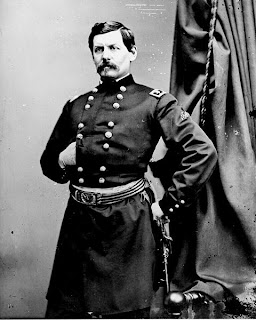
Slotkin uses The Long Road to Antietam to describe George McClellan as arrogant, narcissistic, neurotic, devious, timid, incompetent, and altogether, one really bad dude.


Basically, he is Scar from the Lion King.


Each one is an evil character, intent on seizing power from the good guys (either Lincoln or Mufassa) and using it for their own nefarious schemes. Also, each one has facial hair, so, there is that too.


Scar from "The Lion King"


George Brinton McClellan


See the similarities, right?


Students of the Maryland Campaign are no doubt familiar with Stephen Sears, author of Landscape Turned Red, the most widely read book on the Battle of Antietam. Sears is well known as being very critical of George McClellan. Yet, despite Sears's harsh judgments on McClellan, even he believes it is beyond the pale to question the motives and sincerity of the general. As Sears wrote in an essay collection on the Army of the Potomac:


 "Whether at headquarters or on the battlefield or in the political arena, in defeat and disappointment, George McCelllan never wavered in his determination to put down the rebellion. Historians will no doubt continue to debate his exact contribution to that cause, but they have no cause to deny the sincerity of his efforts." (Sears, "Little Mac and the Historians" in Controversies and Commanders, 24).

In The Long Road to Antietam, Richard Slotkin suggests throughout the book that George McClellan was a general more concerned with his political reputation and future than victory on the battlefield, coming close to, if not crossing the line of, accusing the Union general of treason numerous times.


Repeatedly, Slotkin argues that McClellan cared far more about his reputation in Washington than about the rebel army in Maryland. In fact, he suggests that the only reason McClellan wanted to achieve a victory in the Maryland Campaign was to stick it to Stanton and Halleck and to possibly rise to become the leading figure in the war effort once again. He singles McClellan out as arrogant and nefarious, leaving the reader with an impression of McClellan as a commander more interested in political intrigue than in affairs on the battlefield. In one of the harshest and most peculiar knocks against McClellan, Slotkin argues that the Union commander issued no written orders at Antietam to protect his reputation should the battle go poorly:


McClellan not only limited the forces he entrusted to his assault commanders, he did not fully inform them of the tactical plan for the battle they were about to fight. His refusal may have reflected, and been intended to conceal, his indecision about where and how to strike his heaviest blows. It is also possible that he refused to discuss his plans with his subordinates, and declined to issue written orders, so that no one—neither his colleagues nor his rivals—would know whether his plans had been well—or ill—conceived. His defensive position had to be impregnable on both fronts. (247)


Slotkin is arguing that McClellan did not issue written orders either because he was indecisive (with no proof or explanation as to why) or to protect himself from politicians in Washington (ie. Should the army lose, his orders would not be used against him, with Washington being the second front referred to). This theory goes beyond the normal complaints about McClellan being “slow” or “incompetent,” and ventures into the realm of accusing the general of paranoia, and treachery. To suggest that McClellan would put his soldiers’ lives at risk by knowingly holding back written orders simply to protect himself politically, and to do so without any supporting evidence is an egregious claim that does an enormous injustice to our understanding of both George McClellan and the Battle of Antietam. Slotkin is no doubt not the first to make such accusations, but they are still misguided and incorrect.


Rather than Slotkin's arguments about McClellan's tactical decisions being motivated by political intrigue, let's have a look at the explanation for the lack of written orders put forward by historian Ethan Rafuse in what I consider to be the best book published about George McClellan at Antietam.

McClellan has been criticized for not issuing written orders or providing explicit verbal guidance to his subordinates laying out his intentions prior to the battle. This was a consequence of McClellan’s desire—a commendable one given the unknowns he faced—to maintain flexibility as the fighting developed and avoid committing himself to a course of action that circumstances might prove unwise. (Ethan Rafuse, McClellan's War, 310)


Rafuse’s explanation of why McClellan did not issue written orders does not rely on an interpretation of McClellan as a psychotic general worried about his reputation in Washington over his troops in the field. Instead, it takes McClellan for who he was; a highly intelligent, competent, motivated, and loyal commander who realized that he was facing a fierce opponent in Robert E. Lee, and that the future of the country was in the balance at the Battle of Antietam. Thus, McClellan wanted to ensure that he would not be cornered into a plan which would become obsolete the moment the guns began firing. 


Another major strain of Slotkin's critique of McClellan is that he believed that he, and ONLY HE, had the key to winning the war. This point brings up a few important questions.


Did Robert E. Lee drive Confederate strategy because he believed he knew what was best and how to win the war? Yes, and at a great and detrimental cost to the Confederacy. Lee's intense focus on the East, and on launching two aggressive invasions, cost his army crucial manpower and deprived the Confederate forces in the West of valuable resources and attention that contributed to the loss of the most important strategic points in the entire Confederacy.

Did Sherman believe that his "hard war" on Southerners was the only way to win the Civil War? Yes. He wrote voluminously to that effect. Did Grant believe that his strategy of driving toward Richmond in 1864 was the only way to defeat the Confederacy? Yes, and he pushed forward regardless of the chorus of cries in the North that he was a butcher wasting the flower of American youth on the fields of Virginia in a futile attempt to win the war.


The difference between McClellan and these generals is that he strongly disagreed with his superior in trying to carry out his strategy. Slotkin's argument that McClellan's belief that he alone knew how to win the war is misguided, as that was true for many officers. McClellan's difference is that he did not agree, or get along with, his Commander in Chief, where the other aforementioned generals did.


Historians must understand the disagreement between McClellan and Lincoln for what it was. Slotkin suggests that McClellan went so far as to foster a treasonous atmosphere in his headquarters, yet this was far from the truth. McClellan was true to the Union, and wanted to serve his country. He had political disagreements with Lincoln. He disliked Lincoln's strategy. He disliked Emancipation. As a result, he did not actively pursue Lincoln's goals for the war, which led to his removal from command in November of 1862. While McClellan's disagreements with Lincoln were not appropriate and he certainly deserved to be fired, there was nothing treacherous about this.


For those interested in a new and refreshing book on the Battle of Antietam, Abraham Lincoln, and George McClellan, The Long Road to Antietam is yet more of the same old McClellan bashing. It is a scathing indictment of George McClellan as a general, using errors and myths as evidence. Looks like the Merry-Go-Round of debate and controversy over George McClellan is still spinning away.


All things considered, you might be better off simply watching the Lion King.

Thursday, July 12, 2012

Edwin V. Sumner to his wife, September 20, 1862: "I think I was never in such a fire as when that division broke"

Here is another recent find from my research in various collections in the Manuscript Division of the Library of Congress. The below is the transcript of a letter which Major General Edwin V. Sumner, commander of the Second Corps of the Army of the Potomac at Antietam, to his wife three days after Antietam. It is very candid and informal, and he relays his thoughts on the recent battle, as well as Union strategy going forward from Antietam.


My own dear Wife,
The battle is over and we are safe. The enemy has fled from Maryland and I do not think we shall meet them again for some time, for it will take a little time to make preparations before we pursue them. It was a terrific battle. Some generals under my command were wounded. Mansfield was killed early in the action. He had only had command of his Corps two days, that corps (Banks) is under my command and in addition to my own. I did not like the way in which the troops were put into battle. They went in corps after corps instead of being all forward in battle array before we engaged.
On the right Hooker went [forward], and then my second corps under Mansfield and then my own corps. The consequence was that we were not strong enough—Sedgwick was wounded and his division broke and never did I have to make such exertion as I did to rally that division. I succeeded finally and got them again into line and held my position.
The enemy fought like maniacs to give you an idea of it. Nineteen of their men lay dead about a piece of artillery that one of my batteries knocked to pieces.—Two of my staff were wounded. Col. Revere and young (illegible). They have both gone home.
Our dear boy behaved splendidly. He was much more anxious about me than about himself—he was as cool and manly as an old veteran.
Col. Revere left before he knew the fate of his brother the doctor, he was shot through the heart and killed instantly, but it was not known till the next day. I have sent his remains home in charge of an officer. The battle has been unequally fatal to officers, and especially to those of high command. I think I was never in such a fire as when that division broke—I was obliged to shout in such a way that I could not speak loud for some time afterwards—We have been on the field ever since the battle but today I have got the command a little more comfortably fixed, and we are all enjoying the rest.
I don’t know what their plans will be—I think everything we can raise should be pushed upon them at once and grind them to powder—If there should be a pause in the operations I will come home, dear, and rest for I do feel that I need your care and love.
Fatherly love to all
Dear father,
E
(Sumner Family Papers, Box 1, Library of Congress, Manuscript Division)

This letter fascinates me on many different levels. First off, it is a personal note from Sumner to his wife just after the battle, relaying to her his private thoughts on the fighting at Antietam. Seeing his descriptions of his son's conduct in battle is particularly interesting in this regard. For Sumner, escaping combat unscathed was not just about him, but about his son as well. His closing lines about hoping to come home soon for her love and care are particularly moving as well.

In regards to the battle itself, Sumner's letter adds some colorful descriptions of the fighting involving Sedgwick's division in the West Woods. By describing how loud he was yelling when trying to rally the men, the letter provides an excellent personal account of what the West Woods fight was like for the 2nd Corps commander that morning. When over 7,000 Confederate slammed into Sedgwick's left flank, the route was on, and it was all Sumner could do to save himself and attempt to salvage what was left of the division he had led so confidently into the woods just a few moments before.
Also, his comment objecting to the piecemeal manner in which troops were committed that day holds true to his reported impatience on the morning of the 17th. While the 1st and 12th Corps were plunging into battle, Sumner was still at McClellan's headquarters awaiting his go ahead to take his corps across the creek.

Sumner's comments regarding the necessary time it would take to regather the army after the battle are illuminating as well. It highlights the exhausted nature of the men following the fight, something which many armchair general historians too easily forget. I really like his line regarding his desire to "grind them to powder." It certainly displays his firm resolve to end the war and the rebellion sooner rather than later. 

It is also worth making a point of clarification. Sumner writes of having two corps under his command. During the advance of the Army of the Potomac from Washington, Sumner commanded the army's center wing, consisting of his 2nd Corps and the 12th Corps, formerly the 2nd Corps of the Army of Virginia, previously commanded by Nathaniel Banks (the corps formally switched its designation on September 12). The right wing consisted of the 1st and 9th Corps, and was commanded by Ambrose Burnside, and the left wing consisted of the 6th Corps and Darius Couch's 4th Corps division, and was commanded by William B. Franklin. By the time the army reached the banks of Antietam Creek, this three wing formation was all but dead: the 1st and 9th Corps were on opposite ends of the battlefield, and on the night of the 16th, the 12th Corps was sent across the creek without its 2nd Corps counterpart for the center wing. Indeed, at the start of the battle, only Franklin's wing of the army was still together, being located several miles away in Pleasant Valley. Thus, despite demise of the three wing command by the time the opening guns were firing at Antietam, Sumner was still writing as though he was still the commander of the center wing of the army (both his 2nd Corps and the 12th Corps) three days after the battle.


Saturday, May 26, 2012

"Heroism needs no label to proclaim its quality."


I wanted to take a moment to post a few lines from an address given by Frederick Hitchcock, a Major with the 132nd Pennsylvania Volunteer Infantry, who was present for Pennsylvania Day at Antietam and the dedication for the 132nd Pennsylvania Monument on September 17, 1904. I think you will find the words to be very moving; they certainly fit well with our nation's Memorial Day commemorations this weekend. The 132nd Pennsylvania was one of the many "green" regiments in the Union army at the Battle of Antietam. These men received their baptism by fire on the hills and fields surrounding Bloody Lane on September 17, 1862. Out of roughly 750 present, the 132nd Pennsylvania suffered 152 casualties. Years later, as the survivors gathered once again to commemorate and honor the sacrifices of their comrades in arms, Major Hitchcock delivered these remarks. He began with introductions, thank yous, and other pleasantries; once he finished with setting the scene, Hitchcock set out upon the primary purpose of his speech, to remember the sacrifices of so many soldiers so long ago....


 132nd Pennsylvania Monument at Antietam


The richest possession of any people is its heritage of noble deeds and heroic sacrifices.


Human freedom has ever been attained and maintained at the cost of blood and treasure. The world is full of the graves of patriotic martyrs. Our comrades who fell here, joined the illustrious throng of the world’s heroes. Their noble spirit was well voiced by the intrepid former Captain of the Revolution, Nathan Hale, when he said, standing under the halter in the very shadow of death, “I only regret that I have but one life to give for my country.”


Heroism knows no rank or station. It exalts all to the highest plane… And when amidst the wild clangor of war, or upon the lonely picket line, in hospital or prison pen, a noble life is immolated upon the altar of Liberty, the supreme sacrifice has been made, the spirit is the same. In every instance the hero has earned immortal honor. Heroism needs no label to proclaim its quality. Wherever found it exemplifies the richest and noblest characteristics of humanity. It is said the blood of the martyrs is the seed of the church. Not less true is it, that the blood of patriots always and everywhere has been the  seed of civil and religious liberty….


If, like our forefathers, it was ours to pass through ‘days which tried men’s souls,” in the service of our country, like them we have been permitted to reap richly of the harvest of victory, and far over and beyond them, we have seen our beloved country emerge from her struggle for life, purged of the cancer of slavery which produced it, and advance gloriously step by step to the very forefront of the nations, until today “Old Glory” not a stripe erased nor a star dimmed, the Emblem of liberty, the hope of humanity, kisses the morning breeze all around the world.


But my comrades and fellow citizens we may not rest upon past achievements… It was ours to be faithful and true here, let it still be ours to remain faithful and true yonder. The final battle for our country has not yet been won. Her hundred and twenty-eight years of existence are, let us hope, scarcely more than her infancy. If she is to enjoy a nation’s life, she is no only on the borderland of her youth. Her future is in the hands of her sons today, one may well pause with fear, when he beholds the shoals and rocks which loom upon in the track of our ship of state, but far be it from me, under the inspiration of these scenes, to utter one discordant note of prophecy. The blood shed here shall not have been poured out in vain. Her sons of the future will rise and meet new dangers as they appear, and our country shall move grandly forward meeting the coming generation with the message of old Liberty Bell still voicing her destiny, now swelling into a grander anthem, and proclaiming liberty throughout the wide world ‘to all the inhabitants thereof.’”

Hitchcock went on to describe the statue, which depicts a lone color bearer holding the American flag, moving forward toward the guns of the enemy: 

And now in concluding this grateful service, we leave this mute but eloquent statue, a representation of one of the color bearers of this regiment, still holding aloft his flag though the staff has been shot away. The scene is true to life.

Let it speak to coming generations of duty well done. Let its radiant heroic figure be a type of the true American citizen-soldier—ever inch a man, true to his country; ever ready to bare his breast to her foes; undismayed by difficulties; undaunted by danger and unyielding in duty, though death be the cost.


Hitchcock's address reminds us of the character of the American soldiers whom we honor this Memorial Day: "undismayed by difficulties, undaunted by danger, and unyielding in duty, though death be the cost."


Friday, May 25, 2012

"Pray the Lord that this war may soon end": R. W. Benton of the 14th Connecticut Infantry

As we enter Memorial Day weekend, many of us will think only of a day off of work, cookouts, baseball games, and relaxation. Millions of Americans will forget why it is that we are taking a weekend to watch a parade or fire up the grill. I haven't been very active on here over the past few weeks, as I have spent much of my time either working at the park or working on my research, but I wanted to share a few letters from a man who was at Antietam, as they serve as a reminder of what this country has gone through to enjoy the freedom we all know as Americans.

Raphael Ward Benton served with the 14th Connecticut Infantry, a regiment which was raised in Hartford in August of 1862. The men of the 14th Connecticut were just a few of the many soldiers in the Army of the Potomac for whom Antietam was their first battle. Benton's letters were written to his wife. Typed transcript copies of the letters can be found in the park library's unit file for the 14th Connecticut. They begin with a letter sent home on August 31, 1862, from Fort Ethan Allen, outside of Washington.


Fort Ethan Allen
August 31, 1862
My Dearest Wife,
Although it is the Sabbath there is no preaching here as it is raining. So I spend the time writing to you. First of all I say I am quite well though I think when I tell you the circumstances you will think it strange. Before noon the day that I wrote you last we were ordered to march for Camp Chase which is as near as I can judge not far from six miles from Washington on the Virginia side. So we shouldered our duds and started. It was uncomfortably hot and dusty beyond all reason but a soldier has no business to be tired or complain, we reached there about six o’clock perfectly dripping with sweat, covered with dust less than an inch thick, actually the dust rose in such clouds that men and horses could not be seen at a distance of more than from ten to fifteen rods according to circumstances a great part of the way. Some of our strongest men—George Hall of N.G. was one—were obliged to have their knapsacks put on board of baggage wagons and hardly reached camp at that but somehow my strength held out wonderfully. We pitched our tents and were soon sleeping soundly on the ground beneath hoping to have a good night’s rest but in this we were disappointed for a three a.m. on Friday we called out our guns and ammunition distributed in the dark and with as little noise as possible, we were then given two crackers apiece and a cup of coffee, a rubber blanket and ordered to march we knew not whither, after marching awhile we were informed that it was supposed the rebels were intending to make a demonstration at Chain (?) Bridge some six miles above on the Potomack (sic). We reached that place before noon some of our men behind who were to (sic) tired to go with us, not finding the rebels at that place we were marched two or three further in a westerly direction almost all the way up hill to Fort Ethan Allen where we were directed to (encamp) outside the Fort and in case of attack occupy the rifle pits and here we have remained until the present time and how much longer may I cannot tell neither do I care if we could be made comfortable but as it is with our tents knapsacks blankets and overcoats we know not where, with nought to sleep on but the ground and nothing to cover us but the heavens and a rubber blanket , a wet day and the prospect of a wet night, with nothing to eat but bread and salt pork eaten raw or roasted in the fire on the point of a stick, with no coffee that is decent, we cannot be expected to be quite satisfied. But we hope for better things. Yesterday, we heard the booming of cannon almost all day, and it is reported that there has been another great battle fought terminating in our favor. You will probably know the truth sooner than we. George Hall, Odelle Chittenden, and Henry B. Dudly we left about tired our and when we arrived here several of our men were nearly exhausted. Henry Parmelie went to the hospital today but I think he is not dangerously sick, ditto Samuel Seward, Oliver Evarts also I am afraid will give out. But we hope for the best. We think and talk of and about the friends we love at home very very often and wish to be with them, but if it is the Lord’s will that we reamin (sic) here we are willing although we may be called to do and suffer. I hope and trust that you will daily pray for our reunion but if we meet not here I hope we meet in a better world where partners are unknown.
Yours truly,
R.W. Benton. 


Fort Ethan Allen
Friday, September 5, 1862
My Dearest Wife,

You will perhaps wonder why you have not heard before but there is difficulty in the way of my writing often that are (sic) not easily understood by those not used to Camp life. I consider it a great privilege to be able to write without molestation, but if could only leave this poor body in our tent and transport myself by telegraph or some other way to Ward Benton’s kitchen and sit down with my wife and family one short hour it would make me inexpressibly happy. My health still holds out, in fact I am healthier than at home and I wish I could hear as much from you. I hope you will write before long. I will give your (sic) my address at the close of this letter. I want you to write all how you get along in the house and out the door…I hope you all will succeed in being a blessing to each other and receive the blessing and favor of God who can and will make all things to work together for good to those who love Him....

“Dinner is now ready and I must close, I suppose it will be boiled ham which if well cooked is good enough as it is not the best. Not please write all of you when you can and tell any of my friends I would like to hear from them. Pray often that I may be returned safe home.”

 R.W. Benton


Camp Defiance
Sept. 7, 1862
I spent the few moments I have to spare in giving you a little information on our whereabouts and state generally. We had supposed that we were to stay at Fort Ethan Allen, but Sunday just as we were preparing to attend divine service there came a report that Stonewall Jackson was crossing into Maryland at Harpers Ferry and we received orders to march posthaste to Rockville, Md a little this side. So we packed up our blankets, took our guns, and a little past noon began to march. We marched all the afternoon and half of the night stopping occasionally to rest. About 2 in the night we bivouacked till sunrise and then commenced marching again reaching this place a little past noon pretty well tuckered I tell you, but it is was surprising how soon we got rested today—Tuesday—we feel quite current again. We have had not fighting to do yet, and where we shall be called to next I cannot tell. I wish you would not trouble yourself in my account as I am getting along quite well, much better than I expected—yesterday I felt a little of my old bowel complaint, but feel better today. When you write tell me how Arthur gets along with his farming and about your home affairs generally. I write a short letter for want of time, but not of inclination. Fiske remarked at night he would like his wife’s night cap with her in it. I second the motion. Your loving and never forgetful husband.

R.W. Benton


Clarksville, MD 
Sept. 11, 1862

The day I wrote you we again had marching orders. We bivouacked in night before last and also last night today we are in this and it is rumored that there is a prospect of a battle but I think it quite doubtful as there are so many untrue stories in circulation. I am at the present moment sitting in company with S.D. Crittenden in the commissary wagon. Last night I was quite weak on account of my bowel complaint and got excused by the surgeon from any duty but marching and happening to get a chance to ride I took advantage of it and now the army is a mile or two ahead. I feel better now and as I am afraid of being blamed I think I shall go on and overtake the Regiment this afternoon. I am told we are about half way from Washington to Harpers Ferry. As a number of the other men have been affected similarly to myself and after recovering were healthier than before to be affected in the same way myself. At least I am not discouraged yet. I should have started out before now—2 o’clock—but it rains and I preferred to run my risk and wait a little longer. And now my dearest wife I cannot but express to you my full conviction that if I ever should reach home you will all seem nearer and dearer to me than before. But some things that I expected to miss very much I find I can do very well without. For instance, I think that although the ground is very hard to sleep on at first if I ever return home and it was not for the musketos [sic] I would prefer sleeping on it to all the soft beds in the world and as for the musketoes [sic] there is none here. I can write no more now and don’t  know as I can send this. Yours now at all times and till death—for which I pray often that I may be prepared.

R.W. Benton


September 17, 1862
My Dearest Wife

I hardly know how or what to write for we have been marched from one place to another with such rapidity that I have almost forgot the day of the week and month and everything else but I can assure you I have seen all of the horrors of war that I ever wish to and I sincerely hope that it will soon be over. Tuesday night—I believe—when we were lying at Yatesville (Keedysville) we had ninety rounds of ammunition dealt out to us and we were told we would soon be called to use it. Wednesday we lay along behind the hill where we were Tuesday a severe battle going on all the time the shot and shells flying around us thick and fast but fortunately none of us were hut. But soon we were called on to march on to the field about a mile distant. We were soon in battle array and charging along through fields of corn. The enemy commenced pouring in on us a tremendous fire—the shots fell like hail in a few minutes I was struck by a Minnie ball in the side of my neck several of my comrades laid me on my blankets and carried me from the field since that I have been lying with the other wounded in a  field about a mile distant where I with some difficulty walked—I think my wound is not a bad one but I bled so much and being rather weak before I have but little strength but I begin to feel better and hope soon to be able to be about. I hope you will not be discouraged about me. I am so much better off than hundreds of others I feel great cause for thankfulness. Richard Hull was shot dead at least so the other boys told me. Poor man! E. I. Field was badly wounded and died last night. The other Guilford men I have not heard from. Oh you don’t know the dreadful scenes we have passed through. The dead, the dying, and wounded are lying all around me, and I think may about to thousands. Pray the Lord that this war may soon end. We have it is said gained a great victory, at least—we have plenty of prisoners. They almost all say they are willing to give up but the officers will not permit it. Ozias Leffingwell and Wm. Jones of North Madison have taken care of me they are both very kind. They lent me this paper. Mine is all lost and everything else I brought with me.

Yours affectionately,

R.W. Benton


For Raphael Benton, who prayed that the horrors of war would soon end, the war ended at Antietam. In the days following the battle, he suffered in a field hospital, eventually walking over 20 miles to Frederick with other wounded soldiers who sought help. His wounds and the trip to Frederick combined to be too much for him to handle; on September 25, 1862, Benton died in Frederick, Maryland. His much hoped and prayed for reunion with his wife was not to be. The following letter was written by one of Benton's friends.


Sept  26, 1862, Frederick, MD

Dear Friends,

I once more sit down to write sad news to you. Mr. Benton is dead. He died last night at 6 o’clock. I have been staying with him since I found him in the hospital. We did not think his condition immediately dangerous unless he should take to bleeding. The Dr. told me to watch the wound and if it set to bleeding he would not stand it long. But it had not bled since and the nurses thought he might get along. He has never complained of the wound but of pain in his limbs. I have stayed by him and rubed [sic] him with liniment. He thought I could cure him if I could be allowed to stay with him. He seemed to [get] be easyer [sic] throughout the day. He would look at me and say , “Oh, Henry you can’t think how much better I feel. If you can stay with me I shall get along first rate.” But it proved to be that he was Dyeing [sic] gradualy [sic]. He passed away without a struggle at 6 o’clock last night. I held his hand in mine and he appeared to know me long after he could speak. I would speak to him and he would answer by a slight pressure of the hand. The Doctor says his death was probably caused by not being taken care of. HE was allowed to walk here from the Battlefield. The day he arrived here he had walked 8 miles and had lost so much blood that he was very weak…
I took the things from his packets [sic] and have kept them myself. HE had about Twenty dollars with him. I have had to use some four dollars sending telegraph dispatches and probably may have to more as I have spent nearly all of my own. I thought likely you would be anxious to get the body brought home, but find it cannot be unless it is embalmed and enclosed in a matalic [sic] coffin which will cost some $80.00 Dollars and the Express Company charges some $25.00 which makes a cost of $105.00. This I could not do and I did not know what you thought about it so I Telegraphed last night to find out. I shall come on with it if it means I get a pass. If I do not, I will send his things the first opportunity. I will write again soon fi I do not come and let you know about it. If I do not send the money to you I will write to our folks and have them pay it do you.

From your true friend,

Henry B. Dudley

This weekend, as we go about our busy lives, seeing friends, concerts, and enjoying barbeque, remember that it is because of men like Raphael Ward Benton of the 14th Connecticut, who died from his wounds at Antietam, never getting to speak with or see his beloved wife again, that we have the freedom to enjoy all that we have today.

Here is wishing all of you a safe and happy Memorial Day weekend, where I hope every American will pause to remember those who gave their lives that this nation might live.

Wednesday, May 16, 2012

Antietam Generals: Truman Seymour


Truman Seymour

Born: September 24, 1824, Burlington, Vermont
Died: October 30, 1891, Florence, Italy


As a member of the famed West Point Class of 1846, Truman Seymour was in good company among Civil War commanders. Many of those in his class would join him along the banks of Antietam Creek for America’s bloodiest day on September 17, 1862. Born in 1824 to a Methodist preacher in Vermont, a young Truman Seymour attended Norwich University for two years before heading to the U.S. Military Academy. Upon graduation, Seymour became an artillery officer. He was brevetted a First Lieutenant and Captain during his service in the Mexican War, and he also saw antebellum action against Florida’s Seminole Indians in the latter 1850s. 


Brigadier General Truman Seymour (www.generalsandbrevets.com)


Seymour has the distinction of being one the men inside the walls of Fort Sumter when, on April 12, 1861, Confederate artillery lit up the sky over Charleston Harbor, initiating the American Civil War. Following the fort’s surrender a few days later, Seymour spent the next year aiding the effort to recruit and raise a Federal army large enough to put down the rebellion. On April 28, 1862, he was made a Brigadier General of Volunteers. Initially, he commanded a brigade in George McCall’s division of the 5th Corps; when McCall was taken prisoner at the Battle of Glendale on June 30, 1862, Seymour temporarily took over the division. During the Second Manassas Campaign, Seymour returned to his brigade command because John Reynold’s had taken command of the division, which was attached to the 3rd Corps of the Army of Virginia, under John Pope. When George McClellan went about reorganizing the Washington defenses following the abysmal Federal defeat at Second Manassas, Seymour’s brigade, along with the rest of his division and the 3rd Corps of the Army of Virginia, became the 1st Corps of the Army of the Potomac. Its new commander would be Major General Joseph Hooker.


During the Federal advance into Maryland, the 1st Corps, along with the 9th Corps, formed the right wing of the Union army. It was this wing which was used in attacks against Frosttown, Turner’s, and Fox’s Gaps during the Battle of South Mountain on September 14, 1862. During this fight, Seymour’s Pennsylvania troops distinguished themselves well, overcoming difficult and impeding terrain, driving Confederates under Robert Rhodes off of ground north of Turner’s Gap on South Mountain. By nightfall, Seymour’s brigade had played a key role in an incredibly important Federal victory.


Several days later, at Antietam, it was Seymour’s men who were first engaged against Lee’s defensive lines outside of Sharpsburg. After arriving on the eastern banks of Antietam Creek, McClellan sent the 1st Corps across the Upper Bridge at mid-afternoon on September 16. Once across the bridge, Hooker advanced his corps west so that he would be positioned north of Lee’s left flank. That evening, as Federal forces closed in on Confederate pickets and defensive lines, Seymour’s brigade came into contact with the Confederate division of John Bell Hood in the East Woods. The skirmish fire was brisk, and continued until dark, when both sides settled in to await the break of dawn, when their battle would begin in earnest.


 Carman map showing Seymour's brigade at daybreak on the 17th

When the sun rose the next morning, Seymour’s men continued their fight against the Confederate line, only now, they were engaged with part of Alexander Lawton’s division; specifically, the brigade of Isaac Trimble, along with the brigade of Roswell Ripley, belonging to D.H. Hill’s division. After the first half hour of fighting, Seymour’s brigade began to withdraw, as the rest of the 1st Corps was beginning its assault through the famed Cornfield. Seymour's men remained in the East Woods, or north of the East Woods for the remainder of the day. Later, when Major General Joseph Hooker was wounded, Brigadier General George Meade assumed command of the corps, leaving the division to Seymour for the time being.


 Carman map showing action between 6 and 6:30 a.m.


Seymour’s Brigade at Antietam

1st Pennsylvania Reserves: 27 casualties

2nd Pennsylvania Reserves: 34 casualties

5th Pennsylvania Reserves: 10 casualties

6th Pennsylvania Reserves: 69 casualties

13th Pennsylvania Reserves: 25 casualties

Total: 155 casualties


George Meade’s Division at Antietam:

2855 Present (Ezra Carman Number), 573 casualties (20% casualties)


For his actions at South Mountain and Sharpsburg, Seymour was brevetted first a Lieutenant Colonel and then a full Colonel in the regular army (a distinction existed between a rank in the volunteer army and the regular army; thus, by being brevetted a Colonel in the regular army, Seymour was promoted in rank, despite holding an appointment as a Brigadier General of Volunteers)


Following Antietam, Seymour was sent south once again to Charleston Harbor. There, on July 18, 1863, he oversaw the famed attack against Fort Wagner, where the legendary 54th Massachusetts led the way and suffered near 50% casualties, including their colonel, Robert Gould Shaw (Captain, 2nd Massachusetts at Antietam), who was killed that day. During this assault Seymour was wounded, but he would survive. Later that year, he commanded troops at the Battle of Olustee, the biggest Civil War battle to be fought in the state of Florida.


In May of 1864, Seymour came back to the Eastern Theater of the war. He was captured at the Battle of the Wilderness, and then part of a prisoner exchange that August. Following his exchange he again became a division commander and saw action in the Shenandoah, at Petersburg, and at Appomattox. At the end of the war, he was brevetted a Major General in both the regular and volunteer armies. In 1866, he was given command of the 5th U.S. Artillery, which he held until 1876, when he retired and left the United States. Seymour lived out his remaining days in Florence, Italy, until he died in 1891. While he was buried in Italy, his wife lived on until 1919 when she passed away and was interred at West Point.