Our Country's Fiery Ordeal

A blog about the American Civil War, written and maintained by historian Daniel J. Vermilya, author of The Battle of Kennesaw Mountain (History Press, 2014) and James Garfield and the Civil War (History Press, 2015)

Dedicated to my great-great-great grandfather, Private Ellwood Rodebaugh, Company D, 106th Pennsylvania Volunteer Infantry, killed at the Battle of Antietam, September 17, 1862.

"And may an Overuling Providence continue to cause good to come out of evil, justice to be done to all men where injustice has long prevailed, and finally, peace, quiet, and harmony to come out of this terrible confrontation and our country's fiery ordeal." -- Albert Champlin, 105th Ohio, Diary entry of June 19, 1864 (Western Reserve Historical Society)

Showing posts with label Confederate Soldiers. Show all posts

Wednesday, February 20, 2013

"The Dead Angle": The Confederate Perspective

One of the best things about studying Civil War history is reading the words of the men who fought the war themselves. Among those works, Private Sam Watkins memoir, "Company Aytch", is one of the finest written by any participant of the war. Watkins has provided generations of historians and students of the war a first hand account of the fighting in the West.

On June 27, 1864, the fiercest fighting at Kennesaw Mountain was actually just south of the mountain itself, on a hill just off of the Dallas Road. Today, that hill is known as Cheatham Hill, after Confederate General Benjamin Cheatham. This was the bloodiest spot on the battlefield that day, and it is a haunting place to this day. The fighting was worst at a place where the Confederate lines formed a slight angle, known afterwards as "The Dead Angle." This is where Union Colonel Dan McCook led his brigade uphill against entrenched Confederates. Among those Confederates was Sam Watkins.

I would equate the feeling at Cheatham Hill with the same feeling I get every time I visit the Mule Shoe at Spottsylvania, the fields of Pickett's Charge at Gettysburg, the Hornet's Nest at Shiloh, the Deep Railroad Cut at Second Manassas, and the Cornfield at Antietam. Somewhere in the back of my mind, I keep telling myself, "Something terrible happened here." While that is certainly the case at every Civil War battlefield, some sites just seem more haunting because of the especially fierce brutality of what occured there. At Cheatham Hill, Union soldiers were pinned down by Confederate fire for days after their charge. Men died out in the Georgia sun. Fire broke out among the brush, burning men alive. It was a thoroughly brutal and unforgiving place.

The fight at Cheatham Hill is for me the most intruiging aspect of the Battle of Kennesaw Mountain. It is one of the things we will look at on this blog as I write my book. This post, using the words of Sam Watkins, serves as a way of looking at the fighting there from the Confederate perspective.


Looking up toward the Deal Angle. The Confederate works were built just behind the crest of the hill. On the crest itself sits the Illinois monument, dedicated on June 27, 1914.

"DEAD ANGLE"

The First and Twenty-seventh Tennessee Regiments will ever remember the
battle of "Dead Angle," which was fought June 27th, on the Kennesaw line,
near Marietta, Georgia. It was one of the hottest and longest days of
the year, and one of the most desperate and determinedly resisted battles
fought during the whole war. Our regiment was stationed on an angle,
a little spur of the mountain, or rather promontory of a range of hills,
extending far out beyond the main line of battle, and was subject to the
enfilading fire of forty pieces of artillery of the Federal batteries.
It seemed fun for the guns of the whole Yankee army to play upon this
point. We would work hard every night to strengthen our breastworks,
and the very next day they would be torn down smooth with the ground
by solid shots and shells from the guns of the enemy. Even the little
trees and bushes which had been left for shade, were cut down as so much
stubble. For more than a week this constant firing had been kept up
against this salient point. In the meantime, the skirmishing in the
valley below resembled the sounds made by ten thousand wood-choppers.


Well, on the fatal morning of June 27th, the sun rose clear and cloudless,
the heavens seemed made of brass, and the earth of iron, and as the sun
began to mount toward the zenith, everything became quiet, and no sound
was heard save a peckerwood on a neighboring tree, tapping on its old
trunk, trying to find a worm for his dinner. We all knew it was but the
dead calm that precedes the storm. On the distant hills we could plainly
see officers dashing about hither and thither, and the Stars and Stripes
moving to and fro, and we knew the Federals were making preparations for
the mighty contest. We could hear but the rumbling sound of heavy guns,
and the distant tread of a marching army, as a faint roar of the coming
storm, which was soon to break the ominous silence with the sound of
conflict, such as was scarcely ever before heard on this earth. It
seemed that the archangel of Death stood and looked on with outstretched
wings, while all the earth was silent, when all at once a hundred guns
from the Federal line opened upon us, and for more than an hour they
poured their solid and chain shot, grape and shrapnel right upon this
salient point, defended by our regiment alone, when, all of a sudden,
our pickets jumped into our works and reported the Yankees advancing,
and almost at the same time a solid line of blue coats came up the hill.
I discharged my gun, and happening to look up, there was the beautiful
flag of the Stars and Stripes flaunting right in my face, and I heard
John Branch, of the Rock City Guards, commanded by Captain W. D. Kelly,
who were next Company H, say, "Look at that Yankee flag; shoot that
fellow; snatch that flag out of his hand!" My pen is unable to describe
the scene of carnage and death that ensued in the next two hours.
Column after column of Federal soldiers were crowded upon that line,
and by referring to the history of the war you will find they were massed
in column forty columns deep; in fact, the whole force of the Yankee army
was hurled against this point, but no sooner would a regiment mount our
works than they were shot down or surrendered, and soon we had every
"gopher hole" full of Yankee prisoners. Yet still the Yankees came.
It seemed impossible to check the onslaught, but every man was true
to his trust, and seemed to think that at that moment the whole
responsibility of the Confederate government was rested upon his
shoulders. Talk about other battles, victories, shouts, cheers, and
triumphs, but in comparison with this day's fight, all others dwarf
into insignificance. The sun beaming down on our uncovered heads, the
thermometer being one hundred and ten degrees in the shade, and a solid
line of blazing fire right from the muzzles of the Yankee guns being
poured right into our very faces, singeing our hair and clothes, the hot
blood of our dead and wounded spurting on us, the blinding smoke and
stifling atmosphere filling our eyes and mouths, and the awful concussion
causing the blood to gush out of our noses and ears, and above all,
the roar of battle, made it a perfect pandemonium. Afterward I heard a
soldier express himself by saying that he thought "Hell had broke loose
in Georgia, sure enough."


Remnants of earthworks built by Union soldiers who came close to the Dead Angle and stayed there because they were pinned down by Confederate guns

I have heard men say that if they ever killed a Yankee during the war
they were not aware of it. I am satisfied that on this memorable day,
every man in our regiment killed from one score to four score, yea,
five score men. I mean from twenty to one hundred each. All that was
necessary was to load and shoot. In fact, I will ever think that the
reason they did not capture our works was the impossibility of their
living men passing over the bodies of their dead. The ground was piled
up with one solid mass of dead and wounded Yankees. I learned afterwards
from the burying squad that in some places they were piled up like cord
wood, twelve deep.


The Illinois Monument
 
After they were time and time again beaten back, they at last were
enabled to fortify a line under the crest of the hill, only thirty yards
from us, and they immediately commenced to excavate the earth with the
purpose of blowing up our line.


The trenches where Watkins and his fellow Confederates fought

We remained here three days after the battle. In the meantime the woods
had taken fire, and during the nights and days of all that time continued
to burn, and at all times, every hour of day and night, you could hear
the shrieks and screams of the poor fellows who were left on the field,
and a stench, so sickening as to nauseate the whole of both armies,
arose from the decaying bodies of the dead left lying on the field.

We remained here three days after the battle. In the meantime the woods
had taken fire, and during the nights and days of all that time continued
to burn, and at all times, every hour of day and night, you could hear
the shrieks and screams of the poor fellows who were left on the field,
and a stench, so sickening as to nauseate the whole of both armies,
arose from the decaying bodies of the dead left lying on the field.


Looking from the point of view of the Confederates toward the field through which Federals had to advance

We remained here three days after the battle. In the meantime the woods
had taken fire, and during the nights and days of all that time continued
to burn, and at all times, every hour of day and night, you could hear
the shrieks and screams of the poor fellows who were left on the field,
and a stench, so sickening as to nauseate the whole of both armies,
arose from the decaying bodies of the dead left lying on the field.

Every member of the First and Twenty-seventh Tennessee Regiments deserves
a wreath of imperishable fame, and a warm place in the hearts of their
countrymen, for their gallant and heroic valor at the battle of Dead
Angle. No man distinguished himself above another. All did their duty,
and the glory of one is but the glory and just tribute of the others.


Confederate trenches

 
After we had abandoned the line, and on coming to a little stream of
water, I undressed for the purpose of bathing, and after undressing
found my arm all battered and bruised and bloodshot from my wrist to my
shoulder, and as sore as a blister. I had shot one hundred and twenty
times that day. My gun became so hot that frequently the powder would
flash before I could ram home the ball, and I had frequently to exchange
my gun for that of a dead comrade.


Colonel H. R. Field was loading and shooting the same as any private in
the ranks when he fell off the skid from which he was shooting right
over my shoulder, shot through the head. I laid him down in the trench,
and he said, "Well, they have got me at last, but I have killed fifteen
of them; time about is fair play, I reckon." But Colonel Field was
not killed--only wounded, and one side paralyzed. Captain Joe P. Lee,
Captain Mack Campbell, Lieutenant T. H. Maney, and other officers of the
regiment, threw rocks and beat them in their faces with sticks. The
Yankees did the same. The rocks came in upon us like a perfect hail
storm, and the Yankees seemed very obstinate, and in no hurry to get away
from our front, and we had to keep up the firing and shooting them down
in self-defense. They seemed to walk up and take death as coolly as if
they were automatic or wooden men, and our boys did not shoot for the fun
of the thing. It was, verily, a life and death grapple, and the least
flicker on our part, would have been sure death to all. We could not be
reinforced on account of our position, and we had to stand up to the rack,
fodder or no fodder. When the Yankees fell back, and the firing ceased,
I never saw so many broken down and exhausted men in my life. I was as
sick as a horse, and as wet with blood and sweat as I could be, and many
of our men were vomiting with excessive fatigue, over-exhaustion, and
sunstroke; our tongues were parched and cracked for water, and our faces
blackened with powder and smoke, and our dead and wounded were piled
indiscriminately in the trenches. There was not a single man in the
company who was not wounded, or had holes shot through his hat and
clothing. Captain Beasley was killed, and nearly all his company killed
and wounded. The Rock City Guards were almost piled in heaps and so was
our company. Captain Joe P. Lee was badly wounded. Poor Walter Hood and
Jim Brandon were lying there among us, while their spirits were in heaven;
also, William A. Hughes, my old mess-mate and friend, who had clerked
with me for S. F. & J. M. Mayes, and who had slept with me for lo! these
many years, and a boy who loved me more than any other person on earth
has ever done. I had just discharged the contents of my gun into the
bosoms of two men, one right behind the other, killing them both, and was
re-loading, when a Yankee rushed upon me, having me at a disadvantage,
and said, "You have killed my two brothers, and now I've got you."
Everything I had ever done rushed through my mind. I heard the roar,
and felt the flash of fire, and saw my more than friend, William
A. Hughes, grab the muzzle of the gun, receiving the whole contents in
his hand and arm, and mortally wounding him. Reader, he died for me.
In saving my life, he lost his own. When the infirmary corps carried him
off, all mutilated and bleeding he told them to give me "Florence Fleming"
(that was the name of his gun, which he had put on it in silver letters),
and to give me his blanket and clothing. He gave his life for me,
and everything that he had. It was the last time that I ever saw him,
but I know that away up yonder, beyond the clouds, blackness, tempest
and night, and away above the blue vault of heaven, where the stars keep
their ceaseless vigils, away up yonder in the golden city of the New
Jerusalem, where God and Jesus Christ, our Savior, ever reign, we will
sometime meet at the marriage supper of the Son of God, who gave His life
for the redemption of the whole world.


Grave of an uknown Union soldier near the Dead Angle, believed to be 21 year old Mark Carr, 34th Illinois
 
For several nights they made attacks upon our lines, but in every attempt,
they were driven back with great slaughter. They would ignite the tape
of bomb shells, and throw them over in our lines, but, if the shell did
not immediately explode, they were thrown back. They had a little shell
called _hand grenade_, but they would either stop short of us, or go
over our heads, and were harmless. General Joseph E. Johnston sent us a
couple of _chevaux-de-frise_. When they came, a detail of three men had
to roll them over the works. Those three men were heroes. Their names
were Edmund Brandon, T. C. Dornin, and Arnold Zellner. Although it was
a solemn occasion, every one of us was convulsed with laughter at the
ridiculous appearance and actions of the detail. Every one of them made
their wills and said their prayers truthfully and honestly, before they
undertook the task. I laugh now every time I think of the ridiculous
appearance of the detail, but to them it was no laughing matter. I
will say that they were men who feared not, nor faltered in their duty.
They were men, and today deserve the thanks of the people of the South.
That night about midnight, an alarm was given that the Yankees were
advancing. They would only have to run about twenty yards before they
would be in our works. We were ordered to "shoot." Every man was
hallooing at the top of his voice, "Shoot, shoot, tee, shoot, shootee."
On the alarm, both the Confederate and Federal lines opened, with both
small arms and artillery, and it seemed that the very heavens and earth
were in a grand conflagration, as they will be at the final judgment,
after the resurrection. I have since learned that this was a false alarm,
and that no attack had been meditated.

Previous to the day of attack, the soldiers had cut down all the trees in
our immediate front, throwing the tops down hill and sharpening the limbs
of the same, thus making, as we thought, an impenetrable abattis of vines
and limbs locked together; but nothing stopped or could stop the advance
of the Yankee line, but the hot shot and cold steel that we poured into
their faces from under our head-logs.

One of the most shameful and cowardly acts of Yankee treachery was
committed there that I ever remember to have seen. A wounded Yankee was
lying right outside of our works, and begging most piteously for water,
when a member of the railroad company (his name was Hog Johnson, and
the very man who stood videt with Theodore Sloan and I at the battle of
Missionary Ridge, and who killed the three Yankees, one night, from Fort
Horsley), got a canteen of water, and gave the dying Yankee a drink,
and as he started back, he was killed dead in his tracks by a treacherous
Yankee hid behind a tree. It matters not, for somewhere in God's Holy
Word, which cannot lie, He says that "He that giveth a cup of cold water
in my name, shall not lose his reward." And I have no doubt, reader,
in my own mind, that the poor fellow is reaping his reward in Emanuel's
land with the good and just. In every instance where we tried to assist
their wounded, our men were killed or wounded. A poor wounded and dying
boy, not more than sixteen years of age, asked permission to crawl over
our works, and when he had crawled to the top, and just as Blair Webster
and I reached up to help the poor fellow, he, the Yankee, was killed by
his own men. In fact, I have ever thought that is why the slaughter was
so great in our front, that nearly, if not as many, Yankees were killed
by their own men as by us. The brave ones, who tried to storm and carry
our works, were simply between two fires. It is a singular fanaticism,
and curious fact, that enters the mind of a soldier, that it is a grand
and glorious death to die on a victorious battlefield. One morning the
Sixth and Ninth Regiments came to our assistance--not to relieve us--
but only to assist us, and every member of our regiment--First and
Twenty-seventh--got as mad as a "wet hen." They felt almost insulted,
and I believe we would soon have been in a free fight, had they not been
ordered back. As soon as they came up every one of us began to say,
"Go back! go back! we can hold this place, and by the eternal God we
are not going to leave it." General Johnston came there to look at the
position, and told us that a transverse line was about one hundred yards
in our rear, and should they come on us too heavy to fall back to that
line, when almost every one of us said, "You go back and look at other
lines, this place is safe, and can never be taken." And then when they
had dug a tunnel under us to blow us up, we laughed, yea, even rejoiced,
at the fact of soon being blown sky high. Yet, not a single man was
willing to leave his post. When old Joe sent us the two chevaux-de-
frise, and kept on sending us water, and rations, and whisky, and
tobacco, and word to hold our line, we would invariably send word back to
rest easy, and that all is well at Dead Angle. I have ever thought that
is one reason why General Johnston fell back from this Kennesaw line,
and I will say today, in 1882, that while we appreciated his sympathies
and kindness toward us, yet we did not think hard of old Joe for having
so little confidence in us at that time. A perfect hail of minnie
balls was being continually poured into our head-logs the whole time we
remained here. The Yankees would hold up small looking-glasses, so that
our strength and breastworks could be seen in the reflection in the glass;
and they also had small mirrors on the butts of their guns, so arranged
that they could hight up the barrels of their guns by looking through
these glasses, while they themselves would not be exposed to our fire,
and they kept up this continual firing day and night, whether they could
see us or not. Sometimes a glancing shot from our head-logs would wound
some one.

But I cannot describe it as I would wish. I would be pleased to mention
the name of every soldier, not only of Company H alone, but every man in
the First and Twenty-seventh Tennessee Consolidated Regiments on this
occasion, but I cannot now remember their names, and will not mention
any one in particular, fearing to do injustice to some whom I might
inadvertently omit. Every man and every company did their duty. Company
G, commanded by Captain Mack Campbell, stood side by side with us on this
occasion, as they ever had during the whole war. But soldiers of the
First and Twenty-seventh Regiments, it is with a feeling of pride and
satisfaction to me, today, that I was associated with so many noble and
brave men, and who were subsequently complimented by Jeff Davis, then
President of the Confederate States of America, in person, who said,
"That every member of our regiment was fit to be a captain"--his very
words. I mention Captain W. C. Flournoy, of Company K, the Martin Guards;
Captain Ledbetter, of the Rutherford Rifles; Captains Kelly and Steele,
of the Rock City Guards, and Captain Adkisson, of the Williamson Grays,
and Captain Fulcher, and other names of brave and heroic men, some of
whom live today, but many have crossed the dark river and are "resting
under the shade of the trees" on the other shore, waiting and watching
for us, who are left to do justice to their memory and our cause, and
when we old Rebels have accomplished God's purpose on earth, we, too,
will be called to give an account of our battles, struggles, and triumphs.

Reader mine, I fear that I have wearied you with too long a description
of the battle of "Dead Angle," if so, please pardon me, as this is
but a sample of the others which will now follow each other in rapid
succession. And, furthermore, in stating the above facts, the half has
not been told, but it will give you a faint idea of the hard battles and
privations and hardships of the soldiers in that stormy epoch--who died,
grandly, gloriously, nobly; dyeing the soil of old mother earth, and
enriching the same with their crimson life's blood, while doing what?
Only trying to protect their homes and families, their property, their
constitution and their laws, that had been guaranteed to them as a
heritage forever by their forefathers. They died for the faith that
each state was a separate sovereign government, as laid down by the
Declaration of Independence and the Constitution of our fathers.*


*It should be noted that Sam Watkins's memoir portrays the war in the traditional Confederate interpretation of events, as seen in this final sentence. Namely, it was about states' rights, not slavery. I of course disagree with this, and just wanted to add this note to that effect.


Sam Watkins, "Company Aytch": A Confederate Memoir of the Civil War (1882, reprint, New York: Touchstone, 2003), 142-150. 

Thursday, April 5, 2012

April 5, 1862: "The eyes and hopes of eight millions of people rest upon you"

"While the troops were deploying for battle... the sun set clear and red beyond the tasseling oaks on tomorrow's battlefield. There was a great stillness in the blue dusk, and then the stars came out. The moon, which had risen in the daylight sky, was as thin as a paring, a sickle holding water but unclouded. I never saw the moon so high, so remote--a dead star lighting a live on where forty thousand men, young and old but mostly young, slept on their arms in line of battle, ready for the dawn attack through the woods before them. God knows what dreams came to them or how many lay there sleepless thinking of home."
Reflections of Lieutenant Palmer Metcalfe, Aide-de-Camp on Albert Sydney Johnston's staff, on the night before Shiloh. [From Shelby Foote's novel, Shiloh (Revised edition, New York: Vintage Books, 1980), 25.]


Albert Sydney Johnston


Raid, mud, inexperience, and poor communication had all hampered the march north, but they could not dismay Albert Sydney Johnston. On the evening of April 5, 1862, Johnston was on the eve of his greatest moment. His entire life had been one of service. He could claim to be a general of three republics, as one of his biographers has termed him. He served the United States Army, the army of the Republic of Texas, and now, he was the commander of Confederate forces in the west, one of the highest ranking officers in the entire Confederacy. He even outranked P.G.T. Beauregard, the Confederacy's hero of Fort Sumter and [First] Manassas, victories which gave Southerners hope in 1861.

But now, it was spring of 1862. Beauregard's victories seemed long ago. Federal successes at Forts Henry and Donelson had torn the Confederate defenses asunder, sending legions of blue clad Yankees deep into the heart of the South. Using rivers to move into Southern Tennessee, Major General Ulysses S. Grant had as his next target the only form of transportation that was more important than rivers: railroads. Corinth, where the Mobile and Ohio and the Memphis and Charleston Railroads intersected, was the next strategic point where Federal forces had their hearts set on. With over 48,000 Federal soldiers at Pittsburg Landing on the west bank of the Tennessee River, just 20 miles from Corinth, it appeared as though it would be only a matter of time before Grant achieved yet another incredible victory.

Albert Syndey Johnston knew this. Thus, he determined he would not wait for defeat; he would seize the initiative to achieve victory. On April 3, Johnston and Beauregard began moving north with their Army of the Mississippi, over 40,000 strong and full of green recruits with shotguns previously used for squirrel hunting. By the evening of April 5, the Confederates were behind schedule. Their initial plans had called for an attack on April 4th. Those plans were adapted to attacking on the morning of the 5th. Yet, rather than launching an attack on the morning of the 5th, many Confederates were still arriving in their pre-battle positions throughout the day.

On the evening of the 5th, a Confederate council of war saw Johnston, Beauregard, and their leading commanders discussing the prospects for an attack the following morning. After the long and difficult march, Beauregard now felt the odds of surprising the Federals were no longer in their favor, suggesting Grant's army would be "entrenched to the eyes." The Louisiana native was in favor of withdrawing to avoid being defeated by a well prepared enemy.

Johnston would have none of it. After hearing from several of his commanders, including Major General Leonidas Polk, who was in favor of the attack, Johnston proclaimed, "Gentlemen, we shall attack at daylight."

Upon ending the conference, Johnston remarked to Colonel William Preston, his brother-in-law and aide, "I would fight them if they were a million. They can present no greater front between those two creeks than we can; and the more they crowd in there, the worse we can make it for them.... Polk is a true soldier and a friend."

Johnston's enthusiasm for the moment was not his alone. Many Confederates knew the stakes of the battle that would come on the morrow. An array of Confederates in uniforms of grey, butternut, as well as some in shades of blue, with battle flags of different corps varying in style, was truly an amalgamation of Southerners. Men from Alabama, Mississippi, Tennessee, Arkansas, Louisiana, and Texas were preparing to launch a surprise attack on men who they had previously called their countrymen. The attack that would come the following morning would prove to be a landmark event, forever changing the course and flow of American history. That evening, Johnston's battle message was read aloud to the various units of his army, reminding them of the stakes of the upcoming fight:


“I have put you in motion to offer battle to the invaders of your country. With the resolution and disciplined valor becoming men fighting, as you are, for all worth living or dying for, you can but march to a decisive victory over the agrarian mercenaries sent to subjugate and despoil you of your liberties, property, and honor. 
Remember the precious stake involved; remember the dependence of your mothers, your wives, your sisters, and your children on the result; remember the fair, broad, abounding land, the happy homes, and the ties that would be desolated by your defeat. 
The eyes and hopes of eight millions of people rest upon you. You are expected to show yourselves worthy of your race and lineage; worthy of the women of the South, whose noble devotion in this war has never been exceeded in any time. With such incentives to brave deeds and with the trust that God is with us, your generals will lead you confidently to the combat, assured of success.”

The following morning, as Johnston heard the first shots of the battle from Fraley Field, he said to his staff, "Tonight we will water our horses in the Tennessee River." Yet, by 2:30 that afternoon of April 6, 1862, Johnston lay dead under an oak tree near Sara Bell's Peach Orchard.


Throughout the day, Johnston led from the front, channeling different brigades and regiments into battle. His fiery demeanor and courage inspired the men as they went to meet the enemy. During the early afternoon fighting, Johnston found himself leading an attack into one of the hottest parts of the battlefield. After hearing that several Confederate regiments were hesitant to charge the Federal lines near the Peach Orchard, Johnston rode to the front of the 9th Arkansas, clanging a tin cup he took from a Federal camp along the bayonets of the men, proclaiming, “Soldiers, get ready! Soldiers of the 9th Arkansas regiment are you ready to drive the invaders of your country from our soil?” The men responded with a shout: "We are!"

Johnston then told the Arkansas men, " you who boast of using cold steel, don’t waste your ammunition. I will lead you”. According to one observer, Johnston's words were incredibly powerful and effective: “His presence was full of inspiration… his voice was persuasive, encouraging, and compelling. It was inviting men to death, but they obeyed it. But, most of all, it was the light in his gray eyes, and his splendid presence… that wrought upon them.”

Johnston rode forward with the Confederate attack, retiring back behind the lines around 2 p.m. Shortly thereafter, Tennessee Governor Isham Harris, an aide on Johnston's staff, noticed the general leaning in the saddle. Harris asked Johnston, "General, are you wounded?", to which he replied, "Yes, and I fear seriously." 

Harris helped to lead Johnston's horse "Fire Eater" out of the line of fire, bringing the general down into a nearby ravine. After helping him from his horse, Harris and Johnston's staff frantically checked the general for wounds. None were found. By 2:30 p.m., Johnston bled to death from a wound in the back of his knee, severing an artery. His blood and pooled in his knee high boots. Johnston was found to have had a field tourniquet in his pocket when he died; had he used it, he may have lived. Yet, no one discovered the wound, and before they knew it, Albert Sydney Johnston became the highest ranking officer to be killed during the American Civil War.


Johnston's Monument at Shiloh, located where he was found leaning in the saddle.


Site believed to be where Johnston died. Recent studies have suggested that Johnston's death site was in fact a few hundred yards away from this location.


Taken from the Peach Orchard looking southeast, 
Johnston's monument can be seen in the distance on the right side of the picture.


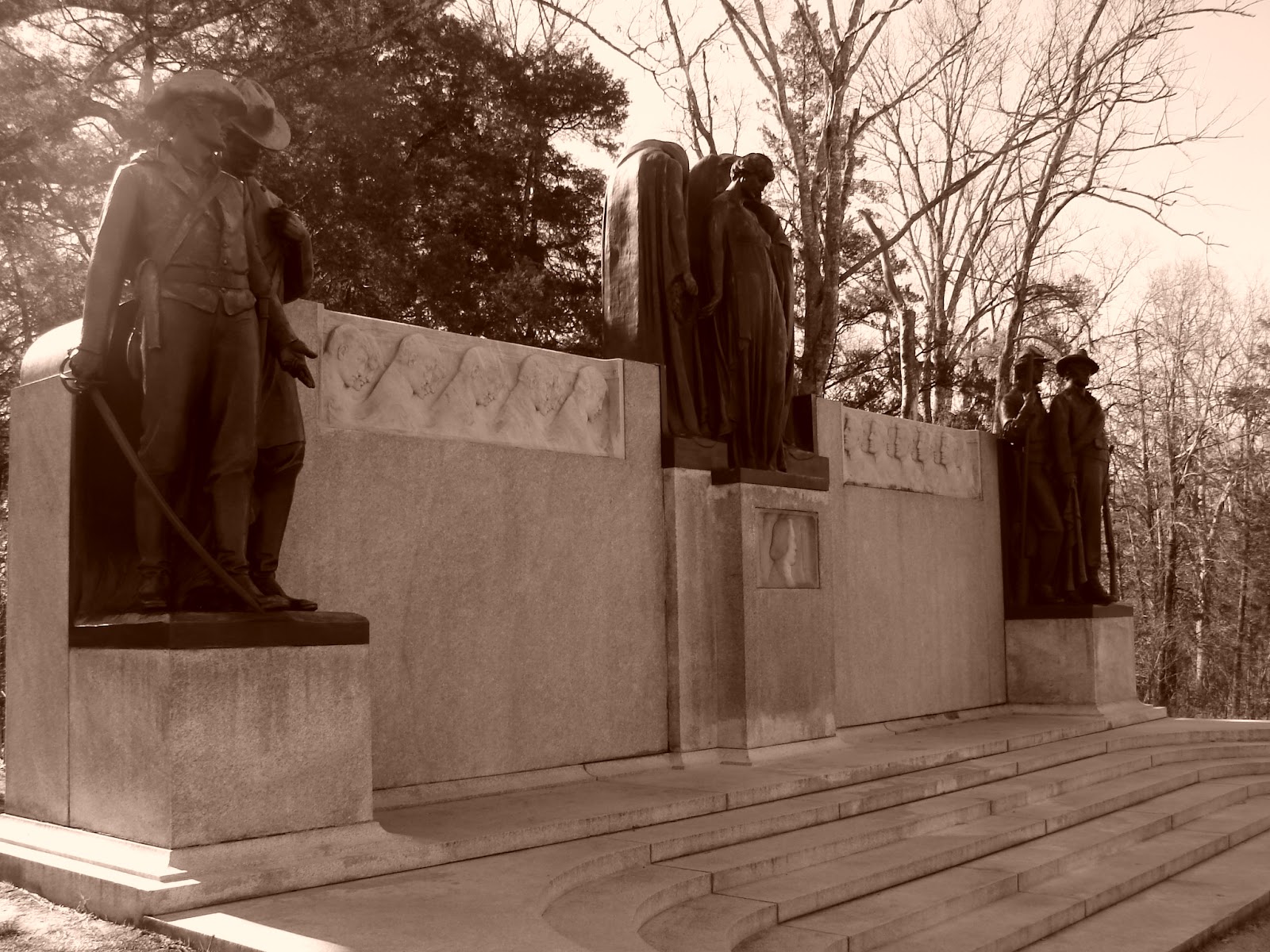
 Johnston's Death is prominently featured and mourned on the Confederate Memorial at Shiloh

Tuesday, March 27, 2012

Shiloh's Rhea Field

This is the latest post in my ongoing series from my recent visit to Shiloh. Rather than posting everything at once, spreading the posts out allows for more detail and more pictures. Hope you enjoy.


The Shiloh Battlefield is covered with forestation, interspersed with various farming fields. Any study of the battle is invariably filled with numerous references to specific fields while describing the ebb and flow of the fighting. One of the fields which I spent time in during my recent visit to Shiloh was Rhea field. Because Sherman is one of my favorite figures from the war, I had to see some of the sites where he fought during Shiloh, and Rhea Field was at the top of the list.

This is where the 53rd Ohio was encamped at the start of the battle. As the southernmost camp in Sherman's command, the men of the 53rd Ohio were the first troops in Sherman's Fifth Division to encounter the Confederate advance. This was also where Sherman himself first saw Confederate troops advancing on his position. He sustained a mild hand wound while riding among the lines of the 53rd Ohio that morning.


Shiloh is covered with markers of all sorts. In my opinion, the most unique ones were those locating where Union camp sites were at the start of the battle. The above picture shows such a marker for the campsite of the 53rd Ohio, the first regiment from Sherman's division to become engaged. The marker points toward where the center of the regimental camp was on the morning of April 6, 1862.


As the sounds of musket fire grew early on the morning of April 6, Colonel Jesse Appler of the 53rd Ohio recognized that somethingwas wrong. He was hearing the sounds emanating through the woods from the initial skirmish fighting near Fraley Field between the first Confederate battle line and portions of Colonel Everett Peabody's brigade. Appler, whose worries over a possible enemy attack had been rebuffed by Sherman just the day before, had pickets and patrols out beyond his camp on the evening of the 5th and morning of the 6th. With the onset of the Confederate attack, Appler's pickets came scampering back into camp, causing alarm among the men of the 53rd Ohio. Appler ordered his regiment into battle lines, facing west, against approaching Confederate troops from Patrick Cleburne's brigade.


Shortly after 7 a.m., Sherman arrived at the 53rd Ohio camp. He had sent a note to Appler earlier that morning, suggesting that he "must be awfully scared over there." Upon arriving, however, Sherman soon realized the approaching threat to his forces.


Appler's battle lines were formed along the eastern edge of Rhea field (to the right of the picture above). As Confederate skirmishers emerged out of the trees on the western edge of Rhea field (to the left of the edge of the above picture), they sent a volley of musket fire into the Union ranks. As was the case with many Confederates that day, these Southerners were firing buck and ball ammunition. Upon seeing the enemy fire a volley, Sherman threw up his right arm in surprise; a small musket ball lodged in his hand, causing a relatively minor wound. One of Sherman's staff officers, Sergeant Thomas D. Holliday, was hit in the head and killed instantly. Realizing what was happening, Sherman was said to exclaim, "My God, we are attacked!" He quickly rode back toward his headquarters, promising Colonel Appler that he would send reinforcements. At that moment, Sherman knew that he needed to rally his division as quickly as possible to form a strong defensive line. Sherman's fight at Shiloh had begun.


(Appler's 53rd Ohio, whose camp would have been in the foreground, aligned themselves along the far tree line)


The Confederates who were advancing on Sherman's position were two regiments from Patrick Cleburne's brigade, the 6th Mississippi and the 23rd Tennessee. Due to the confusing terrain, these two regiments had veered off to the right upon reaching the Shiloh Branch of Owl Creek. After advancing through the campsite of the 53rd Ohio, these two regiments made numerous assaults across Rhea Field against the Ohioans. Over the course of the next hour, from 7 a.m. to 8 a.m., the 6th Mississippi sustained the bulk of its casualties that day. Overall, the regiments lost 300 out of its 450 members on that April 6, a 70% casualty rate, one of the highest for any Confederate regiment in the war.


Trees blossoming in the woods from which the 6th Mississippi launched their attacks.


This picture shows the perspective of Rhea Field for the attacking Confederates. The men of the 6th Mississippi and 23rd Tennessee had to advance from this position, across the open field, over the ridge line, and continue on against the 53rd Ohio, whose men were ensconced safely in the far tree line. After several charges and over an hour of fighting, while the Ohioans were exacting a fearful toll on their Confederate attackers, Colonel Appler's nerves got the best of him; Appler suddenly ordered his men to fall back. This was a disastrous development for the Fifth Division. While Sherman was riding through his various camps to organize a battle line, his left flank was already caving in.


Rhea Field can be seen in the distance. The creek in the foreground is Rhea Springs, or the East Fork of the Shiloh Branch of Owl Creek.


When Appler ordered his men to fall back, then retreated past this creek and into the woods, heading toward the Shiloh Church and Sherman's main lines (from right to left in the above picture), just a few hundred yards north.


Following the retreat of the 53rd Ohio, the 57th Ohio, whose monument is pictured above, became the new left flank regiment for Sherman's immediate command near the Shiloh Church. Sherman's division had four brigades, those of McDowell, Hildebrand, Buckland, and Stuart. The first three were all fighting with Sherman near the Shiloh Church, while Stuart's brigade, camped rather far from Sherman's headquarters, became detached, and ended up fighting on the far left flank of the Union army that day.


To remind us that these monuments are much more than picturesque markers, on the edge of Rhea Field, there is one of Shiloh's many burial trenches. No doubt, this trench contains many of the soldiers from the 6th Mississippi, the regiment which suffered 75% casualties in its assaults across Rhea Field on the morning of April 6, 1862.

Thursday, March 15, 2012

Shiloh's Burial Trenches

In my post from yesterday, I featured some pictures of the National Cemetery at Shiloh interwoven with a brief recounting of the cemetery's story. As was the case with Civil War National Cemeteries, only Federal soldiers were reburied there. While many battlefields saw Confederate dead later removed, they were often moved to either local cemeteries or to cemeteries in the South. For example, the Confederate dead from Antietam are scattered between cemeteries in Shepherdstown, Hagerstown, and Frederick, as well as some that were sent to their home towns in the South.

Shiloh is relatively unique in this respect; the Confederate dead remain on the field, the majority of them in large burial trenches. Grant's orders of April 8th dictating that the dead be buried as quickly as possible applied to both sides. As Federal forces held the field, more care was given to the burial of the Union dead, and in most cases, efforts were made to identify the fallen. However, where Union dead were either buried individually or in small groups, Confederate dead were often placed in shallow graves or mass graves. Often these mass graves were made in spots where the fighting was the heaviest. It was simply quicker, easier, and more efficient to place Confederates in mass graves near the scene of battle.

While as many Union dead as possible were removed to the National Cemetery after the war, post war antipathies overruled arguments for combining the dead of both sides into one cemetery. Confederate soldiers had just waged a four year struggle against the Union, and in the late 1860s, the Federal government was not about to let them be buried alongside loyal Union soldiers. While attitudes of brotherhood, friendship, and bipartisanship between the North and the South grew among veterans of the war toward the end of the century, attitudes which we still largely recognize today, the wounds of battle were still far too fresh in the war's immediate aftermath to allow for Confederate dead to be included into a National Cemetery.

Thus, Confederates were left in large burial trenches across the landscape. As many as twelve such burial trenches exist at Shiloh, yet not all of the locations are marked or known. Early park historians knew the locations of nine such trenches, but the park only currently knows the exact marked location of five, the others all being lost to time. Thus, the battlefield itself is a cemetery for those Confederates who fought and died at Shiloh. With over 1,700 dead, the Confederate army suffered a staggering toll on the now peaceful fields surrounding Shiloh Church. 

Needless to say, the presence of such burial trenches significantly affects the feel of the battlefield. All Civil War fields are to some degree still burial grounds because there is no definitive way to ever completely rebury all soldier's remains from such vast and complex landscapes. However, Shiloh can literally claim to still be a burial ground. Whether one is driving along the tour road or hiking through the woods, a Confederate burial trench is not far away. This is not to mention the countless numbers of individual or small group burials which still dot the landscape, unmarked and lost to time. These burial trenches serve as a reminder of the enormous and often forgotten sacrifices made by Confederate soldiers during the Civil War.


 Each of the five marked Confederate burial trenches at Shiloh has a similar look. They are very plain, having only an official marker (seen up close in photo below) and a small stone monument from the United Daughters of the Confederacy. Many of these UDC and Sons of Confederate Veterans markers and monuments date back to the early decades of  the 20th century. The burial trench pictured above has nothing other than these simple markers to indicate its existence.


 The burial trench located above is the closest known burial spot to the final Federal line on the evening of April 6th.


 With no ability to determine the number of bodies or the identities of the individual soldiers, these burial trenches represent something very powerful on the Shiloh battlefield. National Cemeteries with row upon row of graves provide a visual reminder of the steep price paid for the Union and freedom, but for the Confederacy, these burial trenches provide a small, humble reminder of the lives lost in a cause that was ultimately lost as well.


 The above photograph is of the largest of the known burial trenches. According to one very helpful Shiloh Park Ranger, the trench pictured above contains as many as 700 soldiers.


 Just because Union dead were removed to the National Cemetery does not mean that their original burial grounds are unmarked. As seen above, small markers dot the landscape indicating where various regiments buried their dead in the immediate aftermath of the battle.


 A black and white view of the largest of Shiloh's known burial trenches


The burial trench pictured above can be found in Rhea field, within 100 yards of the camp site of the 53rd Ohio, commanded at Shiloh by Colonel Jesse Appler. This regiment was in the Third Brigade of William Tecumseh Sherman's Fifth Division, and its camp was the furthest south of those with Sherman's main body of troops. Thus, they were among the first Federal soldiers in Sherman's command to be engaged in battle on the morning of April 6, 1862 (more on Sherman at Shiloh to come).