Our Country's Fiery Ordeal

A blog about the American Civil War, written and maintained by historian Daniel J. Vermilya, author of The Battle of Kennesaw Mountain (History Press, 2014) and James Garfield and the Civil War (History Press, 2015)

Dedicated to my great-great-great grandfather, Private Ellwood Rodebaugh, Company D, 106th Pennsylvania Volunteer Infantry, killed at the Battle of Antietam, September 17, 1862.

"And may an Overuling Providence continue to cause good to come out of evil, justice to be done to all men where injustice has long prevailed, and finally, peace, quiet, and harmony to come out of this terrible confrontation and our country's fiery ordeal." -- Albert Champlin, 105th Ohio, Diary entry of June 19, 1864 (Western Reserve Historical Society)

Showing posts with label Maryland Campaign 150. Show all posts

Saturday, September 22, 2012

September 22, 1862: "Then, Thenceforward, and Forever Free..."


“When the rebel army was at Frederick, I determined, as soon as it should be driven out of Maryland, to issue a Proclamation of Emancipation… I said nothing to anyone; but I made the promise to myself and to my Maker. The rebel army is now driven out, and I am going to fulfill that promise.”
Abraham Lincoln, September 22, 1862


150 years ago today, President Abraham Lincoln issued the Preliminary Emancipation Proclamation, signaling a beacon of hope in the darkness for over four million people held in bondage, and signalling the death knell of slavery in the United States. The road toward freedom would not be complete with one proclamation; the proclamation would be but the first of many steps transitioning from slavery to citizenship for African Americans. Yet, without the first step, none of the other steps would have been possible. The blood shed at Antietam on September 17 had radically transformed the country. The dead of Antietam led to "a new birth of freedom" for this country. 


By the President of the United States of America
A Proclamation.
I, Abraham Lincoln, President of the United States of America, and Commander-in-chief of the Army and Navy thereof, do hereby proclaim and declare that hereafter, as heretofore, the war will be prosecuted for the object of practically restoring the constitutional relation between the United States, and each of the states, and the people thereof, in which states that relation is, or may be suspended, or disturbed.

That it is my purpose, upon the next meeting of Congress to again recommend the adoption of a practical measure tendering pecuniary aid to the free acceptance or rejection of all slave-states, so called, the people whereof may not then be in rebellion against the United States, and which states, may then have voluntarily adopted, or thereafter may voluntarily adopt, immediate, or gradual abolishment of slavery within their respective limits; and that the effort to colonize persons of African descent, with their consent, upon this continent, or elsewhere, with the previously obtained consent of the Governments existing there, will be continued.

That on the first day of January in the year of our Lord, one thousand eight hundred and sixty-three, all persons held as slaves within any state, or designated part of a state, the people whereof shall then be in rebellion against the United States shall be then, thenceforward, and forever free; and the executive government of the United States, including the military and naval authority thereof, will recognize and maintain the freedom of such persons, and will do no act or acts to repress such persons, or any of them, in any efforts they may make for their actual freedom.

That the executive will, on the first day of January aforesaid, by proclamation, designate the States, and parts of states, if any, in which the people thereof respectively, shall then be in rebellion against the United States; and the fact that any state, or the people thereof shall, on that day be, in good faith represented in the Congress of the United States, by members chosen thereto, at elections wherein a majority of the qualified voters of such state shall have participated, shall, in the absence of strong countervailing testimony, be deemed conclusive evidence that such state and the people thereof, are not then in rebellion against the United States.

That attention is hereby called to an act of Congress entitled "An act to make an additional Article of War" approved March 13, 1862, and which act is in the words and figure following:
Be it enacted by the Senate and House of Representatives of the United States of America in Congress assembled, That hereafter the following shall be promulgated as an additional article of war for the government of the army of the United States, and shall be obeyed and observed as such:
Article-. All officers or persons in the military or naval service of the United States are prohibited from employing any of the forces under their respective commands for the purpose of returning fugitives from service or labor, who may have escaped from any persons to whom such service or labor is claimed to be due, and any officer who shall be found guilty by a court-martial of violating this article shall be dismissed from the service.

SEC. 2. And be it further enacted, That this act shall take effect from and after its passage.
Also to the ninth and tenth sections of an act entitled "An Act to suppress Insurrection, to punish Treason and Rebellion, to seize and confiscate property of rebels, and for other purposes," approved July 17, 1862, and which sections are in the words and figures following:
SEC. 9. And be it further enacted, That all slaves of persons who shall hereafter be engaged in rebellion against the government of the United States, or who shall in any way give aid or comfort thereto, escaping from such persons and taking refuge within the lines of the army; and all slaves captured from such persons or deserted by them and coming under the control of the government of the United States; and all slaves of such persons found on (or) being within any place occupied by rebel forces and afterwards occupied by the forces of the United States, shall be deemed captives of war, and shall be forever free of their servitude and not again held as slaves.

SEC. 10. And be it further enacted, That no slave escaping into any State, Territory, or the District of Columbia, from any other State, shall be delivered up, or in any way impeded or hindered of his liberty, except for crime, or some offence against the laws, unless the person claiming said fugitive shall first make oath that the person to whom the labor or service of such fugitive is alleged to be due is his lawful owner, and has not borne arms against the United States in the present rebellion, nor in any way given aid and comfort thereto; and no person engaged in the military or naval service of the United States shall, under any pretence whatever, assume to decide on the validity of the claim of any person to the service or labor of any other person, or surrender up any such person to the claimant, on pain of being dismissed from the service.

And I do hereby enjoin upon and order all persons engaged in the military and naval service of the United States to observe, obey, and enforce, within their respective spheres of service, the act, and sections above recited.

And the executive will in due time recommend that all citizens of the United States who shall have remained loyal thereto throughout the rebellion, shall (upon the restoration of the constitutional relation between the United States, and their respective states, and people, if that relation shall have been suspended or disturbed) be compensated for all losses by acts of the United States, including the loss of slaves.
L.S.

In witness whereof, I have hereunto set my hand, and caused the seal of the United States to be affixed.

Done at the City of Washington, this twenty second day of September, in the year of our Lord, one thousand eight hundred and sixty two, and of the Independence of the United States, the eighty seventh.

By the President: ABRAHAM LINCOLN
WILLIAM H. SEWARD, Secretary of State.

Monday, September 17, 2012

September 17, 1862


150 years ago today, Private Ellwood Rodebaugh, an ordinary shoemaker from Canton, Pennsylvania, a husband and a father, sacrificed his life "upon the altar of freedom" on the fields north of Sharpsburg, Maryland.

That day, he was one of 23,000 who were killed wounded or missing.

In honor of all those who fell that day, we will pause today to remember.


The Cornfield at Sunset, September 16, 2012


The following is an article written by Dr. Joseph Harsh for Hallowed Ground, published in 2002. As we commemorate the 150th Anniversary of Antietam today, I found that Harsh's words are quite appropriate to remind all of us of what we are commemorating today. 


They are all gone now.
The dewy cheeked boys, who left home before their first shave; their older brothers, who marched away from young wives clutching infants in their arms; and their grizzled fathers, whose gray streaked hair and beards belied arms as stout as their hearts.
They are all gone.
The men who discovered at Bull Run that war was not a lark, but a vulture; who crept through the Bloody Cornfield and knelt in the Bloody Lane; who crawled through the snows on Marye’s Heights; who would not yield on Little Round Top and who climbed the post and rail fence on the Emmittsburg Pike amidst a hail of bullets; they who lay among the burning trees of the Wilderness; and who endured the dank, stinking trenches of Petersburg.
They who surrendered at Appomattox, and they who did not jeer the vanquished there.
They are all gone.
The men who lost a leg, an arm, an eye, a career, a farm, a fortune. Also gone are their women, who gave up a husband, a son, a brother, a father, a sweetheart.
They are all gone.
They who learned that life is passionate, precarious, and precious. They, who generation was touched with fire.
They are all gone.
And so are their children, for whom they fought. Even their grandchildren are few and very old.
We who are their great, and great-great, and great-great-great grandchildren can never know them now. We can never see them, or hear them, or touch them.
We can know them only through the ancient photographs of faded brown and white, where they stand mute, unmoving, mysterious to our gaze.
Or, through their music, which seems romantic, naïve, and sometimes sickly sentimental to our ears.
Or, through their relics, the torn flags, the moth-eaten uniforms, the dented swords and the rusted buttons, resting on silken pillows, behind glass panes in climate controlled museums, beyond our touch.
Or, through their words, in their diaries and letters and reminiscences, which sometimes approach but never quite convey to our understanding the true meaning of why they fought and what they experienced.
Even more than through any of these, we can come nearer to them when we stand on the ground where they fought, where they sweated in the summer and shivered in the winter, where their blood seeped into the soil, where they risked their lives and many lost the risk, where they faced the ultimate test of loyalty to an idea and a cause.
But, perhaps, we come closest of all to them, when we simply value the legacy they left being. For, WE ARE the future for whom they fought.
Said one of them, who was not a soldier but who also forfeited his life in the war, while standing among the freshly dug graves of Gettysburg, the world “can never forget what they did here.”
But he was wrong. We can forget. We have too often forgotten. We forgot when we built cookie cutter town houses on the fields of Chantilly, and pricey, pseudo-chateaux on Longstreet’s Wilderness, and motels and t-shirt shops on Cemetery Ridge. And, it cannot be that we were remembering, when we contemplated building a racing track at Brandy Station.
Yes, they are all gone now.
And the least that we can do—and, sadly, the most that we can do—to reach back through fast receding years and thank them for the pain, the suffering, the sacrifice, to thank them for our United States, is to preserve, to protect, and to defend the ground they hallowed.
But our obligation is much greater than to thank them. Our most sacred duty, our ultimate loyalty, is to remember, to keep alive, and to pass on their willingness to sacrifice, their love of country, their devotion to freedom.
We are the future now, but ultimately we are only a link between the past and the future. This generation may never be called upon to make huge, soul-wrenching sacrifices of life and fortune.
But someday—and it is as inevitable as the rising of the sun—a future generation will again be touched with fire and will be summoned to defend our country and our freedom.
If our children, or grandchildren, or great-grandchildren, when that call comes, are too soft, too lazy, too uncaring to meet the challenge, not only will they fail, but we fail also, and so will fail every generation which has preceded us.
Antietam, Gettysburg, and Appomattox will have been in vain.
Yes, they are all gone now.
And soon—in a blink of the cosmic eye of time—we also will all be gone. But we are all connected.
The Civil War is not a closed book.
It is a continuing story that never ends.

Saturday, September 15, 2012

Antietam 150th: A Time Like No Other

Since I was a 9 year old, I have dreamed about being a park ranger at Antietam National Battlefield. Today, I got to live that dream to the fullest. I led a Cornfield hike for over 100 people, which I concluded by telling them all the story of my great-great-great grandfather next to the Philadelphia Brigade monument in the West Woods. I saw a few visitors getting a bit blurry eyed when I talked about Ellwood leaving behind his young children to die for his country. I must admit that I found myself getting teary eyed at the occasion. I couldn't help but think back to the days when I sat with my Grandpa in Canton, PA, talking about Ellwood and the Civil War. Those are very special memories for me, as was today.

For the rest of the day, I spent time at the Sunken Road and the Cornfield leading battle talks for groups of visitors. The weather was perfect, the park was overrun with visitors, and the ranger staff, volunteer staff, and park guide staff rose to the occasion. 
I must also say that I have been stopped several times by visitors who recognize me from the blog. I am very grateful that people would first take the time to read what I have to say, and second, that they would then take the time to say hello and tell me that they appreciate my writing. Thank you very much to everyone who visits this site!


I am very blessed indeed. 


Ranger Dan as a nine year old walking in the Sunken Road


Ranger Dan today, September 15, 2012, in front of the Cornfield at Antietam

Wednesday, September 12, 2012

Antietam 150th: Rangers in Action!

Well, folks, Antietam's 150th is just about here. All around the park, tents and new panels are being put in place, grass is being cut, barriers and signs are being set out for safety, and everywhere you look, there seems to be a park ranger working on something.There are many Rangers hard at work this week, making sure that the park is ready for all of the national attention which it will be receiving in the days ahead.

On facebook, the interp staff has been posting a series of videos, one a day, to track the Maryland Campaign as it occurred 150 years ago. We are also filming a series of videos advertising the 150th anniversary of Antietam, as well as videos to track the course of the battle 150 years from when it happened.


 The Pennsylvania History Mobile has arrived at the park, and will be open for the general public to visit during the Sesquicentennial events from the 14th through the 17th


Rangers have been out walking the trails and fields of Antietam, preparing for the hikes which are sure to draw hundreds upon hundreds of visitors. I will be leading two hikes myself: on both Saturday and Sunday morning, I will be leading the 90 minute overview hike of the Cornfield and the West Woods, leaving from the Visitor Center at 10 am. Hope you can tag along!

While many rangers have been hard at work recently, one of those deserves a special shout out in this blog post. My good friend and colleague Ranger Mannie Gentile has been working up a storm in his "Photo Tent" getting ready for the 150th. Let's have a look at what Ranger Mannie has been up to....


Outside the photo tent are signs, made by Ranger Mannie, advertising what is inside...


Inside one gallery, visitors can view many of the photographs of the battlefield taken by Alexander Gardner in the days following the battle...


An image of Alexander Gardner himself

Ranger Mannie hard at work with just a few days to go before the 150th...

Even Bob Casey, head of Western Maryland Interpretive Association, was driving by to check out Mannie's handiwork...

 Ranger Mannie has spent the last week or two painting a very large mural of Burnside Bridge to go inside the other gallery of the photo tent. Although the three canvases still need to be firmly affixed together, the finished product is almost there. Visitors will be able to set their camera on a post and sit in front of the mural to get their picture taken with the Bridge and Antietam 150 in the background. In the end, it should look something like this...


Ranger Dan and Ranger Mannie in the Photo Tent at Antietam!


If you are able to come to Antietam this weekend, please do so. Rangers like Mannie Gentile have been working very hard to make sure that this event is one that people will still be talking about when the Bicentennial rolls around in 2062.


I have to say that the past few days have been some of the best days I can remember. Between my research presentation and award on Saturday, all of the attention the park has been receiving this week, and the events to come, I have to pause and say that I am truly blessed to work at Antietam, and to work here with such wonderful colleagues and friends. On to the 150th!!


Sunday, September 9, 2012

Harsh Award Presentation


Yesterday, I presented my research for the Dr. Joseph L. Harsh Memorial Scholar Award at the Save Historic Antietam Foundation Seminar at Antietam Battlefield, and it all went better than I could have ever expected. I had family and friends in attendance, the reception for the research was wonderful, and I got to meet several members of the Harsh family. To all those who helped me out with the research and the project, I can't thank you enough. Specifically, I want to thank Jim Rosebrock, the leader of Antietam Battlefield Guides, who helped me with research at the National Archives, and who also spent lots of time chatting about the project while working the front desk at the Antietam Visitor Center. Also, I need to thank, once again, my colleagues on the ranger staff at Antietam. Rangers Brian Baracz, Keith Snyder, John Hoptak, and Mannie Gentile all talked with me about the project and assisted with advice and comments along the way. Antietam Superintendent Susan Trail was also in attendance yesterday, and I was especially grateful that she was there. We are all very proud to have her leading Antietam into this important week for the 150th this year. Also, Ranger Alann Schmidt approved the joke I used to start the program, which was perhaps the greatest assistance I could have received. Those of you who have the pleasure of knowing Alann understand why this was an essential component to my presentation. The man knows his jokes.

I have to also thank SHAF President Tom Clemens for all of his work putting the event together, as well as his assistance with the project along the way. It couldn't have been done without his help. 

I hope to put some of the research up on the blog over the next few weeks, but as I will be publishing this research in an article, I will limit what I will put on the blog. Stay tuned however, because I think that this is just the start of what could be more research and work on the Army of the Potomac at Antietam, as there are still many myths about the army that need to be erased. If I had to lay out my conclusions in a concise manner, I would say for the sake of brevity, they are as follows:

1. McClellan did not know his own strength at Antietam. In fact, he likely overestimated it.
2. Straggling was just as big a problem for the Union army as it was for the Confederate army in the campaign.
3. Union commanders from McClellan down to corps, division, and brigade command struggled with understanding their strength and getting the army into a condition where it was ready for combat.
4. The Union army and its commanders, specifically brigade commanders, were FAR less experienced that the Confederate army at Antietam.
5. Returns and morning reports, coupled with Ezra Carman's numbers for the army, show that Federal forces dropped considerably throughout the campaign.


I was able to uncover considerable amounts of unpublished material on the army and its commanders in the campaign, as well as the numbers of the army, and I truly hope that the data, letters, and dispatches which I found and used will help to correct the myth that the Federal army at Antietam was an invincible force. In fact, it was a cobbled together army which limped its way north, and the fact that McClellan was able to do what he did with it is utterly remarkable.Stay tuned for pieces of the research to appear on here, as well as for updates on where and when the research will be published.


That will have to do for now. Here are some pictures of the event yesterday, as well as a short video of the award presentation, filmed by Ranger Brian Baracz.


 SHAF President, and great Antietam historian, Tom Clemens presenting me with the Dr. Joseph L. Harsh Memorial Scholar Award


 Dad, Mom, Myself, and my girlfriend Alison


Antietam Superintendent Susan Trail, myself, Rangers Keith Snyder, Brian Baracz, and John Hoptak

Alison and I


Here is the video of the award presentation...


Friday, September 7, 2012

September 7, 1862: "A victory now and we will soon be together"

150 years ago today, Major General George Brinton McClellan moved his headquarters into Rockville, Maryland, officially beginning his move northward into Maryland to pursue Robert E. Lee and the Confederate Army of Northern Virginia. McClellan wrote the following letter to his wife that day:


We are all well and the entire army is now united, cheerful and confident. You need not fear the result for I believe that God will give us the victory. I leave here this afternoon to take command of the troops in the field. The feeling of the Government towards me, I am sure, is kind and trusting. I hope with God's blessing, to justify the great confidence they now repose in me, and will bury the past in oblivion. A victory now and we will soon be together. I send a short letter today. God bless and reward your trust in Him and all will be well.
 

This short post will have to do for today. For those in the area, tomorrow I will be presenting my research on the strength, experience, and condition of the Army of the Potomac at Antietam for the Save Historic Antietam Foundation Seminar at Antietam National Battlefield. If you are in the area, stop on by. The seminar will be at the Mumma Barn, and I will be speaking at 10:45 am.

It is a great time to be at Antietam. Today, the Visitor Center was packed from open to close, we officially opened our new museum gallery, and the phones were ringing off the hook. The 150th is definitely right around the corner!

Thursday, September 6, 2012

September 6, 1862

150 years ago yesterday, Confederate General Thomas Jonathan Jackson, the legendary "Stonewall", crossed over the Potomac River into Maryland with his command. 150 years ago today, he was followed by James Longstreet's command. Riding across the Potomac with Longstreet's command, in the back of an ambulance due to badly bruised and broken hands, was the man who had, just a few weeks earlier, saved the city of Richmond from McClellan's army and, just a few days earlier, smashed John Pope's Army of Virginia at Second Manassas. While Robert E. Lee was entering Maryland in the back of an Ambulance, the strength and momentum of his army was moving towards what he hoped would be a war winning victory in Maryland.


150 years ago, the Maryland Campaign was officially underway.


I will do my best to keep posting 150 updates on here over the next few weeks, but if you are looking for more 150 updates, be sure to check out the Antietam National Battlefield facebook page. My colleagues and I are posting short 30 second videos every day from now until September 17th, some days more than 1 video. These short segments will cover the main events going on 150 years ago that day. Things are getting very busy at the park. Crowds are up, the phones are ringing off the hook, official programs have arrived, the schedule is set, and now all we have to do is to sit back and enjoy the ride!

If you are in the area this weekend, be sure to stop by the Battlefield on Saturday morning, as I will be presenting my research for the Save Historic Antietam Foundation's Joseph L. Harsh Scholar Award at the SHAF seminar at the Mumma Farmstead. I am speaking at 10:45, and I hope to see you there.


Sunday, September 2, 2012

September 2, 1862: "A terrible and thankless task"


150 years ago today, George Brinton McClellan officially assumed command of all Federal forces defending Washington D.C., including both his force of the Army of the Potomac and John Pope's Army of Virginia.


George Brinton McClellan


To Mary Ellen McClellan, September 2, 1862, 12:30 pm

I was surprised this morning when at breakfast by a visit from the President and Halleck--in which the former expressed the opinion that the troubles now impending could be overcome better by me than anyone else. Pope is ordered to fall back upon Washington and as he reenters everything is to come under my command again! A terrible and thankless task--yet I will do my best with God's blessing to perform it. God knows that I need his help. I am too busy to write any more now--Pray that God will help with a full knowledge of all its difficulties and of the immensity of the responsibility. I only consent to take it for my country's sake and with the humble hope that God has called me to it--how I pray that he may support me!...
Don't be worried--my conscience is clear and I can trust in God

George B. McClellan
The Civil War Papers of George B. McClellan, edited by Stephen Sears, pg. 428.


Later that day, in the mid afternoon hours of September 2, George McClellan put on one of his finest uniforms. He looked resplendent, with a bright yellow sash, golden trim, and his dress sword surrounding the dark blue of his Federal coat. He began riding out to the outskirts of Washington, where he would meet the remnants of Pope's defeated army as they slowly streamed back into the city.  By 4 pm, McClellan had reached Upton's Hill, where he met John Pope, at the head of a column of defeated Union troops. After informing Pope that he was no longer in command, the defeated commander continued his dreary ride into Washington. Simultaneously, men of John Hatch's division of the 3rd Corps, Army of Virginia, had overheard McClellan's conversation. Cheers began erupting up and down the ranks as men jubilantly celebrated the news that "Little Mac," their beloved general, would once again lead them forward into battle. The scene must have been quite dramatic: a defeated John Pope, hanging his head as he rode back into Washington; exhausted, but excited, soldiers cheering their new commander; and George McClellan, in his finest uniform, sitting atop his black horse, "Dan Webster", observing the scene with the pride of knowing he was once again in command, but also knowing that the job ahead of him was, as he wrote his wife earlier that day, "a terrible and thankless task." While these soldiers were cheering now, it would be McClellan's job to turn this force around, transforming it from a defeated and disorganized army into a force capable of defeating Lee and saving the future of the Republic. 150 years ago today, Major General George B. McClellan's work was just beginning.


Friday, August 31, 2012

The Road to Antietam, August 31, 1862: "I am utterly tired out"


150 years ago today, the Confederate victory at Second Manassas was complete. John Pope’s Army of Virginia was slinking back toward Washington, and it appeared as though the end of the Union might soon be in sight. During the day on the 31st, George McClellan wrote to Henry Halleck that his staff was reporting “our army as badly beaten: our losses very heavy… Some of the corps entirely broken up into stragglers.” It was becoming obvious that the situation was desperate for the Union. Several hours later, at 7:30 pm, McClellan again wrote to Halleck, reporting that as many as 20,000 stragglers littered the roads of Northern Virginia between Manassas and Washington (OR, Vol 12, Part 3, 771-773).

Late on the evening of August 31st, General in Chief sent the following telegraph:
Aug 31, 1862
From Washington, 10:07 pm
To Maj. Genl McClellan
Since receiving your dispatch relating to command I have not been able to answer any note of absolute necessity. I have not seen the order as published but will write to you in the morning. You will retain the command of everything in this vicinity not temporarily to be Pope’s army in the field. I beg of you to assist me in this crisis with your ability and experience. I am utterly tired out.
H. W. Halleck, General in Chief

In the last hours of August, as the Union appeared to be crumbling before the victorious army of Robert E. Lee, Halleck was turning to George B. McClellan to pick up the pieces of defeat and attempt to salvage not only the army, but the country, from the mess. The above telegram is not in the Official Records exchange of dispatches sent back and forth on the 31st, and is found in the McClellan papers (McClellan Papers, LOC, Box A75, Reel 30). 

McClellan’s response, which can be found in the O.R., simultaneously accepted his new role and showed uncertainty over to what that role would be: “I am ready to afford you any assistance in my power, but you will readily perceive how difficult an undefined position, such as I now hold, must be. At what hour in the morning can I see you alone, either at your own house or the office?” (OR, Vol 12, Part 3, 773).


Two days later, as the broken remnants of Federal forces seeped into Washington a few days later, it would be McClellan who greeted them on the outskirts of the city. McClellan had by then met with both Lincoln and Halleck, and had been officially placed in command of the Federal troops in and around Washington, tasked with defending the Capital from the menacing threat of Lee's victorious and triumphant Rebel army, just 30 miles away.


150 years ago today, Federal leaders were trying to understand just how bad the situation truly was. It was becoming readily apparent that Pope’s time in command was over. McClellan, uncertain of what his role was to be going forward, received the above dispatch from Halleck informing him that he was likely to have the command of not only his former army from the Peninsula, but the defeated remnants of John Pope’s force as well. Still, McClellan’s orders were not clear, nor was his understanding of his task facing him, or his understanding of the force he would command. In the days to come, the dire condition of his army, as well as the condition of the nation, would become known to McClellan, Halleck, and many others. Indeed, 150 years ago was a trying time not just for Henry Halleck, as he wrote to McClellan, but for the country as well. 

Thursday, August 30, 2012

2nd Manassas 150th, Aug 28-30, 1862

Today marks the 150th anniversary of the final and climactic day of the Battle of Second Manassas. Yesterday, I had the fortune of traveling to the Manassas battlefield to do some hiking and take in a few ranger programs. My day consisted of spending a few hours on the trails around the Brawner Farm and in the famed Unfinished Railroad Cut. I went on a couple Ranger programs, and I must say that Ranger Hank Elliott's battle walk of the action in the late afternoon and early evening of the 29th, covering the Confederate brigade of Maxcy Gregg and the Union division of Phil Kearney, was an outstanding program. Very well done.


In many ways, Second Manassas was the battle which set the stage for the fight at Antietam just a few weeks later. The terrible defeat of John Pope and the Army of Virginia gave enormous strength and momentum to Lee's Army of Northern Virginia. The Confederate victory at Second Manassas emboldened Lee to move north into Maryland, creating a moment of opportunity for the Confederacy and a moment of crisis for the Union. The fighting in Maryland would feature many of the same troops from Second Manassas. Nearly all of Lee's army was the same, and out of the amalgamation of forces which McClellan took into Maryland, over 50% of the divisinos in his army were present at Second Manassas or were involved in the campaign. It always amazes me to think that, for example, some of the Union soldiers moving south in the Cornfield at Antietam were the same troops who were hit by Stonewall Jackson at Brawner's Farm on the evening of August 28th, on the eve of Second Manassas, in what could be called the first day of the battle there. Barely two and a half weeks separated these two climactic battles. In fact, that makes the Union victory at Antietam all the more remarkable, considering the terrible defeat many of those soldiers had suffered just two and a half weeks prior, as 1st Corps artillery officer Charles Wainwright pointed out.


Anyways, my goal here isn't to provide a full history of the battle. You can certainly find far more qualified historians for that than myself. I am not nearly as familiar with the action at Second Manassas as I am with the Maryland Campaign. Today, I simply wanted to post to commemorate the 150th anniversary of the final day of the terrible fight at Manassas. Overall, there were over 22,000 casualties during that several day fight. 150 years ago today, John Pope would continue to slam into Jackson's lines along the Unfinished Railroad Cut, and late in the day, James Longstreet would launch his destructive assault into the Federal flank, sweeping across Chinn Ridge and driving the Federals from the plains of Manassas for the second time in two years.


Gun on Battery Heights, signifying the location of Battery B, 4th US Artillery

5th New York monument

Small US flag at the 5th New York monument

Federal artillery position

Small US flag next to the 14th Brooklyn monument

14th Brooklyn monument

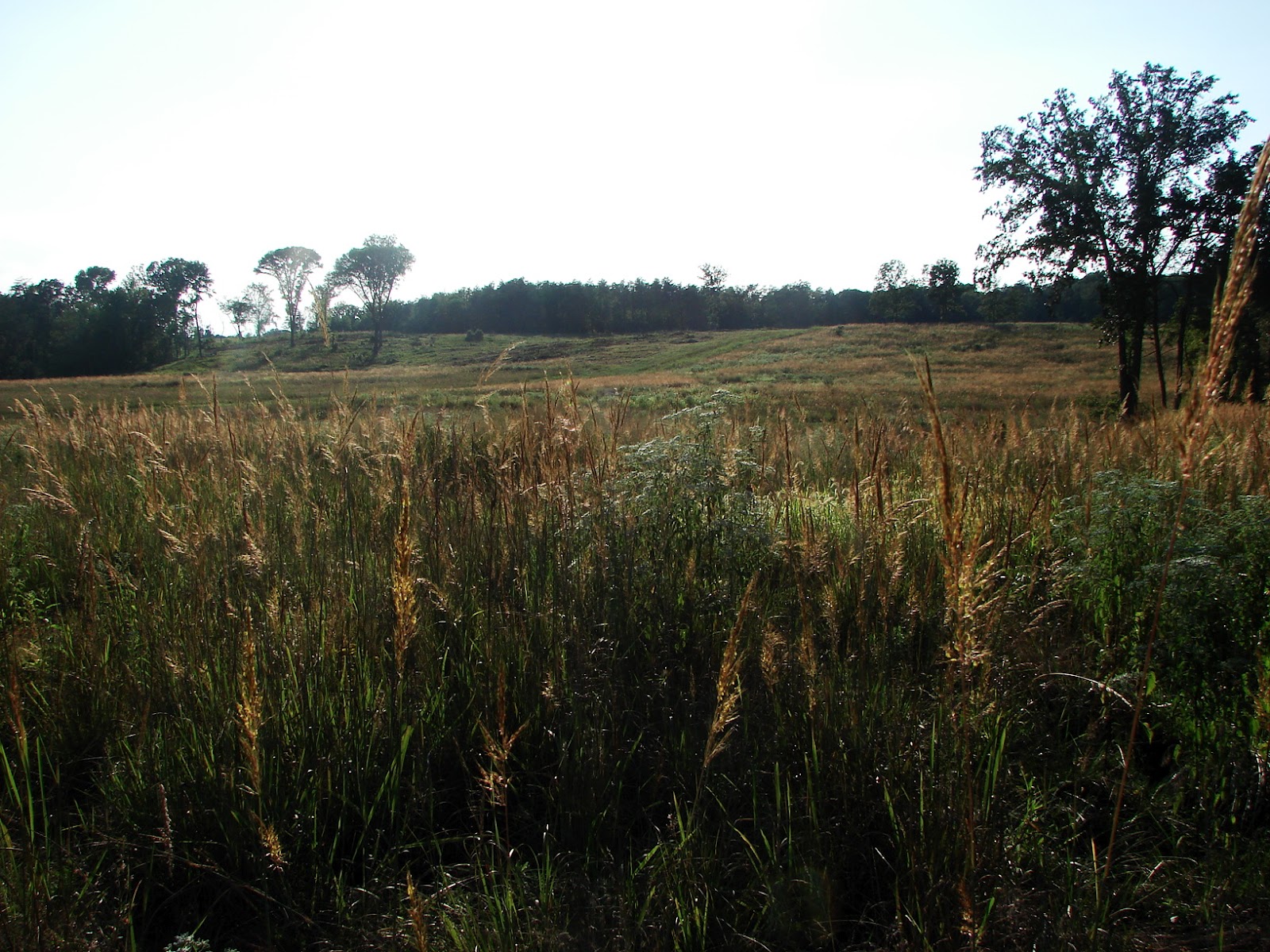
The fields near the Deep Cut in the Unfinished Railroad at Manassas

The fields near the Deep Cut in the Unfinished Railroad at Manassas