Our Country's Fiery Ordeal

A blog about the American Civil War, written and maintained by historian Daniel J. Vermilya, author of The Battle of Kennesaw Mountain (History Press, 2014) and James Garfield and the Civil War (History Press, 2015)

Dedicated to my great-great-great grandfather, Private Ellwood Rodebaugh, Company D, 106th Pennsylvania Volunteer Infantry, killed at the Battle of Antietam, September 17, 1862.

"And may an Overuling Providence continue to cause good to come out of evil, justice to be done to all men where injustice has long prevailed, and finally, peace, quiet, and harmony to come out of this terrible confrontation and our country's fiery ordeal." -- Albert Champlin, 105th Ohio, Diary entry of June 19, 1864 (Western Reserve Historical Society)

Showing posts with label Civil War Memory. Show all posts

Wednesday, August 28, 2013

For What They Died, I Fight a Little Longer


As the summer season has drawn to a close, thus my time at Gettysburg has ended. If you have followed this blog regularly, you will have noticed that I posted very little this summer. I have been incredibly busy over the past few months. I did 12 new interpretive program at Gettysburg this season, including the programing for the Gettysburg 150th this summer. On top of my other projects, there wasn't much time for blogging.

This past Sunday, I returned to work at Antietam (Saturday was my last at Gettysburg). Now, on my first day off in a week, I am sitting in the Smith House at Antietam at my desk (hooked up to the internet, which I don't have in my park housing), looking out over Bloody Lane on a rainy day, reflecting on the past few months.


My time at Gettysburg, and my return to Antietam, has reminded me that what we do in the National Park Service is incredibly important. Fifty years ago today, Martin Luther King, Jr., delivered his famous "I Have a Dream" Speech in Washington on the steps of the Lincoln Memorial. In some of the pictures, you can see NPS rangers working the event, as the Lincoln Memorial was and is an NPS site. In the Park Service, we are the caretakers of our nation's heritage and greatest treasures. If we continue to do our jobs, our nation's history and dreams will continue to live on for future generations. I am very proud to be a part of this organization.


I thought the following letter from Rufus Dawes to his wife in 1881 appropriately summarized the meaning that sites such as Antietam, Gettysburg, and others provide for us today. Dawes, a veteran of the 6th Wisconsin, was a member of Congress at the time, and he took part of a day to visit the graves of 24 soldiers who were killed under his command during the Civil War. These graves were just a few of the many buried at Arlington National Cemetery. The letter is very moving and reminds us of the strength and lessons we can draw from our past.


December 18, 1881
My Dear Wife: I have to-day worshiped at the shrine of the dead. I went over to the Arlington Cemetery. It was a beautiful morning and the familiar scenes so strongly impressed upon me during my young manhood, were pleasant. Many times I went over that road, admiring the beautiful city and great white capitol, with its unfinished dome, going to hear the great men of that day in Congress. An ambitious imagination then builded castles of the time when I might take my place there. Now at middle age, with enthusiasm sobered by hard fights and hard facts, I ride, not run with elastic step over the same road, with this ambition at least realized, and warmth enough left in my heart to enjoy it. My friends and comrades, poor fellows, who followed my enthusiastic leadership in those days, and followed it to the death which I by a merciful Providence escaped, lie here, twenty-four of them, on the very spot where our winter camp of 1861-1862 was located. I found every grave and stood beside it with uncovered head. I looked over nearly the full 16,000 headboards to find the twenty-four, but they all died alike and I was determined to find all. Poor little Fenton who put his head above the works at Cold Harbor and got a bullet through his temples, and lived three days with his brains out, came to me in memory as fresh as one of my own boys of to-day, and Levi Pearson, one of the three brothers of company ‘A,’ who died for their country in the sixth regiment, and Richard Gray, Paul Mulleter, Dennis Kelly, Christ Bundy, all young men, who fell at my side and under my command. For what they died, I fight a little longer. Over their graves I get inspiration to stand for all they won in establishing our government upon freedom, equality, justice, liberty and protection to the humblest.


The letter continues on after this section, but the last sentence here is the key. 

Perhaps, people will leave sites such as Gettysburg and Antietam knowing the cost that was paid here, and will resolve to fight a little longer for all that was won and secured for us by our fore fathers seven score and ten years ago.


I loved every day of my experience at Gettysburg, and I return to Antietam with mixed emotions. I will miss Gettysburg and my colleagues there, but I am certainly very grateful to be returning to such an important and hallowed place. There is no time for rest. The Antietam 151st is just around the corner!!


Friday, April 19, 2013

"Which side was fighting for slavery?"


During my Orientation talk yesterday afternoon, a couple from Australia was sitting right up front. Half way through the talk, I paused to see if any of the visitors had questions. The Australian gentleman raised his hand and asked, “Forgive me for not knowing this already, but which side was fighting for slavery?”


I thought this gentleman's question was really interesting. In the United States, the Civil War is still an active event in some ways. For most of us, we could be described as having a “dog in the fight,” depending on where we were born, where we grew up, where we live, where our ancestors are from, so on and so forth. Yet, this gentleman from another country didn’t have any concerns about the moral implications of the conflict on his own heritage. He simply wanted to know perhaps one of the most important things about the Civil War. Which side was fighting to perpetuate a slave based society, a slave based economy, and a slave based government, and which was fighting to preserve the Union and give freedom to four million people. 


I told the gentleman that it was the Confederacy which seceded over the issue of slavery, and it was the Confederacy that, if they won, would perpetuate slavery and spread the practice into new areas. A few visitors from Texas in the back noted their disagreement with me, but, they were about as polite and cordial as one could possibly expect (I wish all visitors were as friendly when disagreeing with me!). I had a great conversation with them after the program.


Later in the day, a bus of visitors from the Netherlands stopped by the Visitor Center, and after conversing with them, as well as with the Australian gentleman’s question in mind, I have to say: I truly enjoy talking to visitors from other countries. It is, perhaps, one of my favorite things about being a park ranger. The perspective that travelers from across the world bring to American history sites, especially those of the Civil War, give us an outside glimpse of how the world views our history.


Now, I’m off to another day of working the best job in the world.

Monday, January 21, 2013

Dr. King on Emancipaton

Today is Martin Luther King Jr. Day. It is also a day of even greater historical importance because of the Second Inauguration of President Barack Obama. Whether one is a republican or democrat, Inauguration days are historic events for our nation. I think this post is very appropriate for today.


I posted a link to this speech in my post on the 150th Anniversary of the Emancipation Proclamation, but I wanted to post the text of it as well. What follows is the text from remarks given by Dr. Martin Luther King Jr. on the occasion of the 100th anniversary of the Preliminary Emancipation Proclamation. Dr. King's words ring true as they speak of the powerful impact of the proclamation on the course of freedom in the United States.


Dr. King presented the following speech at the New York Civil War Centennial Commission’s Emancipation Proclamation Observance, New York City, September 12, 1962

Emancipation Proclamation Centennial Address

If our nation had done nothing more in its whole history than to create just two documents, its contribution to civilization would be imperishable. The first of these documents is the Declaration of Independence and the other is that which we are here to honor tonight, the Emancipation Proclamation. All tyrants, past, present and future, are powerless to bury the truths in these declarations, no matter how extensive their legions, how vast their power and how malignant their evil.
The Declaration of Independence proclaimed to a world, organized politically and spiritually around the concept of the inequality of man, that the dignity of human personality was inherent in man as a living being. The Emancipation Proclamation was the offspring of the Declaration of Independence. It was a constructive use of the force of law to uproot a social order which sought to separate liberty from a segment of humanity.
Our pride and progress could be unqualified if the story might end here. But history reveals that America has been a schizophrenic personality where these two documents are concerned. On the one hand she has proudly professed the basic principles inherent in both documents. On the other hand she has sadly practiced the antithesis of these principles.

If we look at our history with honesty and clarity we will be forced to admit that our Federal form of government has been, from the day of its birth, weakened in its integrity, confused and confounded in its direction, by the unresolved race question. We seldom take note or give adequate significance to the fact that Thomas Jefferson’s text of the Declaration of Independence was revised by the Continental Congress to eliminate a justifiable attack on King George for encouraging slave trade…Jefferson knew that such compromises with principle struck at the heart of the nation’s security and integrity. In 1820, six years before his death, he wrote these melancholy words:

"But this momentous question (slavery), like a fire bell in the night awakened and filled me with terror. I considered it at once as the knell of the Union. I regret that I am now to die in the belief that the useless sacrifice of themselves by the generation of 1776 to acquire self-government and happiness to their country is to be thrown away, and my only consolation is to be that I live not to weep over it."
The somber picture (of the condition of the American Negro today) may induce the sober thought that there is nothing to commemorate about the centennial of the Emancipation Proclamation. But tragic disappointments and undeserved defeats do not put an end to life, nor do they wipe out the positive, however submerged it may have become beneath floods of negative experience.
The Emancipation Proclamation had four enduring results. First, it gave force to the executive power to change conditions in the national interest on a broad and far-reaching scale. Second, it dealt a devastating blow to the system of slaveholding and an economy built upon it, which had been muscular enough to engage in warfare on the Federal government. Third, it enabled the Negro to play a significant role in his own liberation with the ability to organize and to struggle, with less of the bestial retaliation his slave status had permitted to his masters. Fourth, it resurrected and restated the principle of equality upon which the founding of the nation rested.
When Abraham Lincoln signed the Emancipation Proclamation it was not the act of an opportunistic politician issuing a hollow pronouncement to placate a pressure group.
Our truly great presidents were tortured deep in their hearts by the race question. Jefferson with keen perception saw that the festering sore of slavery debilitated white masters as well as the Negro. He feared for the future of white children who were taught a false supremacy. His concern can be summed up in one quotation, “I tremble for my country when I reflect that God is just.”
Lincoln’s torments are well known, his vacillations were facts. In the seething cauldron of ‘62 and ‘63 Lincoln was called the "Baboon President" in the North, and "coward", "assassin" and "savage" in the South. Yet he searched his way to the conclusions embodied in these words, "In giving freedom to the slave we assure freedom to the free, honorable alike in what we give and what we preserve." On this moral foundation he personally prepared the first draft of the Emancipation Proclamation, and to emphasize the decisiveness of his course he called his cabinet together and declared he was not seeking their advice as to its wisdom but only suggestions on subject matter. Lincoln achieved immortality because he issued the Emancipation Proclamation. His hesitation had not stayed his hand when historic necessity charted but one course. No President can be great, or even fit for office, if he attempts to accommodate to injustice to maintain his political balance.

The Emancipation Proclamation shattered in one blow the slave system, undermining the foundations of the economy of the rebellious South; and guaranteed that no slave-holding class, if permitted to exist in defeat, could prepare a new and deadlier war after resuscitation.

The Proclamation opened the door to self-liberation by the Negro upon which he immediately acted by deserting the plantations in the South and joining the Union armies in the North. Henry Wadsworth Longfellow, seeing a regiment of Negroes march through Beacon Street in Boston, wrote in his diary, “An imposing sight, with something wild and strange about it, like a dream. At last the North consents to let the Negro fight for freedom.” Beyond the war years the grim and tortured struggle of Negroes to win their own freedom is an epic of battle against frightful odds. If we have failed to do enough, it was not the will for freedom that was weak, but the forces against us which were too strong.

We have spelled out a balance sheet of the Emancipation Proclamation, its contributions and its deficiencies which our lack of zeal permitted to find expression. There is but one way to commemorate the Emancipation Proclamation. That is to make its declarations of freedom real; to reach back to the origins of our nation when our message of equality electrified an unfree world, and reaffirm democracy by deeds as bold and daring as the issuance of the Emancipation Proclamation.

Wednesday, December 5, 2012

Antietam's Memorial Illumination: The Cost of Freedom

This past weekend, I was back in Maryland for the 24th Annual Antietam National Battlefield Memorial Illumination. Every year, on the first Saturday in December, 23,110 candles are set out on the battlefield to represent each casualty who fell at Antietam on September 17, 1862. This event has grown over the years, and the turnout this year was among the highest ever by some counts. The Illumination gives us an opportunity to remind ourselves that 23,110 is not simply a number in a history book, but the number of men who experienced the pain, suffering, and misery of Antietam in a way that we will never understand. While we can never understand what they went through, perhaps by remembering them as real individuals we can at the very least appreciate what they did for this nation 150 years ago.


Whether Union or Confederate, whether defending the nation or seeking to split it, each man who fought at Antietam had a life, a family, passions, hopes, and dreams. That is what we seek to remember every year on the first Saturday in December.


We must also remember that this is not a "Civil War" event. This is an American event. On Saturday, the day of the Illumination, I was working the front desk at the Visitor Center, speaking with a gentleman and his wife. The gentleman had an ancestor who died at South Mountain, fighting in the 45th Pennsylvania. Thankfully, we were able to locate his ancestor's grave in the Antietam National Cemetery. We then started to discuss the Illumination, how best to see it, and what it meant. When I began describing the casualties for the gentleman, he began to tear up. He told me that he was a veteran of Vietnam, and seeing the candles reminded him of his friends who were lost in that conflict several decades ago. He then thanked me, shook my hand, and left. For this brave American Veteran, the Illumination was as much about those lost in combat in the 20th century as it was for those lost 150 years ago. This incident brought the candles to life for me in a new way this year, and reminded me once again that, no matter what year it is, American soldiers will always be willing to lay down their lives so that this nation might live.


In Memoriam
Pvt. Ellwood Rodebaugh, Company D, 106th Pennsylvania Volunteer Infantry
Killed in Action, September 17, 1862

Monday, May 28, 2012

Memorial Day 2012: "Higher Conceptions of Life and Duty"


Remembering all those who have fallen in defense of our country...


 "Not for themselves, but for their country"


“The usefulness of the soldiers who fought or died upon this battlefield did not fade away in the shadows which closed that memorable 17th day of September 1862. The example of zealous devotion and noble sacrifice which that hour engendered became a living and indestructible element toward higher conceptions of life and of duty.”


“In the private soldier I seem to see typified the union of purpose, the union of valor, and the union of probity, which gave to this war the benediction of God, and, to our own cause, a glorious victory. Among all nations and throughout all time the soldier, who endures the throes of warfare for the sake of his home and his conceptions of liberty and justice, should merit universal esteem.”

-Captain John C. Stevenson, Sept. 17, 1904, Dedication for the 100th Pennsylvania Infantry monument at Antietam 


“It is eminently fitting that we should leave for other generations some tribute of our admiration to the men whose valor did so much for the preservation of our institutions, and who neither hesitated nor halted to give their all that a nation dedicated to liberty and freedom should not perish from off the earth.”
-General Robert P. Kennedy, veteran of the 23rd Ohio Infantry, October 13, 1903, at a dedication ceremony for Ohio monuments at Antietam


Saturday, March 31, 2012

Shiloh's Hornets' Nest

“In many cases, and certainly at Shiloh, the treatment of the events after the fact has had more to do with how we view the battles today than how they were actually fought.” –Timothy B. Smith, “Anatomy of an Icon: Shiloh’s Hornets' Nest in History and Memory,” in The Shiloh Campaign, Edited by Steven Woodworth pgs. 55- 75, (Southern Illinois Press, 2009), 56.


Some names and places associated with the Civil War speak for themselves. When one hears Pickett’s Charge or Bloody Lane, one would likely think of Gettysburg or Antietam. Places such as these are seared into our collective historical conscience. They represent both our country at its best and our country at its worst. Another such place is Shiloh’s Hornets' Nest.


View of the Sunken Road, just east of the Hornets' Nest


Sunken Road, running through the Hornets' Nest


Along with Albert Sydney Johnston’s death site, Shiloh's Hornets' Nest stands out as easily one of the most famous parts of the battlefield. Even if one visits Shiloh with just a passing knowledge of the battle and the battlefield, odds are they will be drawn to the Hornets' Nest.
In many ways, this makes perfect sense. The Hornets' Nest is located right smack dab in the middle of the battlefield. It has Shiloh’s sunken road running through it, an excellent place for hikes and walks. It has an abundance of monuments in and around it as well, including several state monuments, and the Confederate Memorial


One of the many monuments to Iowa regiments which fought in this area

  Union artillery positions, with the forest of the Hornets' Nest in the background


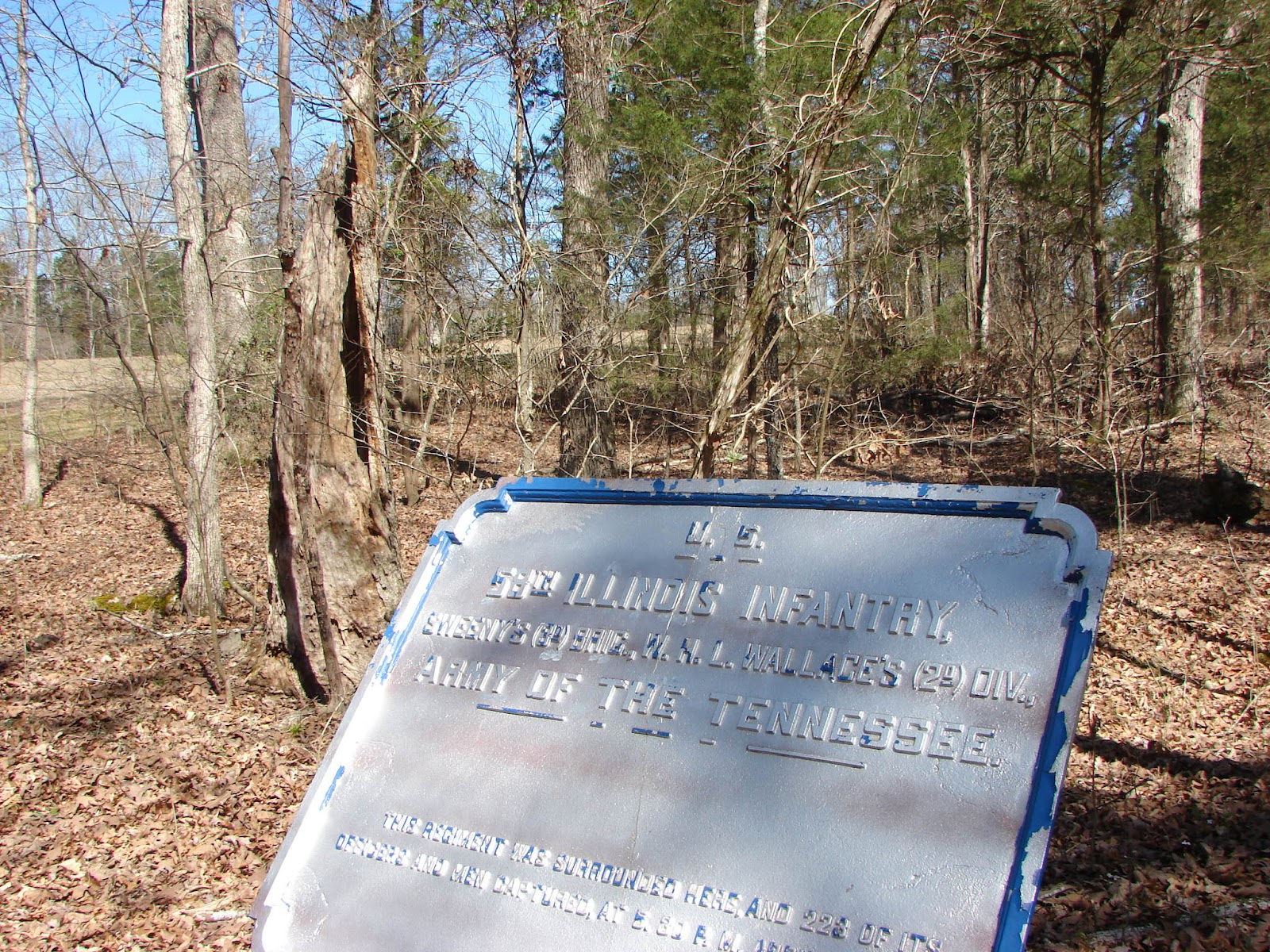
More importantly, for many years, historians have hailed the Hornets' Nest as the most important part of the Battle of Shiloh. According to the standard interpretation, as Federal forces fell back on the right and left flank, remnants of Benjamin Prentiss’s division and several brigades of W.H. L. Wallace’s division held fast, serving as a hindrance for the Confederate advance. Confederates who made gallant attempts to overcome these Union troops later compared the experience of the shot and shell flying through the air to the sounds and stings of hornets, thus creating the name, "The Hornets' Nest." After hours of heated fighting with numerous Confederate frontal assaults and artillery barrages, Federal forces at the Hornets' Nest were overwhelmed. The collapse of supporting troops on their right and left flanks meant that the attacking Confederates enveloped the position entirely; some Federals got away, but over 2,000 Union soldiers surrendered, including Brigadier General Benjamin Prentiss himself (another post on Prentiss's division at Shiloh can be found here). If one takes a short walk into the Hornets' Nest woods, markers locating the surrender sites for many of these regiments can be found (these were easily some of my favorite markers on the battlefield).


 Surrender site of Brigadier General Benjamin Prentiss

 Prentiss surrender site in the Hornets' Nest

David W. Reed, a veteran who fought as a part of an Iowa Regiment in the Hornets' Nest, became the first historian of Shiloh. His work and interpretations of the battle focused heavily on the Hornets Nest, sparking generations of historical works which likewise saw the action there as the central moment of the battle.  The Federal stand at the Hornets' Nest delayed the Confederate advance, allowing Grant time to form his last defensive line near Pittsburg Landing. Thus, Federal forces at the Hornets' Nest may have been captured, but they served a vital and indispensable purpose for Grant’s army that day. This interpretation, advanced first by Reed, picked up by later generations, and carried along by the long running Shiloh park film, is perhaps why the Hornets' Nest is such a famous aspect of the battle. 


 Sunken Road, on the Federal right flank in the Hornets' Nest, with Duncan Field to the left

 
 Across Duncan field (to the right), on the afternoon of the 6th, over 50 Confederate guns were gathered for an artillery barrage aimed at driving back Federal troops at the position above.


In more recent interpretations of the battle, historians such as Shiloh Park Historian Stacy Allen and former Shiloh ranger Timothy Smith have advanced theories that the Hornets' Nest was not the key to the battle. In fact, they suggest, using detailed views of the battle, that the heaviest fighting occurred both east and west of the Hornets' Nest, particularly to the west, where the divisions of William T. Sherman and John McClernand fought a brutal struggle against nine Confederate brigades on the Union right flank. Allen and Smith have argued that rather than the stand at the Hornets' Nest, Confederates lost the battle due to confusing terrain, not understanding the position of the Union army, and a lack of cohesion in the Confederate attacks that day. Johnston's battle plan had called for the Confederates to turn the Federal left flank close to the Tennessee River; the Confederates could then push Grant’s army back on the swampy land around Owl Creek, forcing the surrender or destruction of the Army of the Tennessee. Moreover, these historians have argued that the fighting around the Hornets Nest was relatively light compared to elsewhere on the field. While several fierce Confederate charges were made, they were not as great in number as others may claim.
After doing extensive reading on the battle over the last few weeks, I would have to say that I personally agree with the newer interpretation of Shiloh. I find the Hornets' Nest to be a fascinating, compelling, and important part of the battle. But, I don’t see it as the one area where the Union army was saved or turned the Confederate tide. In a battle as vast and complicated as Shiloh, there cannot be just one area where the tide turned (same thing with Gettysburg: sorry Chamberlain, you were great, but so was George Sears Greene on Culp’s Hill). Perhaps it was the fierce fighting of Sherman and McClernand as they fell back, the stubborn stand of Prentiss and Wallace at the Hornets' Nest, the death of Johnston, the firm last defensive line of Grant, and Beauregard’s decision to halt the attack that evening which together conspired to slowly turn the tide from Confederate surprise to Federal defensive stand on April 6. Of course, all of these factors were ultimately influenced by the confusing terrain and the jumbled Confederate attack. It all goes back to the necessity of understanding the terrain and the field to understand how battles were fought and why they ended as they did.


 Park wayside marker for the Hornets' Nest surrender. The portion of the Federal line running along the road in the foreground was held by two brigades of Brig. Gen. W.H.L. Wallace's division


Along with Allen and Smith, the late historian O. Edward Cunninghman’s thesis on the battle, which was published posthumously and edited by Gary Joiner and Timothy Smith, elucidates these newer interpretations of the battle quite nicely. I would highly recommend it for anyone interested. For the other historians who I have mentioned, Shiloh historian Stacy Allen penned a great two part piece on Shiloh that appeared in the Blue and Gray magazine in the late 1980s, which is a must read. Timothy Smith has written a few fantastic books on the battle and the battlefield, among which are The Untold Story of Shiloh, ThisGreat Battlefield of Shiloh, an upcoming book on the fight for Corinth which followed Shiloh (titled Corinth,1862). Smith also penned an essay specifically on the Hornets Nest which can be found in The Shiloh Campaign, edited by well known historian Steven Woodworth. Anyways, these are just a few thoughts from your humble blogger/Antietam ranger, who will be the first to admit his lack of expertise in the field of Shiloh studies (If you can permit me to write in the third person, that is). If you are interested in this topic, feel free to check out some of these outstanding works on the battle that I have thoroughly enjoyed reading over the past few months (you will find that the titles are linked to amazon.com pages for the books). I thought a brief historiographical piece and my thoughts on the topic would be a much more interesting way of showing off my Hornets' Nest pictures. If you are like me, then you find how we interpret Civil War battles to be just as fascinating and important as the actual battle itself.