Our Country's Fiery Ordeal

A blog about the American Civil War, written and maintained by historian Daniel J. Vermilya, author of The Battle of Kennesaw Mountain (History Press, 2014) and James Garfield and the Civil War (History Press, 2015)

Dedicated to my great-great-great grandfather, Private Ellwood Rodebaugh, Company D, 106th Pennsylvania Volunteer Infantry, killed at the Battle of Antietam, September 17, 1862.

"And may an Overuling Providence continue to cause good to come out of evil, justice to be done to all men where injustice has long prevailed, and finally, peace, quiet, and harmony to come out of this terrible confrontation and our country's fiery ordeal." -- Albert Champlin, 105th Ohio, Diary entry of June 19, 1864 (Western Reserve Historical Society)

Showing posts with label Book Reviews. Show all posts

Wednesday, April 30, 2014

Book Review--Confederate Combat Commander: The Remarkable Life of Brigadier General Alfred Jefferson Vaughan, Jr., by Lawrence Peterson


While there are far too many books on the Civil War to count, there are surprisingly few on the Confederate forces of the war’s Western Theater actions. In the theater which many historians argue saw the largest impact on the overall strategic outcome of the war, there is a dearth of biographies and examinations of key Confederate leaders. This extends from the relative lack of studies on Braxton Bragg to lesser known generals and officers. One of these lesser known officers is Brigadier General Alfred Vaughan Jr., a brigade commander in the Army of Tennessee who lost his leg to an exploding artillery shell near Smyrna, Georgia, in early July 1864.

I drew interest in Vaughan because his brigade was positioned at the “Dead Angle” position at Kennesaw Mountain, seeing some of the fiercest fighting during the days of struggle at Kennesaw in late June 1864. But a recent biography by Lawrence K. Peterson--Vaughan's great-great grandson--opened my eyes to the remarkable Civil War career which Vaughan had, stretching far beyond Kennesaw Mountain. Vaughan’s career in the Army of Tennessee extended back to the very origins of that army. His personal list of battles reads as a list of the bloodiest and most important battles of the West: Shiloh, Perryville, Stones River, Chickamauga, Chattanooga, and the Atlanta Campaign. If one wanted to follow one officer through the worst of the West, battle by battle, Vaughan is an excellent choice.

Peterson’s biography is well written and well researched, providing great insight on Vaughan’s leadership and experiences. The narrative focuses heavily on Vaughan’s actions in each of the major battles, as well as the behind the scenes action in the Army of Tennessee, which, considering the personalities in that army, could be just as complex as the battles themselves. The primary source used appears to be Vaughan’s own account of his regiment, the Personal Record of the Thirteenth Regiment, Tennessee Infantry, C.S.A. (Memphis: S.C. Toof, 1897). Vaughan was instrumental in the formation of the regiment, serving as the first Captain of Company E, which was previously a militia group known as the “Dixie Rifles”, a group of Mississippians (Vaughan’s adopted home state was Mississippi, despite his Virginia birthplace) who were armed and equipped by the state of Tennessee. By June 1861, Vaughan became the lieutenant colonel of the regiment. During the fighting at Belmont in November 1861, Vaughan assumed command of the regiment, and was promoted to the rank of colonel after the battle. He served with distinction at Shiloh, and later in 1862 he rose to brigade command. Peterson follows Vaughan and the Army of Tennessee through the rest of the war with a nice balance between the biographical narrative and the broader history of the campaigns and battles which Vaughan was involved in. It was only after his stellar conduct at Chickamauga in September 1863 that Vaughan was promoted to the rank of brigadier general, receiving praise and recommendations from numerous commanders, including Patrick Cleburne and Benjamin Cheatham.

The author makes mention several times that Vaughan had a “personal servant” with him during the war, named Roach Howard. Howard was, of course, one of the Vaughan family slaves. Peterson notes that after the war Howard was set free, but does not give further detail into why or how this occurred. It is only one small instance in a larger book, but this reader wished that more information and detail was provided in the text on the life of Howard, as well as the master-slave relationship between the two men.

Peterson's biography goes beyond Vaughan's war years as well, discussing the general's post war years, a subject often neglected by Civil War studies of particular officers and units. These insights, as well as the detailed focus on Vaughan and his brigade through the western theater of the war, make this a very well rounded book, the likes of which there are too few, especially in regards to the leaders and brigades of the Army of Tennessee.

For those looking for a deeper understanding of the Army of Tennessee, as well as a deeper knowledge of the major battles of the war’s Western Theater, pick up Lawrence Peterson’s biography of Alfred Vaughan, published by The University of Tennessee Press, titled, Confederate Combat Commander: The Remarkable Life of Brigadier General Alfred Jefferson Vaughan, Jr. Peterson deftly examines the life of an important yet little known Confederate brigade commander who saw some of the war’s fiercest combat.

Friday, December 13, 2013

Book Reviews- Smithsonian Civil War: Inside the National Collection


This review is much different from others that I have done. While most books that I review on here are typical monographs, where an author is either presenting a history or an argument of some kind, the latest book from the Smithsonian on the Civil War is more of a picture/coffee table book.

That being said, don’t miss it. It is incredible.

The book highlights the best from the Smithsonian’s Civil War collection, as well as short pieces describing the artifacts and what their meaning or significance is to the larger war. I spent some time going through it with my wife the other night, and we were both hooked. It is a very well done book, with a fantastic hard cover exterior and clean, bright pages with great design and amazing photographs. These are high quality pictures of Smithsonian items. It is almost as if you have the item in front of you.

Among the high resolution pictures of Smithsonian items are an image of a shattered tree trunk from Spotsylvania, cut down by musket fire; the masks worn by the Lincoln assassination conspirators during their imprisonment; the famed painting Grant and his Generals by Ole Peter Hansen Balling; the sword of Union Colonel Strong Vincent, mortally wounded at Little Round Top on July 2, 1863; a uniform coat, pistol, and chess set belonging to George McClellan; and the sword which Sherman wore at Shiloh. 

I found these after just a few minutes of flipping through the pages.

The accompanying text is a nice addition, but for me, the artifacts pictured in the book, as well as its nice layout, are enough to make this an awesome addition to my library. Having recently moved in with Alison in our apartment in State College, I set up a few small book shelves in the living room with some nicer books that I like having out. This book is certainly one of them.

The book is a timely reminder of the most compelling artifacts from our nation’s most important war. During the 150th anniversary of the Civil War, we need to look back and remember the war in its reality. Seeing dramatic photographs and artifacts such as these bring the war to us in a very real way. If you can’t visit the Smithsonian to see these items, buying the book is a great way to have them with you at home. Jon Meacham’s Forword for the book lays out a case for the importance of the Smithsonian’s Civil War collection, and this book, quite adeptly:

Americans of the twenty-first century need books like this and institutions like the Smithsonian, for without photographic images of the brutally scarred back of a slave or of the dead on battlefields and in trenches that we tend to associate more with the Somme than with our own land, the Civil War risks receding into fable rather than urgent fact.


If you need a Christmas present for the Civil War buff in your life, Smithsonian Civil War: Inside the National Collection, is a perfect choice.

Monday, December 2, 2013

Book Review: John Bell Hood-The Rise, Fall, and Resurrection of a Confederate General, by Stephen Hood


I had originally wanted to publish this review much sooner, but alas sometimes life gets in the way. Look for more reviews on here in the coming weeks, as my season at Antietam has drawn to a close in time for me to finish some of the other projects that are ongoing.


And now, for the review...


There has been much discussion over Stephen Hood’s new book “John Bell Hood: The Rise, Fall, and Resurrection of a Confederate General.” The volume, published by Savas Beatie, is a fresh examination of Hood, not as much the man or the general, but rather how he has been perceived through the generations. The book is organized by chapters which each tackle a separate Hood “myth” or misunderstanding. Much of the text is spent discussing historiography and what others have said about Hood. Among the specific topics taken on the author discusses how certain “myths” about the general came about, such as his alleged use of Laudanum and misstatements about the bravery of his men. 

During the course of these arguments, the reader picks up quite a bit of information about Hood. I have seen other historians and writers criticize the book as being shallow on historiography. I cannot understand why, as every chapter devotes significant attention to various authors and historians who have perpetuated myths regarding Hood. Of all the things that can be said of this book, saying the author doesn’t take historiography into account is certainly not one of them.

Overall, the book is a worthwhile addition to the literature on Confederate generals, especially on Hood. I can’t imagine anyone writing on Hood in the near future and not having to either read, cite, consult, or address Stephen Hood’s new book. At the end of the day, that is perhaps one of the most important things that can be said of any work. 

That being said, I didn’t find every argument the author made to be compelling, and there were some points that were made with which I just flat out disagreed. The author addressed some of the myths or charges against Hood by deflecting attention and blame onto other commanders. For example, when discussing claims that Hood was ruthless or that he spoke poorly of his men, the author cites Sherman’s writings and conduct following Kennesaw Mountain as an example that other generals occasionally spoke in cold, calculating terms about bloodshed on the battlefield. This example doesn’t really address the stated issue of the chapter, nor does it specifically refute the idea of Hood as a cold general when it came to loss. 


There certainly were other arguments which I found unconvincing. I agree in part with Carole Emberton's review of the work, published on the Civil War Monitor here. Emberton raises some issues with the book that are legitimate (I'll leave it to you to read her arguments and take part in the debate), but her judgment that the book misses the mark because it fails to provide a new view of Hood is incorrect. The author is quite clear in stating that this book is not a biography, but rather a defense of Hood in light of the negative aura that historians have built around the general for decades. Knowing that going in to the book is a key part to understanding its arguments.


Don’t let this distract you or dissuade you from taking the book seriously, however. The point isn’t whether I was entirely convinced by every chapter and every argument. In some instances, my opinion was changed. In others, it wasn’t. An author shouldn't have to make his reader agree with every point in the book for him to accomplish his job. The point is that each chapter and each argument caused me to stop, think, and reevaluate my own understanding of Hood. I can think of few higher compliments that can be given to any new book. That fact alone means that the author and the book are doing something right. 


One of my complaints with the work is that throughout, many mentions are made of the author having a set of new, never before published personal papers from Hood. The papers are quotes or referenced selectively, and the reader is left desiring to learn more about this collection. I have recently learned, however, that there is a forthcoming volume of these new Hood papers, edited by Stephen Hood, and being published by Savas Beatie. I am in part reserving some judgment on the book until these papers are published. Because the papers mentioned in the book were brought up sparingly and selectively, I am curious to learn more and see how they may or may not further support the author's arguments.


When I finished the book, I had a renewed respect for John Bell Hood. Many of the “myths” surrounding him were soundly, efficiently, and entirely dismantled, such as the idea that Hood was addicted to laudanum.

Despite this being one of the most talked about part of the book in various reviews and online blog posts, I found it to be a rather small piece of the larger story. Viewing this book as an argument that Hood never used laudanum is to miss the forest for the trees. The point isn’t the alleged drug use; the point is to clarify, and where necessary debunk, the wild rumors which have impeded our view and understanding of Hood for so many years. The author's efficient and systematic dismantling of this myth was a small, yet important part of the book in that regard.


I have read biographies on the general before, and expected this to be more biographical in nature. However, despite the book taking a different approach than I expected, I still finished it glad that I had read it. The field of Civil War scholarship needs more books like this one, with more authors like Stephen Hood, being willing to challenge long held and deeply entrenched myths about the American Civil War. I have long believed that the average history buff knows more fiction than fact about the Civil War. Books like this have a place, and are needed in scholarship to correct such myths, start conversations, fuel debates, and give us pause to reflect upon whether or not our opinions are formed by fact or by years of misstatements and mythology. If you have an interest in John Bell Hood, or if you have an interest in fresh new approaches to writing about the Civil War, I would recommend John Bell Hood: The Rise, Fall, and Resurrection of a Confederate General by Stephen Hood.

Thursday, September 5, 2013

Book Review: Connecticut Yankees at Antietam

Hello all,


I wanted to post about a new book out on Antietam by John Banks, who runs a great blog on Connecticut soldiers at Antietam and Gettysburg (his is one of the featured blogs in my links section on the side of the page).


I have had the chance to meet John a few times, and I am very glad he has published a book on Connecticut soldiers at Antietam through the History Press, which is churning out a large number of high quality works as of late.


John's book doesn't look at the battle in any sort of regiment by regiment fashion, following various Connecticut units movements on the field. Rather, he approaches the topic by telling stories. With a background in journalism (he actually works for ESPN!), Banks writes with the narrative ability of a natural story teller. The book is an incredibly good read, and the material used in the stories provides some incredibly moving examples of humanity and suffering at Antietam. Certainly, Banks spent many hours doing thorough research for this volume. Each chapter is relatively short (as is the book, a typical size for History Press works), which makes it very accessible for novices and experts alike.


One story that stood out the most for me among the moving stories featured in Connecticut Yankees at Antietam is that of Captain Newton Manross of the 16th Connecticut, who wrote to his wife explaining his decision to serve his country, "You can better afford to have a country without a husband than a husband without a country." Manross was killed at Antietam.

What a powerful quote. Nearly every story featured in this book has material that will be sure to captivate a wide audience from park rangers to those picking up their first book on Antietam.

I have really enjoyed reading through this new volume, and I highly recommend it. With battle anniversary just around the corner, I will likely be including some of Banks's Connecticut stories in my programming for the upcoming Antietam 151st, especially on my Burnside Bridge hike on Sept 14th. I highly recommend this new work, which you can find on amazon.com here.


Saturday, November 24, 2012

Christmas Shopping: Civil War Books

Yesterday, I went to see "Lincoln" with my Dad (it was the third time I have seen it, and it is still incredible), and afterwards, I braved the "Black Friday" crowds to check out Barnes and Noble (I am a member so I get discounts there, only reason to go). While there, I picked up a few Christmas gifts (when you are related to a Civil War historian, odds are you will get books or book themed gifts for Christmas, ok, enough with the parentheses). I also picked up Jon Meacham's new biography of Thomas Jefferson, titled, Thomas Jefferson: The Art of Power. After reading a few chapters, I can say that I am really enjoying it, and would recommend it to anyone with an interest in the political history of the early Republic, or anyone who simply is interested in great American leaders. Anyways, picking up that new book gave me an idea for pointing out a few other Civil War themed books that have just been released that are on my radar for the Holiday shopping season. Keep in mind, I haven't read these yet, but they look pretty intriguing. If you have read them, feel free to post your thoughts on them as a comment below.


Confrontation at Gettysburg, by John David Hoptak

John Hoptak, my colleague from Antietam, and a very good friend, has just released his latest work for the History Press's Sesquicentennial Series on the Civil War. Last time, John did a splendid job taking on the Battle of South Mountain. This time, he went for a topic a little bit more obscure: Gettysburg. I had the pleasure of reading some of John's manuscript earlier this year, and I must say, it is very good. This book is meant to be an introduction to the battle. Following each chapter, John has a paragraph on sources and other works to investigate for learning about the campaign and each day of the battle in more depth. I would highly, highly, highly recommend this to anyone who has a dad or brother who loves history and wants to learn more about Gettysburg. With the 150th anniversary of that battle coming up next year, there is no better time to pick up a copy of John's book than now. I will post a full review of it on here when I get a chance. But for now: buy it. It is very good.


The Man Who Saved the Union: Ulysses S. Grant in War and Peace, by H.W. Brands

I have read some mixed reviews on H.W. Brands's new biography of Grant. From what I know, Brands is an accomplished historian, and this work is well written and does a splendid job of discussing Grant as a general. However, where it falls short (again, this is just based off of reviews I have read, not my own thoughts) is in fitting Grant's story into current trends of scholarship, mainly in terms of Grant's feelings toward slavery and emancipation. I will have to read it for myself to either verify or reject these claims, but I think this book is still worth a look. Here is a review from acclaimed historian Eric Foner that explains these notes in more depth: http://www.washingtonpost.com/opinions/the-man-who-saved-the-union-ulysses-grant-in-war-and-peace-by-h-w-brands/2012/11/02/154ae6e0-fe79-11e1-8adc-499661afe377_story.html


A Wicked War: Polk, Clay, Lincoln, and the 1846 U.S. Invasion of Mexico, by Amy Greenberg

In many ways, the War with Mexico was a warmup for the nation's plunge into Civil War. Many Civil War officers from both sides got their start during the 1840s conflict in Mexico, and the end result of the war led to some of the arguments and problems which directly contributed to the start of the Civil War just over one decade later (namely land acquisition and the spread of slavery). Now, again, I haven't read this work yet, but from what I have read about it, Amy Greenberg has done a nice job in taking on the War with Mexico. Here is a review of the work: https://www.kirkusreviews.com/book-reviews/amy-s-greenberg/wicked-war/#review.


Battle of Stones River: The Forgotten Conflict between the Union Army of the Cumberland and the Confederate Army of Tennessee, by Larry Daniel

Those who are students of the War in the West are no doubt familiar with Larry Daniel, who has authored one of the best books out there on Shiloh and a definitive account of the Army of the Cumberland. I have already ordered his latest on Stones River, and hope to post some thoughts on it when it arrives, but if this is as good as his other works, I won't be disappointed.


To Antietam Creek: The Maryland Campaign of 1862, by D. Scott Hartwig

This is one work which I have been reading for awhile. It is almost 800 pages, and covers the Maryland Campaign up to the night before the Battle of Antietam. After reading most of it, I can firmly say that I fully recommend this book. It is fantastic. It will soon become one of the must read, go to accounts of the Maryland Campaign. I posted some early thoughts on it awhile back, and I have to say that I still agree with much of what I posted about this work upon first getting it. If you are interested in Antietam and don't yet have this book, you are doing yourself a great disservice.


Here are a few other new titles which might merit investigating...


We Have the War Upon Us: The Onset of the Civil War, November 1860 to April 1861, by William J. Cooper

Seward: Lincoln's Indispensable Man, by Walter Stahr

Terrible Swift Sword: The Life of General Phillip H. Sheridan, by Joseph Wheelan


And, although it is not Civil War related, the third and final volume of the late William Manchester's biography of Winston Churchill has just been released. Churchill ranks high upon my list of admired figures in history, and I will certainly be looking to pick this one up soon.

The Last Lion: William Spencer Churchill: Defender of the Realm, 1940-1965, by William Manchester and Paul Reid


These are just a few titles that have caught my eye. If you are a history buff, or are shopping for one, look into them. Keep in mind, the only ones which I am fully recommending are John Hoptak's book on Gettysburg and Scott Hartwig's To Antietam Creek (although I would recommend Jon Meacham's aforementioned Jefferson bio as well). As I said, if you have read any of these books, feel free to post your thoughts as a comment below. If you are like me and you haven't yet read them but are interested, check out these books!


Tuesday, September 25, 2012

Early Thoughts on "To Antietam Creek", by D. Scott Hartwig

One of the best parts of the Antietam 150th is that many new titles have come out about the battle and the campaign. I recently reviewed Bradley Gottfried's latest work, Maps of Antietam, here, but I would also like to highlight a few others.

Hopefully, sometime soon, I can post some thoughts about the latest installment of Ezra Carman's magisterial work on the campaign. Volume 2 of Carman's manuscript was recently released, and Tom Clemens once again provides extraordinary insight and knowledge in the footnotes. I have been thumbing through the book, and plan to post on it relatively soon.

For now, however, I want to highlight a book that was just released this week. Many years in the making, To Antietam Creek is a history of the Maryland Campaign, part one of a two volume set on the campaign and Battle of Antietam. To Antietam Creek is an incredibly in depth work which runs from the start of the campaign through September 16th, providing detailed analysis on each army, on commanders, and on the action which led the armies, appropriately enough, to Antietam Creek. Written by Gettysburg NMP historian D. Scott Hartwig, this volume is not for the faint of heart. Complete with footnotes and order of battle, it runs nearly 800 pages. Needless to say, I haven't had the time to read all 800 pages in the few days since I picked up my copy at the Antietam bookstore. However, what I have been reading is really good and looks very promising.


I am sure I will find parts of the book which I don't entirely agree with, or some I may strongly disagree with, but based on what I have read so far, I think I can conclusively say this: Hartwig's To Antietam Creek is, unlike other recent works (such as Richard Slotkin's The Long Road to Antietam), a scholarly historical work that gives the Maryland Campaign the treatment that an event of its magnitude deserves. Certainly, the work of historians such as Carman, Clemens, Harsh, and Rafuse have done wonders for our understanding of this campaign; in fact, those historians have set a standard of excellence by which we can measure other work on the campaign. Perhaps this new volume can rise to that standard as well. Hartwig's book certainly deserves our attention. I have a feeling that this work will be sitting on my bookshelf for years, filled with notes, underlined sections, and well worn pages.

I want to highlight a few passages from Hartwig's chapter on the Army of the Potomac in the Maryland Campaign, as they seem to be in sync with some of my own research and work on the Army of the Potomac this year (hopefully without sounding too vain on my part; anything I have done pales in comparison to work of this length, depth, and magnitude). Hartwig doesn't go into the detail on troop strengths throughout the campaign and the experience levels that I used in my research for the Joseph Harsh award, but his work is an extremely refreshing take on the difficulties, challenges, and complexities facing the Union forces in the Antietam Campaign. Considering that my work was more of a comparative study against false conceptions of the Army of the Potomac in the most popular histories of the campaign, this young historian is especially comforted to know that some of what I presented on is backed up by the work of a historian of Scott Hartwig's caliber.


Here are just a few quotes from Hartwig's work that were wonderful to read...

"Straggling, absenteeism, and lax discipline were the byproducts of the defeatism that afflicted the army." (135)

"Straggling was nearly as serious in the Army of the Potomac as it was in Lee's army" (135).

"The popular image of a well-fed, well clothed, Union army in the Maryland Campaign is one of its myths. Although the army was generally better clothed, better fed, and better equipped than the Confederates, there were plenty of 'Ragged Yankees'" (137-138).

Speaking of Federal strength upon leaving Washington, namely, the veteran forces in the army: "The entire field army at this point numbered about 60,000 effective soldiers, hardly the Union juggernaut that is typically described in Maryland Campaign studies" (139).

"Histories of the Maryland Campaign rarely fail to highlight the Army of the Potomac's superiority in numbers, but at the outset of the campaign that advantage was rather slight, and the qualitative edge went to the Army of Northern Virginia." This refers to the relative inexperience of Federal forces in the campaign (139).

"The Army of the Potomac marched into Maryland as a powerful but imperfect force. It was better equipped, uniformed, and supplied than its adversary, and it had a slim advantage in numbers. But the negatives outweighed the these advantages. Mutual suspicion and a lack of confidence marked the relationship of its commander with the president, his cabinet, and the army's chief of staff. Two of the corps commanders were facing a potential court-martial at the end of the campaign. The senior leadership lacked the unity and trust in each other that Lee's command structure had, and McClellan generally discouraged any initiative by his subordinates. There were no leaders at corps command who were of Jackson's and Longstreet's caliber. The infantry contained large numbers of new recruits with little training. The army's overall organization remained incomplete, and some branches, such as the artillery, were downright inefficient. Lee may have had the smaller army, but it was an army with superior organization, morale, and leadership, which invariably proved to be more flexible and responsive, as well as capable of concentrating troops more rapidly.
"Still, for all its imperfections, there was something magnificent about this Army of the Potomac. It had shown its resilience and dedication in the speed with which it shook off the disaster at Manassas. Defeat had washed away the starry-eyed optimism that had once buoyed the army, and it viewed the future with the grim knowledge that whatever lay ahead would be hard and bloody... So much rode on the shoulders of this army: the preservation of the Union, and the future of freedom in America. The Army of the Potomac would determine on the battlefield whether the document in the president's desk remained locked away or shed its light on the nation's future [referring here to the draft of the Emancipation Proclamation written in July, 1862] (160-161).


Now, if you will excuse me, I have an 800 page book to read cover to cover. More thoughts to come once I can make my way through the book in its entirety. Let's hope that my early optimism is rewarded upon finishing the work.

Wednesday, September 19, 2012

Book Reviews: Maps of Antietam


I have had this book sitting on the shelf for a few weeks, and haven’t gotten around to reviewing it until now. Bradley Gottfried’s latest work, The Maps of Antietam, fills a void in the scholarship on the Antietam Campaign. While numerous books have been written on the battle and campaign, few cover the movements of troops in an easily accessible format. For students of the battle, the maps of Ezra Carman are the gold standard in studying the movements of troops on the field during the action. Gottfried’s work is based in part upon the Carman maps, and many of the troop placements and positions are familiar. The maps are conveniently divided into different sets, covering the campaign, various parts of the battle, as well as the end engagements near Shepherdstown on the 19th and 20th. Each map is accompanied by a page of text, detailing the actions of the specific map. Taken together, they provide a thorough explanation of the actions on the field for both first time readers and seasoned Antietam readers alike.

Maps of Antietam
, like any work, is not without its flaws, however. There are typos on several maps, and some of the troop placements are questionable. For example, Map 16:5, showing the fighting in and around the Sunken Road, shows the 61st and 64th New York flanking the very end of the Confederate line, placing the Union breakthrough further east than it actually was. Had these two regiments broken the line at that point, their fire into the Confederate flank would have been obscured by a distinct ridgeline running through the Sunken Road. Other examples include referring to Union Brigadier General Abram Duryee as “George Duryee” on page 132, and mislabeling the 107th New York of George Gordon’s Brigade as the 107th Pennsylvania (which was correctly labels in maps as being in Duryee’s brigade). Errors such are unfortunate, yet do not detract from the overall value of the book as much as simply make necessary a second printing so that they can be properly corrected.


Ultimately, while not perfect, Maps of Antietam is a very worthwhile work. It is nicely produced, the maps are easy to read and accessible, which is something that cannot be said for other maps of Civil War battlefields. I would recommend it for veteran students of the battle, as well as for Antietam novices, as it will serve as a handy reference for troop movements. It is not a comprehensive and authoritative work, but a good reference guide for those tramping the battlefield or searching for the movements of a particular unit. While nothing will ever surpass the work done by the magisterial Ezra Carman, Maps of Antietam is a welcome addition to the literature on Antietam and the Maryland Campaign.

Tuesday, August 7, 2012

Book Review: The Long Road to Antietam, by Richard Slotkin

"Good philosophy must exist, if for no other reason, because bad philosophy needs to be answered."
-C.S. Lewis


I wanted to begin my review of the latest Antietam book to hit the market with this quote for two reasons.

1. I love C.S. Lewis, and have a general rule of using his writing as much as possible.
2. While referring to philosophy, I think the principle of the quote applies to history as well. Good history must be written, if for no other reason, because bad history needs to be answered.


Which leads me to The Long Road to Antietam by Richard Slotkin, the latest in a long string of popular histories written to tell the tale of Antietam and the Maryland Campaign of 1862. The story of the campaign is, after all, one of the most important in American history. At the start of September, Vegas surely would have been giving good odds for Robert E. Lee and the Confederacy to win their independence, and soon. Federal forces in Washington were in disarray, Lee's army was riding a high tide of momentum, and it appeared as though Abraham Lincoln may never have the chance to issue the draft of the Emancipation Proclamation that had set in his desk since July. Yet, incredibly enough, just two and a half weeks later, Lee's army was limping back into Virginia, Federal forces had saved Washington, Maryland, and Pennsylvania, the North had new life, and Lincoln was issuing the Emancipation Proclamation. Surely, the Union general who led the Union Army of the Potomac has been heralded by authors like Richard Slotkin out of thanks to his contributions in saving the country....


This, however, is not the story Richard Slotkin tells in his latest work. This book is an attempt to tell the story of "how the Civil War became a revolution," as the subtitle reads. Antietam is a vital part of the story of freedom in this country. It was the battle that transformed the Civil War from being a fight to restore the Union to a revolution that would destroy slavery and establish a new standard of freedom for all Americans. In many ways, Antietam was a battle for the future of freedom in America. That is the story this book sets out to tell.


Granted, this work does have its strong suits. The prose is highly readable and enjoyable, and its emphasis on trying to combine political and military history is one which is sorely needed in the field of Civil War scholarship. However, after reviewing the work, I can't really say that this work does much to benefit our understanding of the Antietam Campaign and George McClellan.


First off, the narrative is filled with numerous errors when discussing the history of Antietam and the Maryland Campaign. One of the most glaring errors that I found (on page 239) was Slotkin writing that the Roulette farmstead that was burned during the Battle of Antietam. The William Roulette farmstead was not burned during the battle. The Mumma farmstead was. Perhaps even the casual visitor who has taken the Antietam driving tour would be able to point this out, being that the Mumma farm is one of the 11 stops on the park driving tour, and interpretive markers discuss what happened to the farm. Certainly, the Roulette farm is near the Mumma farm, but mistakes like this simply should not make their way into print. The burning of the Mumma farm was an important landmark on the battlefield, and affected both troop movements and the lives of the Mumma family alike.

Another error, this one repeated throughout the work, is Slotkin's assertion that Lee's army was organized into a corps structure during the Maryland Campaign. This is not true. In Maryland, Lee used a two wing structure for parts of the campaign: one wing was ostensibly commanded by “Stonewall” Jackson, and the other by James Longstreet. During the division of his army under Special Orders 191, these two wings were divided up to accomplish Lee’s objective. Slotkin argues that the Confederate corps structure increased the organizational cohesion of the Confederate force; that was not the case. During the Battle of Antietam, units that were supposedly in Longstreet’s “wing” were fighting under Jackson, and Jackson's men fighting under Longstreet. Furthermore, it is not until a few days after the battle, once Lee was back in Virginia, that his army adopted a corps command structure. 
Other errors that can be easily found include the claim that Union generals Fitz-John Porter and William Franklin were actually arrested following their conduct at Second Manassas (they had charges leveled against them, but neither was actually arrested). Slotkin also suggests that George Meade was given the Pennsylvania Reserve Division in the First Corps at the start of the campaign to improve its function as a fighting unit. This is untrue; Meade took command of the division just a few days before the battle when its prior commander, John Reynolds, was sent to Pennsylvania to take command of the state militia. Slotkin also rather strangely refers to the East Woods and the West Woods as the East and West “Wood”. I could keep going for quite awhile, but you are starting to get the picture.

Despite these inaccuracies, my primary problem with Richard Slotkin’s newest book is the treatment of George B. McClellan.

DISCLAIMER: I am not a McClellan “apologist”. I am a Civil War historian who focuses on the Antietam Campaign, and one who thinks that discussing McClellan based on facts, evidence, and rational inquiry provides a more balanced view of the general, highlighting both his good and bad actions as a commander.

Now, back to the review.

Slotkin uses The Long Road to Antietam to describe George McClellan as arrogant, narcissistic, neurotic, devious, timid, incompetent, and altogether, one really bad dude.


Basically, he is Scar from the Lion King.


Each one is an evil character, intent on seizing power from the good guys (either Lincoln or Mufassa) and using it for their own nefarious schemes. Also, each one has facial hair, so, there is that too.


Scar from "The Lion King"


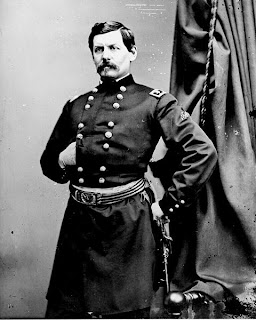
George Brinton McClellan


See the similarities, right?


Students of the Maryland Campaign are no doubt familiar with Stephen Sears, author of Landscape Turned Red, the most widely read book on the Battle of Antietam. Sears is well known as being very critical of George McClellan. Yet, despite Sears's harsh judgments on McClellan, even he believes it is beyond the pale to question the motives and sincerity of the general. As Sears wrote in an essay collection on the Army of the Potomac:


 "Whether at headquarters or on the battlefield or in the political arena, in defeat and disappointment, George McCelllan never wavered in his determination to put down the rebellion. Historians will no doubt continue to debate his exact contribution to that cause, but they have no cause to deny the sincerity of his efforts." (Sears, "Little Mac and the Historians" in Controversies and Commanders, 24).

In The Long Road to Antietam, Richard Slotkin suggests throughout the book that George McClellan was a general more concerned with his political reputation and future than victory on the battlefield, coming close to, if not crossing the line of, accusing the Union general of treason numerous times.


Repeatedly, Slotkin argues that McClellan cared far more about his reputation in Washington than about the rebel army in Maryland. In fact, he suggests that the only reason McClellan wanted to achieve a victory in the Maryland Campaign was to stick it to Stanton and Halleck and to possibly rise to become the leading figure in the war effort once again. He singles McClellan out as arrogant and nefarious, leaving the reader with an impression of McClellan as a commander more interested in political intrigue than in affairs on the battlefield. In one of the harshest and most peculiar knocks against McClellan, Slotkin argues that the Union commander issued no written orders at Antietam to protect his reputation should the battle go poorly:


McClellan not only limited the forces he entrusted to his assault commanders, he did not fully inform them of the tactical plan for the battle they were about to fight. His refusal may have reflected, and been intended to conceal, his indecision about where and how to strike his heaviest blows. It is also possible that he refused to discuss his plans with his subordinates, and declined to issue written orders, so that no one—neither his colleagues nor his rivals—would know whether his plans had been well—or ill—conceived. His defensive position had to be impregnable on both fronts. (247)


Slotkin is arguing that McClellan did not issue written orders either because he was indecisive (with no proof or explanation as to why) or to protect himself from politicians in Washington (ie. Should the army lose, his orders would not be used against him, with Washington being the second front referred to). This theory goes beyond the normal complaints about McClellan being “slow” or “incompetent,” and ventures into the realm of accusing the general of paranoia, and treachery. To suggest that McClellan would put his soldiers’ lives at risk by knowingly holding back written orders simply to protect himself politically, and to do so without any supporting evidence is an egregious claim that does an enormous injustice to our understanding of both George McClellan and the Battle of Antietam. Slotkin is no doubt not the first to make such accusations, but they are still misguided and incorrect.


Rather than Slotkin's arguments about McClellan's tactical decisions being motivated by political intrigue, let's have a look at the explanation for the lack of written orders put forward by historian Ethan Rafuse in what I consider to be the best book published about George McClellan at Antietam.

McClellan has been criticized for not issuing written orders or providing explicit verbal guidance to his subordinates laying out his intentions prior to the battle. This was a consequence of McClellan’s desire—a commendable one given the unknowns he faced—to maintain flexibility as the fighting developed and avoid committing himself to a course of action that circumstances might prove unwise. (Ethan Rafuse, McClellan's War, 310)


Rafuse’s explanation of why McClellan did not issue written orders does not rely on an interpretation of McClellan as a psychotic general worried about his reputation in Washington over his troops in the field. Instead, it takes McClellan for who he was; a highly intelligent, competent, motivated, and loyal commander who realized that he was facing a fierce opponent in Robert E. Lee, and that the future of the country was in the balance at the Battle of Antietam. Thus, McClellan wanted to ensure that he would not be cornered into a plan which would become obsolete the moment the guns began firing. 


Another major strain of Slotkin's critique of McClellan is that he believed that he, and ONLY HE, had the key to winning the war. This point brings up a few important questions.


Did Robert E. Lee drive Confederate strategy because he believed he knew what was best and how to win the war? Yes, and at a great and detrimental cost to the Confederacy. Lee's intense focus on the East, and on launching two aggressive invasions, cost his army crucial manpower and deprived the Confederate forces in the West of valuable resources and attention that contributed to the loss of the most important strategic points in the entire Confederacy.

Did Sherman believe that his "hard war" on Southerners was the only way to win the Civil War? Yes. He wrote voluminously to that effect. Did Grant believe that his strategy of driving toward Richmond in 1864 was the only way to defeat the Confederacy? Yes, and he pushed forward regardless of the chorus of cries in the North that he was a butcher wasting the flower of American youth on the fields of Virginia in a futile attempt to win the war.


The difference between McClellan and these generals is that he strongly disagreed with his superior in trying to carry out his strategy. Slotkin's argument that McClellan's belief that he alone knew how to win the war is misguided, as that was true for many officers. McClellan's difference is that he did not agree, or get along with, his Commander in Chief, where the other aforementioned generals did.


Historians must understand the disagreement between McClellan and Lincoln for what it was. Slotkin suggests that McClellan went so far as to foster a treasonous atmosphere in his headquarters, yet this was far from the truth. McClellan was true to the Union, and wanted to serve his country. He had political disagreements with Lincoln. He disliked Lincoln's strategy. He disliked Emancipation. As a result, he did not actively pursue Lincoln's goals for the war, which led to his removal from command in November of 1862. While McClellan's disagreements with Lincoln were not appropriate and he certainly deserved to be fired, there was nothing treacherous about this.


For those interested in a new and refreshing book on the Battle of Antietam, Abraham Lincoln, and George McClellan, The Long Road to Antietam is yet more of the same old McClellan bashing. It is a scathing indictment of George McClellan as a general, using errors and myths as evidence. Looks like the Merry-Go-Round of debate and controversy over George McClellan is still spinning away.


All things considered, you might be better off simply watching the Lion King.

Thursday, December 15, 2011

Book Review: Midnight Rising: John Brown and the Raid that Sparked the Civil War, by Tony Horwitz


A View of Harpers Ferry from Maryland Heights.


On December 2, 1859, John Brown, a 59 year old abolitionist, was hung at the gallows in Charlestown, Virginia. Just a few weeks prior, Brown and a band of abolitionists had led a daring and ill fated raid on Harpers Ferry, Virginia, attempting to seize the Federal arsenal there and secure weapons to arms slaves in a massive insurrection which would spread throughout the South. Such a daring plan, infused with Christian theology and a radical hatred of slavery, has made John Brown one of the most famous crusaders in American history. Brown lives on in American memory through songs, poems, portraits, sculptures, memorials, and books.

The engine house which became John Brown's fort during his Harpers Ferry Raid

The latest of these books is Pulitzer Prize winner Tony Horwitz’s Midnight Rising: John Brown and the Raid that Sparked the Civil War. Most will be familiar with Horwitz from his outstanding work on the presence of the Civil War in the modern South, Confederates in the Attack. In Midnight Rising, Horwitz has seemingly taken a new direction, moving from a journalistic view of the past to more traditional historical writing. While the focus of Horwitz’s book is different from his previous works, his writing remains quite similar. Just as Confederates in the Attack was a fascinating read, Midnight Rising keeps the reader consistently engaged from the first page to the last. While some historians view journalists writing history with skepticism, often times it takes one with the writing ability of a non-academic historian to write history in an interesting and deliverable format. Horwitz’s narration of Brown’s dramatic raid at Harpers Ferry places one in the midst of the action at the confluence of the Potomac and Shenandoah Rivers in October 1859.

An obelisk marking the original site of John Brown's fort, looking toward its current location, less than 100 yards away.


While I thoroughly enjoyed Midnight Rising, I found Horwitz’s discussion of the differences between John Brown and Abraham Lincoln to be an unfortunate flaw to his otherwise fine work. In 1859, like many Republicans, Lincoln distanced himself from Brown, denouncing the Harpers Ferry Raid as poorly guided violence that did little to help the political, moral, and social problems facing the country. When discussing the two, Horwitz notes that Brown’s raid on Harpers Ferry and Lincoln’s assassination served as “bookends to the great national bloodletting over slavery” (280). Horwitz’s characterization of the two men draws a stark contrast between their views: “in death, the reluctant emancipator was joined to the abolitionist he had distanced himself from six years before” (280).

This comparison is a small part of the book’s conclusion, yet it speaks to much larger questions about the two men and their achievements. While John Brown’s cause was no doubt admirable, his story serves as a lesson on how to affect political change. Taking up arms and starting an insurrection to achieve a political goal leads to bloodshed in the streets and further entrenching one’s opposition. Horwitz and many others are right; Brown’s actions sparked outrage in the South, contributing to the already smoldering fire that would soon erupt into Civil War. However, once that war began, the question of slavery was far from being answered. The many twists and turns along the way made abolition anything but a guaranteed result of the conflict. It took the statesmanship of Lincoln to turn emancipation from a possibility to a reality. Lincoln tried combating slavery through rhetoric, politics, and the law. He did not choose the path of violence and war. However, once the war had begun, Lincoln's statesmanship accomplished what the sword of John Brown could not. While Horwitz and many others may paint Lincoln as the “reluctant emancipator,” it was the prairie lawyer from Illinois, not the militant crusader of Kansas, who effectively brought about the end of slavery in America. Chipping away at Lincoln’s achievements to praise John Brown does little to help the reputation of either. Rather, it is best for us to let each stand on his own, understanding each man for what he accomplished. While Brown was an admirable crusader who failed to properly and prudently pursue his goals, Lincoln was a true statesman, using politics and rhetoric to deftly navigate the treacherous slavery issue during the nation’s “fiery trial.”


One aspect of Midnight Rising that I did like was Horwitz’s emphasis on Brown’s Christian beliefs. While the laws of the nation permitted slavery, John Brown firmly believed that such an egregious moral sin could not be tolerated under God’s law, and he was thus required to fight against it. Thus, Brown killed slave owners out of a sense of Divine retribution. Christianity’s crucial place in John Brown’s fight against slavery is representative of most 19th century social reformers. From abolitionists to the temperance movement, the 19th century was filled with individuals seeking to remake American society in God’s image, curing it of all its evils. Certainly, not all went to the lengths of John Brown to accomplish their goals. One should also note that while many Northern abolitionists used the Bible in their fight against slavery, just as many Southern slave owners claimed that God was on their side of the matter. These differing views regarding God’s judgment on slavery lay at the heart of the burgeoning conflict between the North and the South.


Overall, Midnight Rising is quite good, and certainly worth reading. It is a well written narrative of a thrilling event in our nation’s history. Horwitz brings John Brown to life, taking the reader on a journey through Brown’s long crusade against slavery, finally and firmly placing him in the middle of Harpers Ferry during the raid of October 16, 1859. What occurred on that fateful October night was far more than a band of crusaders trying to capture weapons; it represented the nation beginning to tear itself apart. The violence that occurred in the streets of Harpers Ferry soon spilled out across the nation. Without understanding John Brown’s story in all of its tragedy, meaning, and detail, it is difficult to truly understand the road to Civil War.