Our Country's Fiery Ordeal

A blog about the American Civil War, written and maintained by historian Daniel J. Vermilya, author of The Battle of Kennesaw Mountain (History Press, 2014) and James Garfield and the Civil War (History Press, 2015)

Dedicated to my great-great-great grandfather, Private Ellwood Rodebaugh, Company D, 106th Pennsylvania Volunteer Infantry, killed at the Battle of Antietam, September 17, 1862.

"And may an Overuling Providence continue to cause good to come out of evil, justice to be done to all men where injustice has long prevailed, and finally, peace, quiet, and harmony to come out of this terrible confrontation and our country's fiery ordeal." -- Albert Champlin, 105th Ohio, Diary entry of June 19, 1864 (Western Reserve Historical Society)

Monday, October 29, 2012

Georgia Visit Postscript

Yesterday, I flew back to Ohio from Georgia. Judging from the wind and rain outside my window right now, it was not a moment too soon. While I love Georgia, and I love seeing my Uncle Jeff and Aunt Paula, who hosted me for a few days, being able to avoid the mess of cancelled flights and all the joys they bring is a big relief.

In the days and weeks ahead, I will begin to turn the attention of this blog to the Atlanta Campaign a bit more. I will still try to do posts on the events of the war 150 years after they occured, as well as continue to provide Antietam content. Additionally, I want to begin posting some things regarding my research for the Joseph Harsh award on here, as I am coming close to finishing a few articles regarding the project. However, while I will still work on my Army of the Potomac research, I have some other projects this winter that will turn my interests to the south, and to two years after Antietam, during the pivotal, and grueling, Atlanta Campaign of 1864. I have posted a few things on here about this campaign before, but not a whole lot. For those who don't know, I wrote my Master's Thesis at John Carroll University on the experiences and motivations of Ohio soldiers during this campaign. In fact, the title of this blog comes from a diary entry of one of those soldiers, Private Albert Champlin of the 105th Ohio. Champlin was from Willoughby, Ohio, a town right next to my own hometown of Kirtland. I hope to post some letters, diary entries, and other thoughts from soldiers who experienced the Atlanta Campaign, as it was a crucial point in the war. While I can't yet say where all of this is going, it is all a part of a new project I am working on. Stay tuned for more details...


For now, here are some more pictures from my trip to Georgia. For those who guessed last time, my visit was to primarily see Kennesaw Mountain National Battlefield Park (the pictures were of the battlefield there). Here are some more photos from the visit.


 View toward Atlanta from the top of Big Kennesaw, 1800 feet high

 A Confederate artillery position on top of big Kennesaw

 A monument marking the spot where Confederate General Leonidas Polk was killed instantly by an artillery shell on Pine Mountain, June 14, 1864

 Confederate earthworks on Pigeon Hill

 Confederate artillery placement on Cheatham Hill

 Illinois Monument, along with remnants of a tunnel begun by Union soldiers, on Cheatham Hill

 Field where portions of George Thomas's command formed up to assault Confederate lines on Cheatham Hill

 The last open stretch which the men of Col. Daniel McCook's brigade had to charge across to assault Confederate works at the "Dead Angle" on Cheatham Hill

 Marietta National Cemetery, Marietta, Georgia, Kennesaw Mountain in the background. Over 10,000 Union dead from the Atlanta Campaign are interred here.


 At the Marietta History Museum, they remember William T. Sherman fondly. When he and his men left for their March to the Sea, Sherman burned portions of Marietta. The top floor of what was then the Fletcher House hotel was lost in that fire. That building now houses this museum. Thus, the men's room is equated with Sherman.

 Mural of Sherman in the men's room...


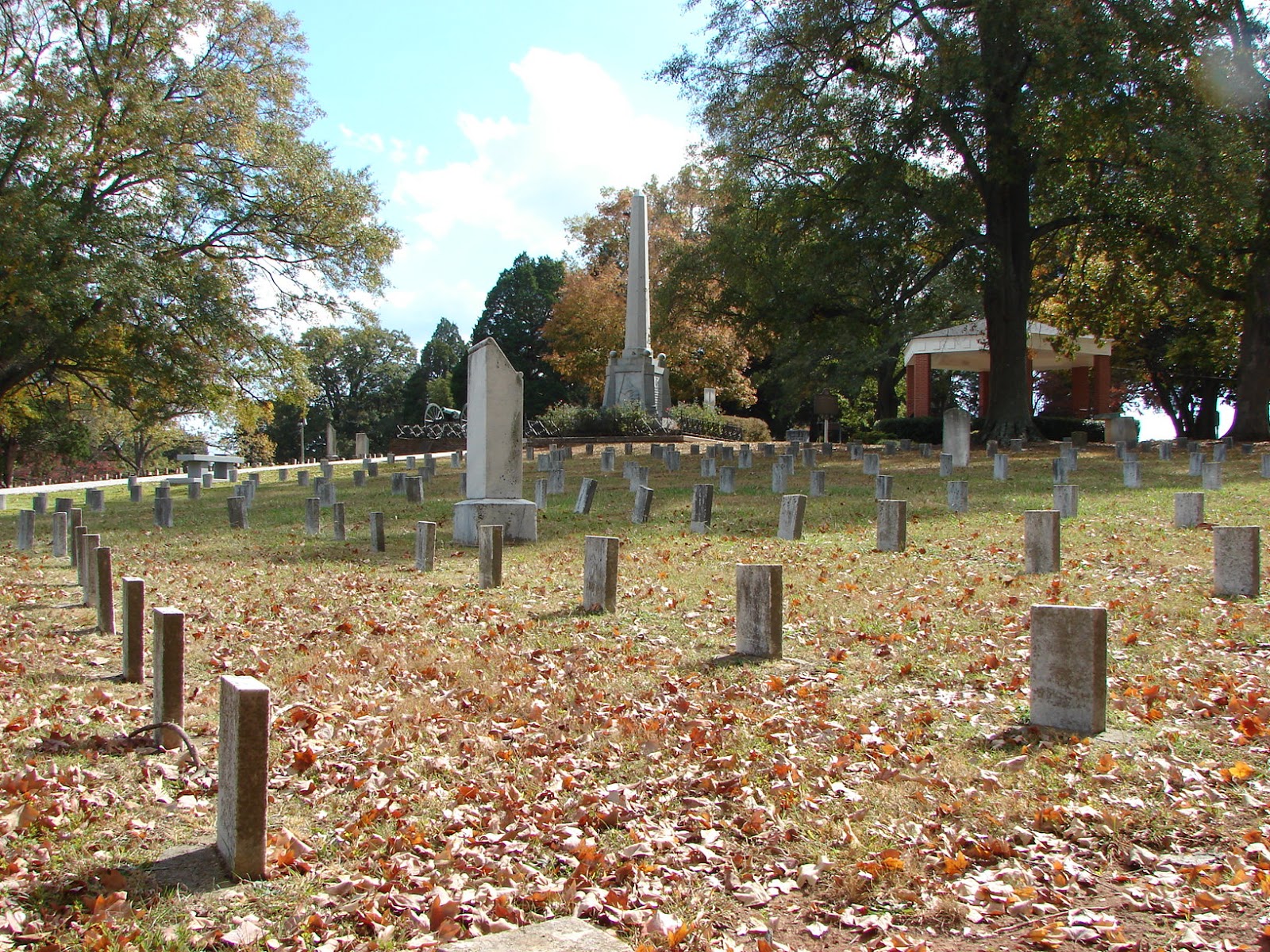
 Confederate Cemetery in Marietta, Georgia, where over 3,000 Confederates are buried. 


These are just a few of the photos from my wonderful trip to Georgia. Stay tuned... lots more on Georgia, the Atlanta Campaign, and Kennesaw Mountain to come...


Saturday, October 27, 2012

Georgia on my Mind

For the past few days, I have been visiting the beautiful state of Georgia. I am here doing some research and battlefield hiking to prepare for a new project that I am working on. I can't officially announce it yet, but it has something to do with the pictures below...


Oh, and by the way, I need to mention my Uncle Jeff and Aunt Paula, who are hosting me for a few days, and are wonderful, wonderful people (plus, Jeff loves it when he is mentioned on here, so I need to give him the public thanks that he and Aunt Paula so deserve!)


(Library of Congress)


Saturday, October 20, 2012

Home Again

It is that time of the year again, when leaves change color, the air becomes cooler, and summer dies out and gives way first to fall, and then to winter. It is also that time of the year which NPS seasonal rangers dread the most. As of a few days ago, I am back home in Ohio once again. My incredible year at Antietam has come to a close. It has been an unbelievable few months, especially the last few weeks with the 150th. In the months ahead, I will be back home, trying to make ends meet and do what I can to continue moving forward as a young ranger and historian. These are tough times for many folks right now, so I am certainly not alone in that regard.

And yet, while I am back home for a few months over the winter, all is not lost. I will be back in Maryland in a few weeks for Antietam's annual luminaries, and I hope to resume my regular ranger duties sometime in the spring months. Being back home affords me the opportunity to continue doing volunteer work for the James A. Garfield NHS, which is a fascinating site with an outstanding ranger staff. I am very fortunate that the folks at the Garfield site have taken me in to give me another park to call home for the winter.

In addition, I have some very exciting projects in the works as well. First, I am in the process of writing articles based on my research for publication. I hope to have news on that front soon. I am looking at a few shorter articles to supplement a larger article encompassing the project in its many facets


 A few days before I left Maryland, I made an early morning trek to Gettysburg to watch the sunrise from Cemetery Ridge. Let these photos remind you, as they remind me, that no matter how difficult things might seem in the short term, the sun will always continue to rise, and God has a plan and a future for all of us. All we have to do is have faith in Him.


Thursday, October 4, 2012

New Trailer Steven Spielberg's Lincoln

This movie looks incredible. It looks as though it portrays our 16th and greatest president as he should be: a heroic leader who saved this country while leading us through death and destruction toward a "new birth of freedom." Lincoln's fight to end slavery was nothing short of one of the most brilliant, complex, and incredible efforts in the history of politics, and it should be remembered as such. He was a true statesman. I hope that this film does Lincoln justice.


I can't wait to see this film. What I am dreading, however, is the increased Lincoln hatred it is sure to stir up. There are many folks out there who still view Lincoln as a tyrant who cost the nation hundreds of thousands of lives for no reason. Of course, that is why our country needs good historians and good history teachers. I look forward to the lively debate that this is sure to spark.

Monday, October 1, 2012

Antietam 150th: Looking Back On My Top 5 Moments

Now that we have had some time to catch our collective breath, I wanted to post a few more thoughts and photos from the Antietam 150th. Here are my top moments from the 150th commemoration activities on the 14th through the 17th...


5. Getting to work with some of the best park rangers and battlefield guides around was a great part of the 150th weekend. For several days, it was non stop interp alongside some great historians. I got to work with folks such as Tom Clemens, Frank O'Reilly, Chris Bryce, Bill Sagle, and Jim Rosebrock, along with many others, all top notch Civil War historians and interpreters. This is not to mention my colleagues on staff at Antietam, who I will get to a little later on in the list.
A few shots of me doing talks at the Cornfield on Sunday, September 16th 


Jim Rosebrock, myself, and Bill Sagle
4. On the morning of the 15th and 16th, I was tasked with leading the Cornfield overview hikes. On Saturday, I had at least 150 people, and on Sunday, I had at least 200. Thankfully, on Sunday a few boy scouts came along to carry a speaker so I did not have to lose my voice halfway through the 150th events. We covered the Cornfield and West Woods action in about 90 minutes each day, providing an overview of the first few hours of Antietam. The people who came along on the hikes were wonderful. They asked great questions, were very interested in the topic, and they couldn't have been friendlier. They were also very much surprised when I told them that I had never led hikes like those before this weekend. Leading those hikes was a real highlight and thrill for me.

A quick cell phone picture that I snapped while heading out on my Saturday morning hike. As you can see, the group was quite big, and it grew even larger when we reached the Cornfield.


3. At 10 am on September 17th, I began a Cornfield program for over 100 people. When I wrapped up at 10:45 am, it was roughly the time 150 years to the moment from when my ancestor was killed in the West Woods (remember, no daylight savings time in 1862). I was able to stand on Antietam National Battlefield and tell Ellwood Rodebaugh's story to what was by then a group of over 150 people. At the end I began to tear up, so I thanked everyone for being there and explained my personal story and the significance of the moment. Many of the visitors had some tears as well. Following the program, I went to stand along the fence line, currenly Starke Avenue, where Ellwood was last seen alive. Ranger Tom Jones snapped my picture there to mark the moment, which was one I will never forget.


 Standing on the same spot where 150 years earlier my ancestor gave his life so that this nation might live. One of the most emotional and meaningful moments of my life. It would soon be topped, however.


2. Sunrise in the Cornfield

AT 6:30 am on the morning of the 17th, the park interpretive staff and 600 of our closest friends gathered at the Cornfield for a program to mark the moment 150 years from when the battle began. The program featured an introduction by Antietam Ranger and Chief of Interpretation Keith Snyder. Ranger Snyder was followed by the rangers present reading quotes and providing brief narration. Each reading was composed of words from soldiers, both Union and Confederate, which described the night before Antietam and the start of the battle. A few quotes in, cannon fire and musket fire began. With the mist hanging in the damp early morning air, the artillery fire echoed across the hills, and the intervening moments between gun fire and rangers reading quotes was eerily silent. To have over 600 people gathered together in complete silence to hear an echo of artillery fire 150 years to the moment from when the battle began is something which I will remember for as long as I live. There are no words to describe this experience. Only the photos below do it justice. They are all taken from the NPS social media team, which did outstanding work over Antietam's 150th weekend.


Ranger Alann Schmidt, myself, and Ranger Keith Snyder


 I am proud to call these rangers my colleagues and friends. They are an exceptional group of historians. I would say that one would be hard pressed to find a more professional and oustanding interpretive staff in the country today (left to right: Brian Baracz, Mannie Gentile, Alann Schmidt, Mike Gamble, Chris Gwinn, myself, Keith Snyder, John Hoptak, Mike Weinstein).

1. The closing ceremony in the National Cemetery was incredible. It featured a reading of the names of all those who died at Antietam, a very special way to commemorate their sacrifice. It was wrapped up with Ranger Alann Schmidt reading the "Bivouac of the Dead" poem and a 21 gun salute.
 Ranger Alann Schmidt on the rostrum leading the closing ceremony, reading the poem, "The Bivouac of the Dead"


Jim Rosebrock and park volunteer staff preparing for the 21 gun salute


Now, here is where it gets really cool. 

I wrapped up doing my last program at Burnside Bridge at around 5 pm on the 17th. I decided to drive up to the National Cemetery to see how things were progressing there. I never thought that I would be there in time to read my ancestor's name, so I didn't give it much thought. However, my good friend and colleague Ranger Alann Schmidt kept the sheet with Ellwood's name separate in case I could be there. As I walked into the cemetery, Alann saw me, and signaled for me to come to the rostrum in the National Cemetery. He handed me a sheet of paper and said, "Get in line." I was just in time to read Ellwood's name.

All weekend long, I had done programs for hundreds of people, but this was the only time I was nervous. My friends and colleagues were all there to witness the moment, as was Park Superintendent Susan Trail. When the time came, I ascended the stairs, stepped up to the mike, and read a list of names of those who died at Antietam. When I read the name of Ellwood Rodebaugh, I paused and simply said, "He was my great-great-great grandfather." I continued, and upon finishing the list, when I stepped off the rostrum, I lifted my head up to the sky, and said a few simple words....

"Thank you grandpa"


A photo of me reading Ellwood's name at the National Cemetery. There is an album of pictures on the park facebook page as well, available here.


There are not words to describe how amazing Anniversary Weekend was. If there ever was a weekend where it was clear to me that I am a ranger at Antietam because that is God's plan for me, the weekend of the 150th was it. I am very blessed indeed. I will remember those days for the rest of my life.


Tuesday, September 25, 2012

Early Thoughts on "To Antietam Creek", by D. Scott Hartwig

One of the best parts of the Antietam 150th is that many new titles have come out about the battle and the campaign. I recently reviewed Bradley Gottfried's latest work, Maps of Antietam, here, but I would also like to highlight a few others.

Hopefully, sometime soon, I can post some thoughts about the latest installment of Ezra Carman's magisterial work on the campaign. Volume 2 of Carman's manuscript was recently released, and Tom Clemens once again provides extraordinary insight and knowledge in the footnotes. I have been thumbing through the book, and plan to post on it relatively soon.

For now, however, I want to highlight a book that was just released this week. Many years in the making, To Antietam Creek is a history of the Maryland Campaign, part one of a two volume set on the campaign and Battle of Antietam. To Antietam Creek is an incredibly in depth work which runs from the start of the campaign through September 16th, providing detailed analysis on each army, on commanders, and on the action which led the armies, appropriately enough, to Antietam Creek. Written by Gettysburg NMP historian D. Scott Hartwig, this volume is not for the faint of heart. Complete with footnotes and order of battle, it runs nearly 800 pages. Needless to say, I haven't had the time to read all 800 pages in the few days since I picked up my copy at the Antietam bookstore. However, what I have been reading is really good and looks very promising.


I am sure I will find parts of the book which I don't entirely agree with, or some I may strongly disagree with, but based on what I have read so far, I think I can conclusively say this: Hartwig's To Antietam Creek is, unlike other recent works (such as Richard Slotkin's The Long Road to Antietam), a scholarly historical work that gives the Maryland Campaign the treatment that an event of its magnitude deserves. Certainly, the work of historians such as Carman, Clemens, Harsh, and Rafuse have done wonders for our understanding of this campaign; in fact, those historians have set a standard of excellence by which we can measure other work on the campaign. Perhaps this new volume can rise to that standard as well. Hartwig's book certainly deserves our attention. I have a feeling that this work will be sitting on my bookshelf for years, filled with notes, underlined sections, and well worn pages.

I want to highlight a few passages from Hartwig's chapter on the Army of the Potomac in the Maryland Campaign, as they seem to be in sync with some of my own research and work on the Army of the Potomac this year (hopefully without sounding too vain on my part; anything I have done pales in comparison to work of this length, depth, and magnitude). Hartwig doesn't go into the detail on troop strengths throughout the campaign and the experience levels that I used in my research for the Joseph Harsh award, but his work is an extremely refreshing take on the difficulties, challenges, and complexities facing the Union forces in the Antietam Campaign. Considering that my work was more of a comparative study against false conceptions of the Army of the Potomac in the most popular histories of the campaign, this young historian is especially comforted to know that some of what I presented on is backed up by the work of a historian of Scott Hartwig's caliber.


Here are just a few quotes from Hartwig's work that were wonderful to read...

"Straggling, absenteeism, and lax discipline were the byproducts of the defeatism that afflicted the army." (135)

"Straggling was nearly as serious in the Army of the Potomac as it was in Lee's army" (135).

"The popular image of a well-fed, well clothed, Union army in the Maryland Campaign is one of its myths. Although the army was generally better clothed, better fed, and better equipped than the Confederates, there were plenty of 'Ragged Yankees'" (137-138).

Speaking of Federal strength upon leaving Washington, namely, the veteran forces in the army: "The entire field army at this point numbered about 60,000 effective soldiers, hardly the Union juggernaut that is typically described in Maryland Campaign studies" (139).

"Histories of the Maryland Campaign rarely fail to highlight the Army of the Potomac's superiority in numbers, but at the outset of the campaign that advantage was rather slight, and the qualitative edge went to the Army of Northern Virginia." This refers to the relative inexperience of Federal forces in the campaign (139).

"The Army of the Potomac marched into Maryland as a powerful but imperfect force. It was better equipped, uniformed, and supplied than its adversary, and it had a slim advantage in numbers. But the negatives outweighed the these advantages. Mutual suspicion and a lack of confidence marked the relationship of its commander with the president, his cabinet, and the army's chief of staff. Two of the corps commanders were facing a potential court-martial at the end of the campaign. The senior leadership lacked the unity and trust in each other that Lee's command structure had, and McClellan generally discouraged any initiative by his subordinates. There were no leaders at corps command who were of Jackson's and Longstreet's caliber. The infantry contained large numbers of new recruits with little training. The army's overall organization remained incomplete, and some branches, such as the artillery, were downright inefficient. Lee may have had the smaller army, but it was an army with superior organization, morale, and leadership, which invariably proved to be more flexible and responsive, as well as capable of concentrating troops more rapidly.
"Still, for all its imperfections, there was something magnificent about this Army of the Potomac. It had shown its resilience and dedication in the speed with which it shook off the disaster at Manassas. Defeat had washed away the starry-eyed optimism that had once buoyed the army, and it viewed the future with the grim knowledge that whatever lay ahead would be hard and bloody... So much rode on the shoulders of this army: the preservation of the Union, and the future of freedom in America. The Army of the Potomac would determine on the battlefield whether the document in the president's desk remained locked away or shed its light on the nation's future [referring here to the draft of the Emancipation Proclamation written in July, 1862] (160-161).


Now, if you will excuse me, I have an 800 page book to read cover to cover. More thoughts to come once I can make my way through the book in its entirety. Let's hope that my early optimism is rewarded upon finishing the work.

Saturday, September 22, 2012

September 22, 1862: "Then, Thenceforward, and Forever Free..."


“When the rebel army was at Frederick, I determined, as soon as it should be driven out of Maryland, to issue a Proclamation of Emancipation… I said nothing to anyone; but I made the promise to myself and to my Maker. The rebel army is now driven out, and I am going to fulfill that promise.”
Abraham Lincoln, September 22, 1862


150 years ago today, President Abraham Lincoln issued the Preliminary Emancipation Proclamation, signaling a beacon of hope in the darkness for over four million people held in bondage, and signalling the death knell of slavery in the United States. The road toward freedom would not be complete with one proclamation; the proclamation would be but the first of many steps transitioning from slavery to citizenship for African Americans. Yet, without the first step, none of the other steps would have been possible. The blood shed at Antietam on September 17 had radically transformed the country. The dead of Antietam led to "a new birth of freedom" for this country. 


By the President of the United States of America
A Proclamation.
I, Abraham Lincoln, President of the United States of America, and Commander-in-chief of the Army and Navy thereof, do hereby proclaim and declare that hereafter, as heretofore, the war will be prosecuted for the object of practically restoring the constitutional relation between the United States, and each of the states, and the people thereof, in which states that relation is, or may be suspended, or disturbed.

That it is my purpose, upon the next meeting of Congress to again recommend the adoption of a practical measure tendering pecuniary aid to the free acceptance or rejection of all slave-states, so called, the people whereof may not then be in rebellion against the United States, and which states, may then have voluntarily adopted, or thereafter may voluntarily adopt, immediate, or gradual abolishment of slavery within their respective limits; and that the effort to colonize persons of African descent, with their consent, upon this continent, or elsewhere, with the previously obtained consent of the Governments existing there, will be continued.

That on the first day of January in the year of our Lord, one thousand eight hundred and sixty-three, all persons held as slaves within any state, or designated part of a state, the people whereof shall then be in rebellion against the United States shall be then, thenceforward, and forever free; and the executive government of the United States, including the military and naval authority thereof, will recognize and maintain the freedom of such persons, and will do no act or acts to repress such persons, or any of them, in any efforts they may make for their actual freedom.

That the executive will, on the first day of January aforesaid, by proclamation, designate the States, and parts of states, if any, in which the people thereof respectively, shall then be in rebellion against the United States; and the fact that any state, or the people thereof shall, on that day be, in good faith represented in the Congress of the United States, by members chosen thereto, at elections wherein a majority of the qualified voters of such state shall have participated, shall, in the absence of strong countervailing testimony, be deemed conclusive evidence that such state and the people thereof, are not then in rebellion against the United States.

That attention is hereby called to an act of Congress entitled "An act to make an additional Article of War" approved March 13, 1862, and which act is in the words and figure following:
Be it enacted by the Senate and House of Representatives of the United States of America in Congress assembled, That hereafter the following shall be promulgated as an additional article of war for the government of the army of the United States, and shall be obeyed and observed as such:
Article-. All officers or persons in the military or naval service of the United States are prohibited from employing any of the forces under their respective commands for the purpose of returning fugitives from service or labor, who may have escaped from any persons to whom such service or labor is claimed to be due, and any officer who shall be found guilty by a court-martial of violating this article shall be dismissed from the service.

SEC. 2. And be it further enacted, That this act shall take effect from and after its passage.
Also to the ninth and tenth sections of an act entitled "An Act to suppress Insurrection, to punish Treason and Rebellion, to seize and confiscate property of rebels, and for other purposes," approved July 17, 1862, and which sections are in the words and figures following:
SEC. 9. And be it further enacted, That all slaves of persons who shall hereafter be engaged in rebellion against the government of the United States, or who shall in any way give aid or comfort thereto, escaping from such persons and taking refuge within the lines of the army; and all slaves captured from such persons or deserted by them and coming under the control of the government of the United States; and all slaves of such persons found on (or) being within any place occupied by rebel forces and afterwards occupied by the forces of the United States, shall be deemed captives of war, and shall be forever free of their servitude and not again held as slaves.

SEC. 10. And be it further enacted, That no slave escaping into any State, Territory, or the District of Columbia, from any other State, shall be delivered up, or in any way impeded or hindered of his liberty, except for crime, or some offence against the laws, unless the person claiming said fugitive shall first make oath that the person to whom the labor or service of such fugitive is alleged to be due is his lawful owner, and has not borne arms against the United States in the present rebellion, nor in any way given aid and comfort thereto; and no person engaged in the military or naval service of the United States shall, under any pretence whatever, assume to decide on the validity of the claim of any person to the service or labor of any other person, or surrender up any such person to the claimant, on pain of being dismissed from the service.

And I do hereby enjoin upon and order all persons engaged in the military and naval service of the United States to observe, obey, and enforce, within their respective spheres of service, the act, and sections above recited.

And the executive will in due time recommend that all citizens of the United States who shall have remained loyal thereto throughout the rebellion, shall (upon the restoration of the constitutional relation between the United States, and their respective states, and people, if that relation shall have been suspended or disturbed) be compensated for all losses by acts of the United States, including the loss of slaves.
L.S.

In witness whereof, I have hereunto set my hand, and caused the seal of the United States to be affixed.

Done at the City of Washington, this twenty second day of September, in the year of our Lord, one thousand eight hundred and sixty two, and of the Independence of the United States, the eighty seventh.

By the President: ABRAHAM LINCOLN
WILLIAM H. SEWARD, Secretary of State.